

Sicily has a habit of changing character every thirty minutes of driving. One stretch of coast road and you’ve swapped ancient Greek ruins for Baroque staircases, then swapped those again for a volcano quietly steaming on the horizon. Our route through the east of the island, from the Messina ferry to the slopes of Etna, was the leg of our southern Italy trip when the island really introduced itself.
A quick note on the route: our loop took us from Brindisi through Calabria and by ferry into Messina, along the east coast to Etna, then south through Sicily and across to the west coast and Palermo. We’re publishing these posts in clusters rather than strict travel order, so don’t worry if the sequence jumps around a little.
Crossing the Strait: Arriving in Messina
We crossed from Villa San Giovanni on the Calabrian mainland – a short hop across the Strait of Messina that takes around twenty minutes.
Boarding was surprisingly quick. When we pulled up at the ferry terminal, a departure was already loading, and we weren’t holding out much hope of making it. We got lucky, rolling straight onto the ferry with barely a wait. We paid roughly €20 for the car at the time, although ferry fares have changed considerably since then, so it’s worth checking current crossings and prices before you travel. Current standard car fares are substantially higher than what we paid.
It was still golden hour when we arrived at the terminal, and full dark by the time we reached the other side. Messina itself, Sicily’s third-largest city, was little more than a blur of harbour lights as we drove straight through towards Acireale, on the road to Taormina and Catania. It was close to midnight by the time we checked in – one of those late, slightly frazzled arrivals every road trip seems to include at least once.
Acireale: Our Coastal Base
Acireale is a small town on Sicily’s east coast, a short drive from Catania, the island’s second city after Palermo. We’d booked a guesthouse here for a few nights as our base for exploring the east before heading west. Finding the exact address in the dark took some patience – not unusual in Italy if you’re working from a rough map pin rather than precise coordinates – but the owner was waiting for us at the gate, which made the long day’s travel feel worth it.
Two things about the guesthouse, whose name we can no longer recall, have stayed with us. It sat right at the top of the hill, and getting there in the dark was a challenge in itself. But the view the next morning made up for it – we could see the sea from our window, and going down to the beach was the first thing we did once we were up.
Syracuse: 2,700 Years of History
Our first full day was dedicated to the east coast, starting with Syracuse (Siracusa). It’s Sicily’s fourth-largest city and one with serious historical weight: founded by Greek settlers around 2,700 years ago, it grew into a powerful city-state and was Sicily’s leading city until Palermo took over as capital under the Kingdom of Sicily. The old town, Ortigia, sits on a small island connected to the mainland and surrounded by the sea, making it ideal for a proper coastal wander.
Syracuse is genuinely one of the most impressive cities either of us has visited in years of travelling together. We walked the city walls, wandered the tangle of narrow streets in the old town, and had lunch at a restaurant looking straight out over the sea.

Syracuse and the rock-cut necropolis of Pantalica together form a UNESCO World Heritage Site, recognised for the extraordinary layers of Greek, Roman, Byzantine, medieval and later history across the area.
Noto: Baroque Sicily at Its Best
About 35 kilometres south-west of Syracuse, Noto is worth the detour. The town was rebuilt in an elaborate late Baroque style after the devastating earthquake of 1693, and it’s now part of the Val di Noto group of eight towns added to the UNESCO World Heritage List in 2002.
Noto is built on a slope, so a stroll here means plenty of steps and staircases, golden stone catching the afternoon light, and views opening up unexpectedly around corners. The main square, with its fountains, is a natural place to slow down with a coffee and watch the town go by, which is exactly what we did after working our way up from the square through a network of small side streets.

Taormina and Isola Bella
Taormina sits between Catania and Messina, perched above the Ionian Sea, and its popularity is easy to understand the moment you catch sight of the coastline from above. The drive up is scenic in its own right – all switchbacks and sudden sea views.
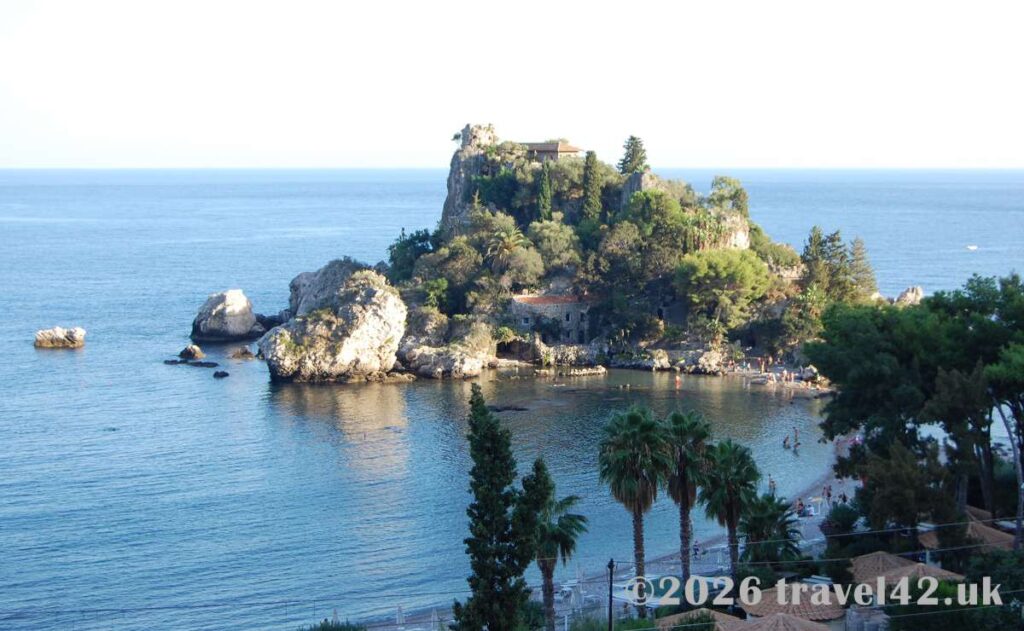
The real draw for us, though, was Isola Bella: a small island just off the shore, connected to the mainland by a narrow strip of beach, with a view back towards the coast that stops conversation for a minute.
A postscript worth including for other travellers: the coffee, espresso and gelato along this stretch of coast were consistently excellent – reason enough to sit down for twenty minutes rather than rushing through. Parking near the old town, on the other hand, can be a real challenge.
Next time, we’d love to spend longer exploring Taormina’s old town properly rather than squeezing it into an afternoon.
Mount Etna: Meeting Europe’s Most Active Volcano
After days on the coast, we turned inland towards Etna, impossible to miss on the way in, with its lava fields visible from the approach roads long before the peak itself comes into view.
A few facts worth having in your back pocket
Etna rises above the complex boundary between the African and Eurasian tectonic plates, part of the geological setting that helps explain its extraordinary activity. Its height changes over time with volcanic activity, and recent measurements have put the summit at around 3,400 metres. UNESCO describes Mount Etna as the highest active volcano within the geographical limits of Europe and one of the world’s most active volcanoes. It covers around 1,178 square kilometres and was added to the UNESCO World Heritage List in 2013.
Etna has continued to erupt repeatedly in recent years, so “active” here isn’t just a label on a sign. INGV, Italy’s National Institute of Geophysics and Volcanology, recorded significant eruptive activity during 2025, including an episode in June and a further effusive phase from August into early September.
Getting there
Fom Messina, it’s roughly 100 kilometres to the southern approach at Rifugio Sapienza; from Catania it’s much shorter, at around 35 kilometres. From Palermo, it’s considerably farther and makes for a much longer drive. There are hiking trails throughout Parco dell’Etna for a slower approach, but we headed straight for Rifugio Sapienza, where a large car park serves visitors arriving by car and coach.
From the car park, the cable car takes visitors from roughly 1,920 metres to the upper station at 2,500 metres. Beyond that, current excursions continue by 4WD vehicles, with guided tours reaching around 3,000 metres. Access and routes can change according to weather, volcanic activity and safety restrictions, so check the current arrangements before setting off.
When we visited, we’d planned to take the cable car and then continue higher. We paid around €51 for the full return package at the time, although today’s prices are higher and the exact products have changed. Current Funivia dell’Etna tickets include a cable-car-only option and guided excursions to around 3,000 metres.
Whatever the ticket price, the experience itself is hard to overstate: walking across ash and lava fields, smaller craters scattered around you, steam drifting from the volcanic landscape, and the ground genuinely warm underfoot. It’s equal parts unsettling and exhilarating – a good excuse to hold hands a little tighter than usual.

Practical Notes for the Route
- Ferry: Villa San Giovanni to Messina takes around 20 minutes, with frequent departures throughout the day.
- Base: Acireale makes a convenient stop between Messina and Catania for exploring the east coast.
- Distances: Syracuse to Noto, about 35 km; Messina to Rifugio Sapienza, roughly 100 km; Catania to Rifugio Sapienza, roughly 35 km.
- Etna access: The cable car reaches 2,500 metres, while current combined excursions continue by 4WD vehicle and guided walk to around 3,000 metres. Allow several hours for the full experience and check current operating conditions before travelling.
T42 Vibe – East Sicily & Mount Etna
| Category | Rating | Verdict |
| Couple Factor | ▰▰▰▰▰ | Excellent |
| Setting & Views | ▰▰▰▰▰ | Excellent |
| History & Towns | ▰▰▰▰▰ | Excellent |
| Experience | ▰▰▰▰▰ | Excellent |
| Practicality | ▰▰▰▰▱ | Very Good |
T42 Vibe – Overall: ▰▰▰▰▰ 5/5
The east coast of Sicily works particularly well for couples because the experiences are so varied without requiring huge distances between them. Ancient history, elegant Baroque towns, sea views, good food and a genuinely active volcano all fit into the same road-trip leg. The main drawbacks are practical ones – parking in Taormina and the unpredictability of Etna access – rather than shortcomings in the experience itself.
Closing Thoughts
This stretch of the east coast packs in an unusual range for just a few days: Greek history, Baroque hill towns, a film-set little island, and a live volcano to finish. If you’re planning a loop of Sicily, we’d suggest treating the east coast and Etna as one continuous leg before heading west – which is exactly how our own route unfolded.
It wasn’t a long leg of the trip, but it’s stayed with us as one of the more complete little journeys we’ve had – the kind where a beach, a Baroque square and a smoking crater all somehow belong to the same few days.
If a live volcano and a Baroque town in the same afternoon sounds like your idea of a good couples’ trip, this corner of Sicily delivers it in full.
You can also read the other half of this loop: A Road Trip Through the Heel of Italy and West Sicily.
Travel42 UK is a couples travel journal dedicated to immersive road trips, slow travel, and destination storytelling.
Explore More of Italy:
The long way round, as a couple
About the Author
The author, ainarsbl, is a Level 7 Google Local Guide, Master Reviewer and expert travel reviewer focused on scenic landscapes, UNESCO sites and meaningful couples travel experiences.