

We landed at Brindisi Airport with a loose plan and a rental car booking, and drove off three hours later than we’d meant to. That, it turns out, is a fairly reliable way to start a trip through southern Italy.
This is the story of the drive that took us from Puglia, down through Calabria and across to the western side of Sicily – Alberobello’s trulli, a beach at Tropea, and three very different Sicilian towns before we handed the keys back at Palermo Airport.
Why this route? Partly because we’d been longing to see the trulli houses in person, and partly because neither of us had ever visited Sicily before. We also stumbled on an unusually good deal: cheap flights paired with a car rental that let us return the car at a different airport for no extra cost – something we’ve rarely come across before or since.
A quick note on the route: our journey took us from Brindisi to Alberobello, then through Calabria and by ferry into Messina, along the east coast towards Etna, before heading south to Agrigento and across to the west coast and on to Palermo. We’re publishing these posts in clusters rather than strict travel order, so don’t worry if the sequence here jumps around a little.
Landing in the Heel of Italy
Puglia sits right at the heel of the Italian boot, with the Adriatic on one side and the Ionian on the other – not a bad position for a region to be in. It’s a substantial one too: at roughly 19,000 square kilometres and with a population of just under four million, it’s comparable in size to Slovenia, and it borders three other regions – Molise, Campania and Basilicata.
Long before it became part of modern Italy, the area was fought over and settled by the Greeks, and later came under Arab and Norman influence, which is part of why the towns here don’t look quite like anywhere else in the country.
None of that history was on our minds in the car park at Brindisi Airport, however. The queue at the car rental desk was longer than we’re used to – we don’t often run into this, though a similarly disorganised process caught us out once before in Portugal, so perhaps it’s simply the nature of regional airports during busy periods.
By the time we’d sorted insurance, excess cover and a baffling paperwork misunderstanding, it was already dark. The 80-kilometre drive to Alberobello, which should have shown off some pleasant Puglian countryside, was instead a blur of headlights and roadside olive groves we could only sense rather than see.
A Late Swim and an Early Lesson
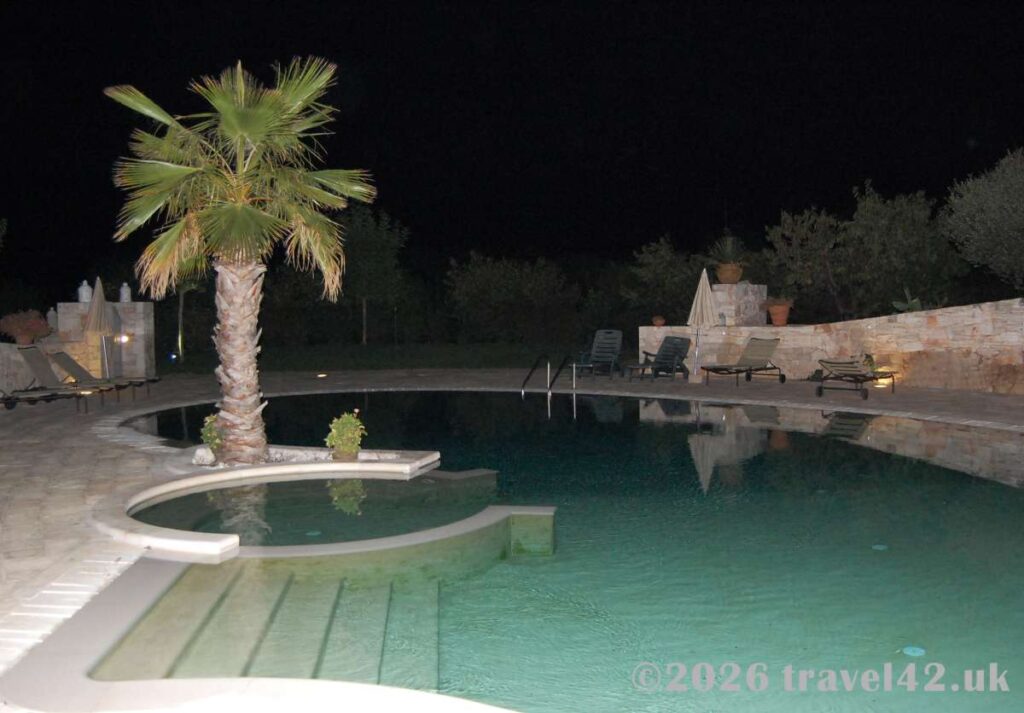
We found a hotel on the edge of Alberobello just before midnight, fully intending to fall straight into bed.
Then we discovered the pool.
It was outdoors, it was warm, and we had it entirely to ourselves. Ten minutes earlier we’d have told you we were too tired to do anything but sleep; twenty minutes later we were floating on our backs, laughing about the car rental office, glad we’d come after all.
It’s a small moment, but it’s the kind that tends to define how a trip starts to feel. Italy doesn’t always go to plan. It has a habit, though, of making up for it.
Alberobello and Its Trulli
By daylight, Alberobello is one of the stranger and more charming townscapes in Italy.
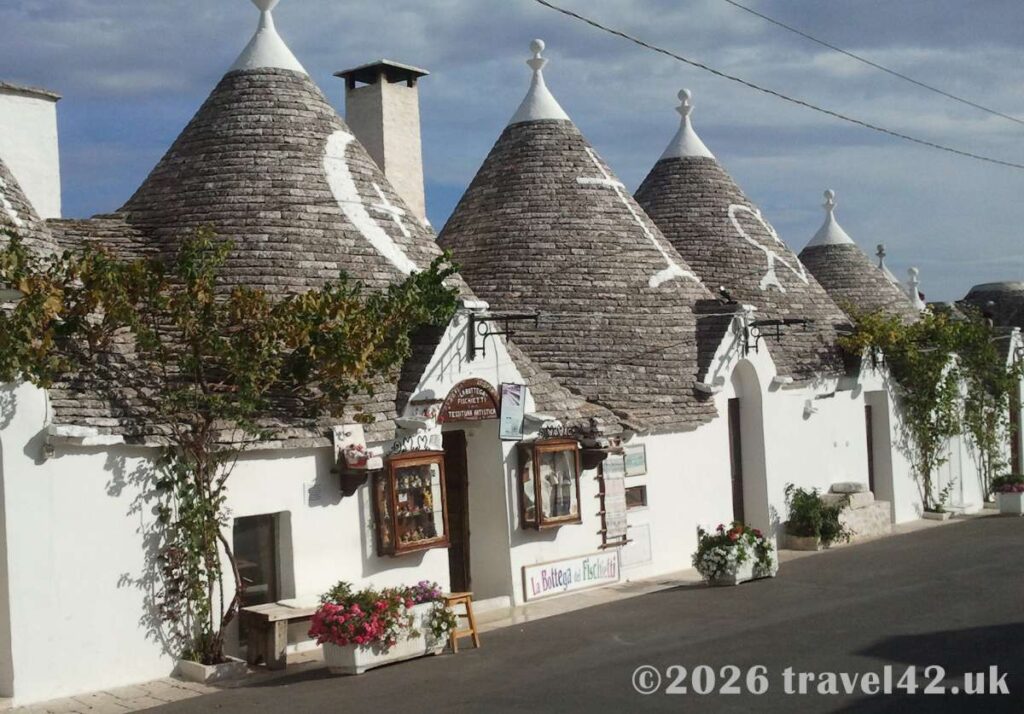
The trulli – squat, whitewashed stone houses topped with grey conical roofs – were built using dry-stone construction, without mortar. More than 1,500 survive in the two historic districts of Rione Monti and Aia Piccola, with some still used as homes and others converted into shops, accommodation and museums. UNESCO recognised the Trulli of Alberobello as a World Heritage Site in 1996.
There’s a local story attached to the construction method that we liked enough to repeat here: because the trulli could be built without mortar, they could also supposedly be dismantled quickly. When royal tax inspectors were rumoured to be on their way, homeowners could pull a few key stones and let the roof collapse into a pile of rubble – no house, no tax, no argument. Once the inspectors moved on, the same stones could go back up again.
Whether that’s precise local history or a tale that’s improved with retelling, it suits the town’s slightly stubborn, self-sufficient character rather well.
We spent a few unhurried hours wandering the narrow streets and ducking into a couple of trulli that have been turned into small shops, before pointing the car south again. The area can get busy, but we still found a parking space close to the main sights – a pleasant surprise we hadn’t expected.
South Through Calabria: A Detour to Tropea
Sicily was the main event of this trip, and by far the longer leg, but the drive there wasn’t something to rush through.
We broke the journey in Calabria at Tropea, a clifftop town on the Tyrrhenian coast often described as one of the region’s most beautiful. The old town sits on a promontory above the sand, and the view from the beach up to the clifftop buildings is the kind that makes you pull over even when you’d told yourselves you wouldn’t stop again.
It’s not strictly part of the Puglia or Sicily story, but it’s worth knowing about if you’re plotting a similar route: southern Italy’s coastline doesn’t stop being worth a stop just because it isn’t the headline destination.
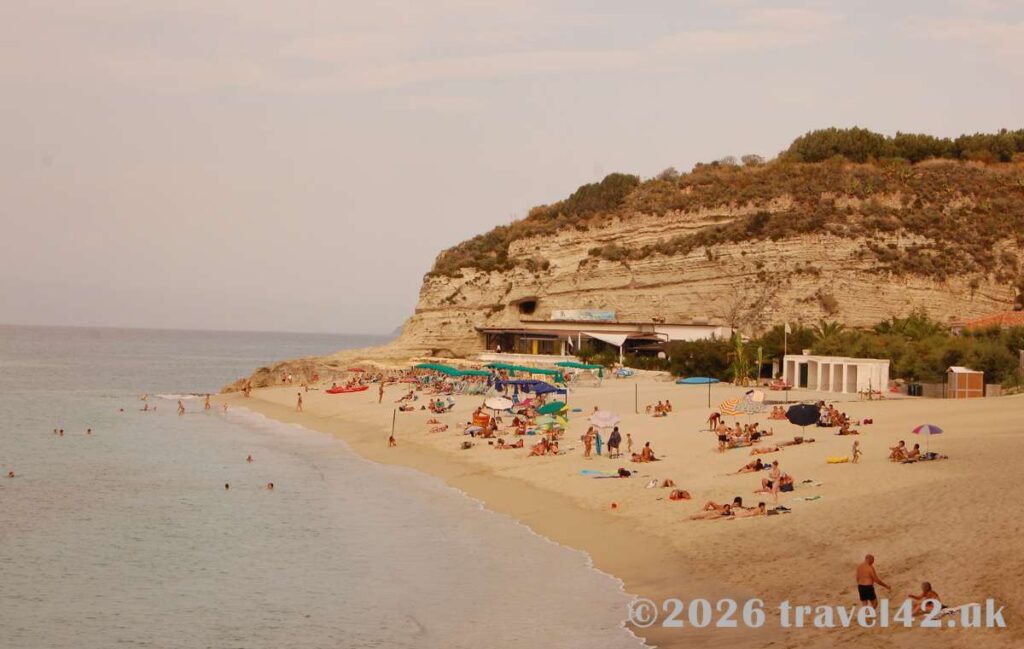
We only spent a couple of hours in Tropea, mostly on the beach and walking a little way along it. On our way out, we stopped at a kiosk for fruit and vegetables. Tropea is well known for its sweet red onions, though there was plenty else fresh and dried to choose from too.
Crossing into Sicily: Agrigento and the Valley of the Temples
Sicily itself is enormous by Mediterranean standards – nearly 26,000 square kilometres and home to roughly five million people. It’s changed hands many times over the centuries: Greek colonies, Roman rule, then Byzantine, Arab and Norman influence in turn, before becoming the Kingdom of Sicily in 1130 and finally joining a unified Italy in 1861.
You feel that layered history everywhere, but nowhere more directly than at Agrigento.
The Valley of the Temples, just outside the town, is a UNESCO World Heritage Site and one of the most important surviving concentrations of ancient Greek architecture outside Greece. Give it a proper couple of hours; it’s not a quick photo stop.
That’s how it reads in the guidebooks, at least. In person, I was expecting temples and found mostly ruins – though it’s fair to say there has been some effort at restoration in places.
One practical note: if you’re visiting in summer, bring plenty of water. It gets very hot in southern Sicily, and the site offers limited shade.
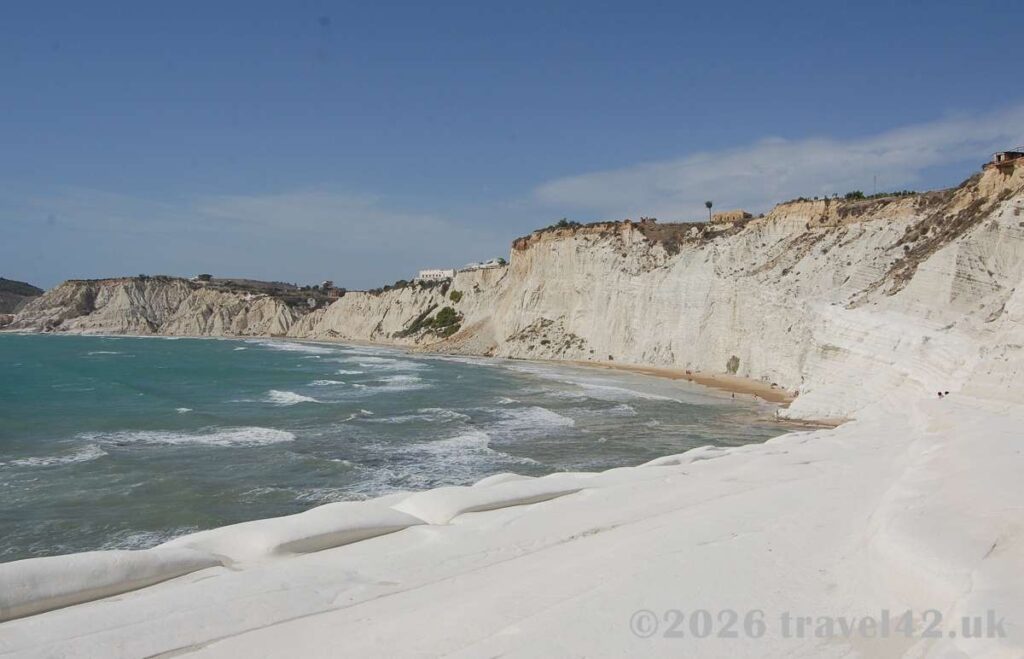
About ten kilometres further west is Scala dei Turchi, a stretch of pale, almost chalk-white cliffs stepping down into the sea. We’d recommend parking a short walk away rather than fighting for space right beside it, and building in time simply to sit – it’s a genuinely good spot to slow down, though it can get windy, so pack a layer.
This was the part I personally enjoyed far more: a fresh sea breeze, sitting on white cliffs, and even a swim in fairly high waves – the kind of thing that makes a holiday feel like a holiday.
Trapani: An Unpolished Coastal City
Trapani, on Sicily’s north-western tip, doesn’t get anywhere near the attention Agrigento or Palermo do, and that’s arguably part of its appeal.
It’s a working city, built around fishing, salt production and the sea, but a walk along the seafront and through the older streets turned up more good, unfussy cafés than we expected.
It’s also worth knowing about for anyone planning a similar loop. Trapani’s airport can be useful when comparing routes into western Sicily, although passenger numbers and individual routes change from year to year. If you’re focusing a trip on the west or south of Sicily, it’s worth comparing current fares and schedules against Palermo before booking.
Erice, Saved for Last
If Sicily’s west coast were a meal, Erice would be dessert.
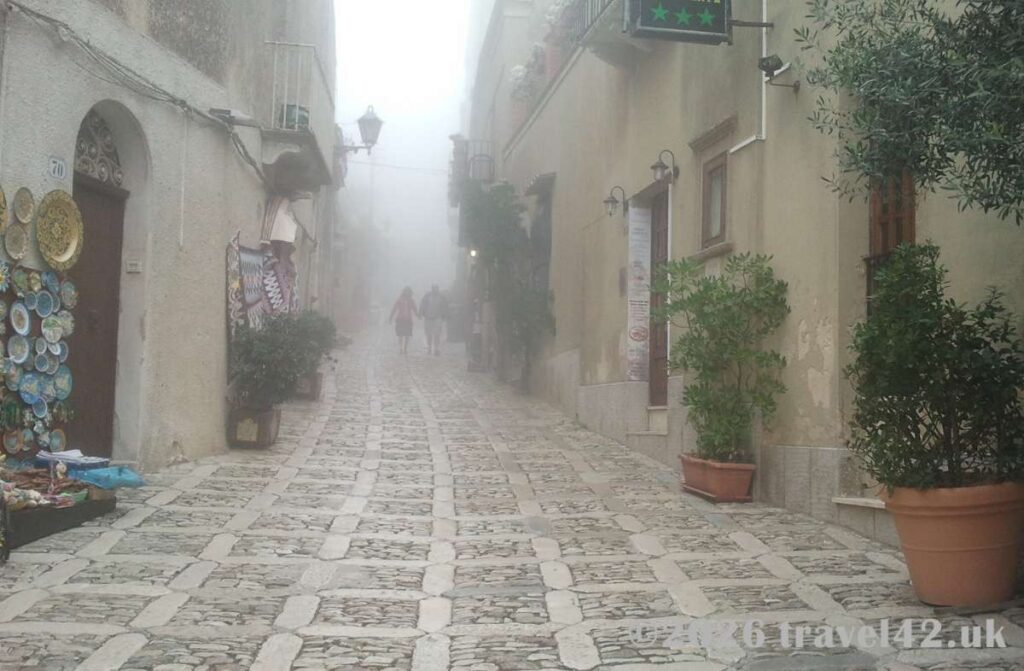
It sits high above Trapani on a hilltop, and getting there took longer than the map suggested, mostly thanks to the switchbacks. We arrived early, into thick fog, and our first real challenge was finding anywhere at all to park – the streets are steep, narrow and clearly not designed with cars in mind.
We left the car where we could and walked the rest of the way up.
For a while there was nothing to see but grey – cobbled lanes disappearing a few metres ahead of us, medieval walls looming and vanishing again. Then, gradually, the fog lifted, and the view that opened out over the coastline and the salt pans below was worth every wrong turn on the drive up.
It was our last stop before Palermo Airport, and easily one of the most memorable half-days of the whole trip. If we visit this part of Sicily again, Erice will go straight back on the itinerary.
Planning Your Own Route
If you’re tracing a similar line across the south – Puglia, a Calabrian coast stop, then western Sicily – a few practical notes are worth keeping in mind: allow more time than you think for car hire collection at regional airports, book Alberobello accommodation with some flexibility around arrival time, and consider visiting Erice earlier in the day if you’d rather experience the town before it becomes busy.
This trip was the first half of a longer journey around Sicily; the eastern side of the island, including Mount Etna, is a story for another post – East Sicily and Mount Etna. If you’re building a Puglia visit of your own, our dedicated guide to Puglia by car will be published soon.
Our Sardinia road trip follows a similar couples’ pace a little further north, if you fancy island-hopping further afield.
And perhaps that’s the thing we liked most about this route. It wasn’t a perfectly efficient way to cross southern Italy. There were queues, paperwork, a late-night drive, a foggy mountain road and at least one detour that wasn’t strictly necessary.
But there was also a midnight swim, Alberobello in the morning light, a few hours on a Calabrian beach, white cliffs above the Sicilian sea and a final morning in Erice when the clouds finally parted.
For us, that’s a much better measure of a road trip than how neatly it looks on a map. More from the same trip read our other post about Mont Etna and east coast of Sicily.
Travel42 UK is a couples travel journal dedicated to immersive road trips, slow travel, and destination storytelling.
Explore More of Italy:
The long way round, as a couple
About the Author
The author, ainarsbl, is a Level 7 Google Local Guide, Master Reviewer and expert travel reviewer focused on scenic landscapes, UNESCO sites and meaningful couples travel experiences.