Guangzhou, wehre we arrived from Yangshuo on China High-Speed Rail train, was our final stop in China before heading back to Shanghai – and it turned out to be one of the most surprising cities we visited on the entire trip. it was supposed to be completely different from Fenghuang which we visited earlier during our trip.
We had two and a half days and three nights there, which gave us just enough time to scratch the surface of a city far more layered than its reputation as a commercial hub might suggest. Guangzhou, the capital of Guangdong province in southern China, is home to more than 18 million people and has long been one of the country’s great trading centres. Yet behind the glass towers and sprawling motorways, it also holds Buddhist temples, heritage pedestrian streets, futuristic architecture, and a river that comes alive after dark.
We barely scratched the surface, and we were already wishing we had more time.
Where We Stayed
We spent three nights at the Waito Yuexiu Park Guangzhou hotel, which cost around £55 per night – significantly less than many city-centre options. The hotel sits near Yuexiu Park rather than in the thick of the central districts, but this turned out to be no obstacle whatsoever.
The room was exactly what we had expected – not luxurious and not enormous, but with a well-sized bathroom, a separate toilet, and a spacious enough lobby area. Breakfast was good both in quality and variety, with enough European-style options alongside Chinese dishes to keep everyone happy. Overall, the value for money was excellent.
We arrived by metro and decided to walk to the hotel from the opposite side of the park. It did not look like a long route on the map – and it wasn’t – but the several hills we encountered made it more of an adventure than anticipated, particularly with luggage in tow. We stopped a few times to catch our breath. The day was already hot, but the shade of the trees and the miniature lakes scattered throughout the park made the whole walk feel rather pleasant in the end. In hindsight, it was a lovely first introduction to Guangzhou.
Guangzhou’s metro, by the way, is one of the best underground systems we have used anywhere in the world. It is fast, clean, comprehensively networked, and brilliantly signed in both English and Chinese. We returned to the hotel by metro every evening without exception, and it never once let us down. On the day we arrived, we chose to walk rather than change trains – but from then on, the metro became our constant companion.
Getting to Guangzhou – and a Note on Train Tickets
We had originally planned to return to Shanghai by overnight sleeper train after two nights. Despite booking well in advance, we were unable to secure sleeper berths for our preferred departure. This is one of the quirks of travelling in China: train tickets – including on the high-speed rail network – are typically only released around two weeks before departure. That window can sound generous until you realise how quickly popular routes sell out, especially sleeper services between major cities.
Our agency offered alternatives, but none suited our schedule, so we made a quick decision and booked a flight from Guangzhou Baiyun International Airport to Shanghai instead. The flight was the following morning, which unexpectedly gave us an extra evening in the city.
We were a little stressed at first, but it turned out to be a happy accident. The refund arrived within a few days, booking the flight was straightforward, and we were already travelling on a high-speed train with good Wi-Fi when everything unfolded. And that extra evening in Guangzhou? We would have been sorry to miss it.
Day One: Bio Island and the Young Tram
The Autonomous Robobus – China’s Future on Four Wheels
Straight after dropping our bags at the hotel, we headed to Guangzhou International Biological Island – widely known as Bio Island – a purpose-built technology and science district in the Pearl River that is home to pharmaceutical companies and tech firms. It is also, somewhat unexpectedly, home to one of the most memorable transport experiences we have ever had.
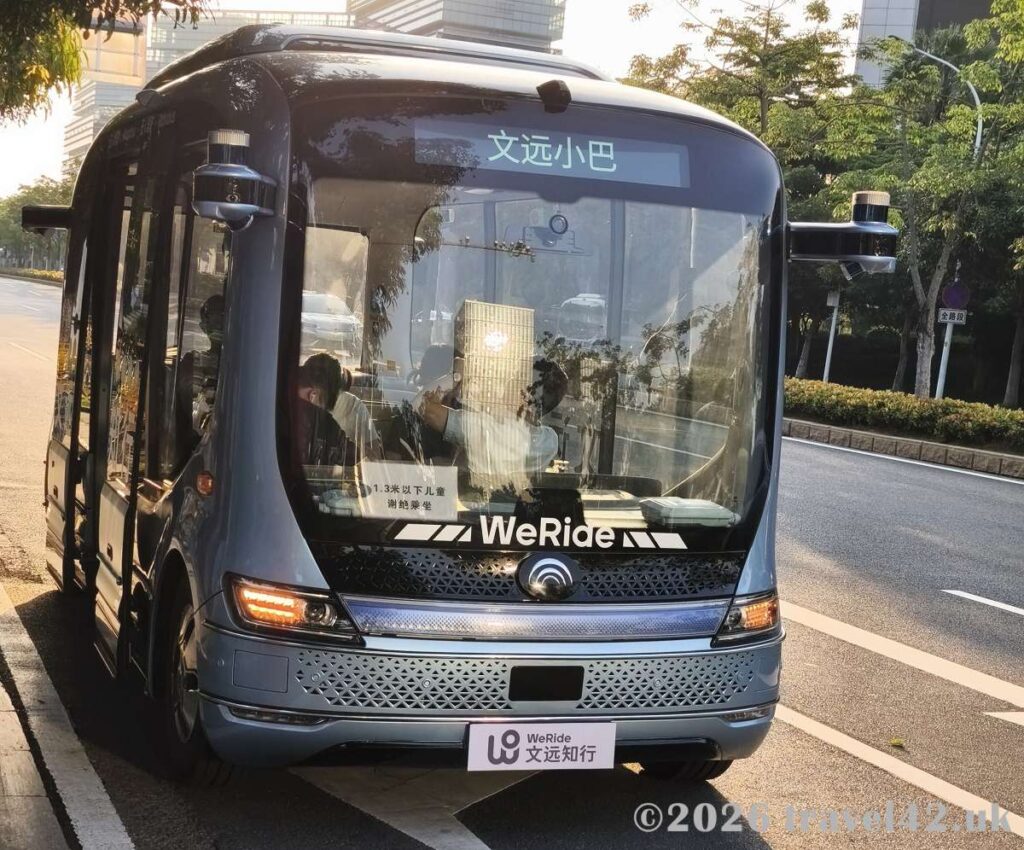
The island operates a fully autonomous Robobus service run by WeRide, a Guangzhou-based autonomous driving company. These are Level 4 self-driving minibuses, meaning they operate without any human intervention whatsoever. There is no driver’s cab, no steering wheel, and no one at the front pretending to be in charge. Just rows of seats, cameras covering every angle inside and out, and a vehicle that thinks entirely for itself.
We watched it pull into the stop and could not quite believe what we were seeing. The bus would not move until every passenger had fastened their seatbelt – at which point it simply eased out into traffic and went about its business with quiet confidence. It changed lanes when needed, overtook slower vehicles, stopped at each station along the route, and eventually returned us to our starting point after a full circuit of the island.
The whole journey was free of charge.
It felt as though we had stepped into the future in a single moment – and then been given a smooth, unhurried tour of it. And that feeling was clearly not ours alone. Every other passenger on the bus was Chinese, and they looked just as wide-eyed as we did.
The Guangzhou Young Tram
We had arrived at Bio Island by metro and chose to return to the city centre by a different route – the Guangzhou Young Tram, also known as Tram Line 1. This modern tram runs from Wanshengwei to Canton Tower, covering 11 stops across a 7.7- kilometre route through the central districts. It is comfortable, contemporary, and worth taking simply for the pleasure of the journey – a slower, more contemplative way to watch the city unfold.
When we visited, the final section of the line was still under construction, so we disembarked before the terminus and walked the remaining stretch along the Pearl River bank. The timing turned out to be perfect. The light was fading gently, the city was waking up for the evening, and the promenade was gradually filling with people out for an evening stroll. It was quieter than we expected – unhurried, almost romantic. We passed other couples and small groups of friends enjoying the cooling air, and the whole atmosphere invited us to slow down and simply take it all in.
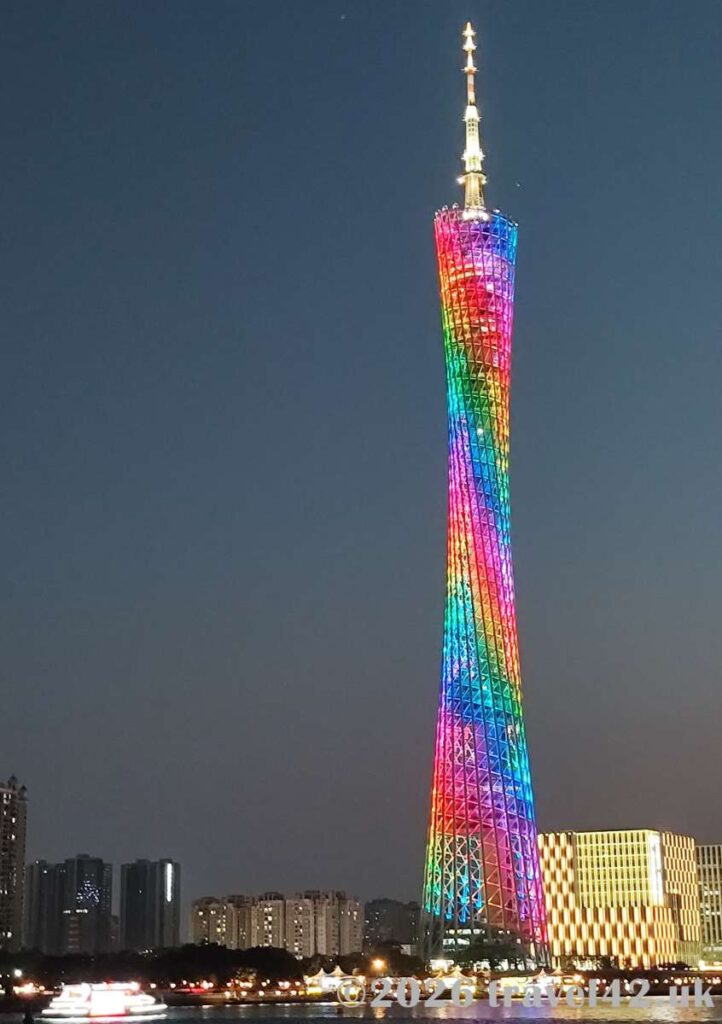
Canton Tower: Guangzhou’s Glowing Landmark
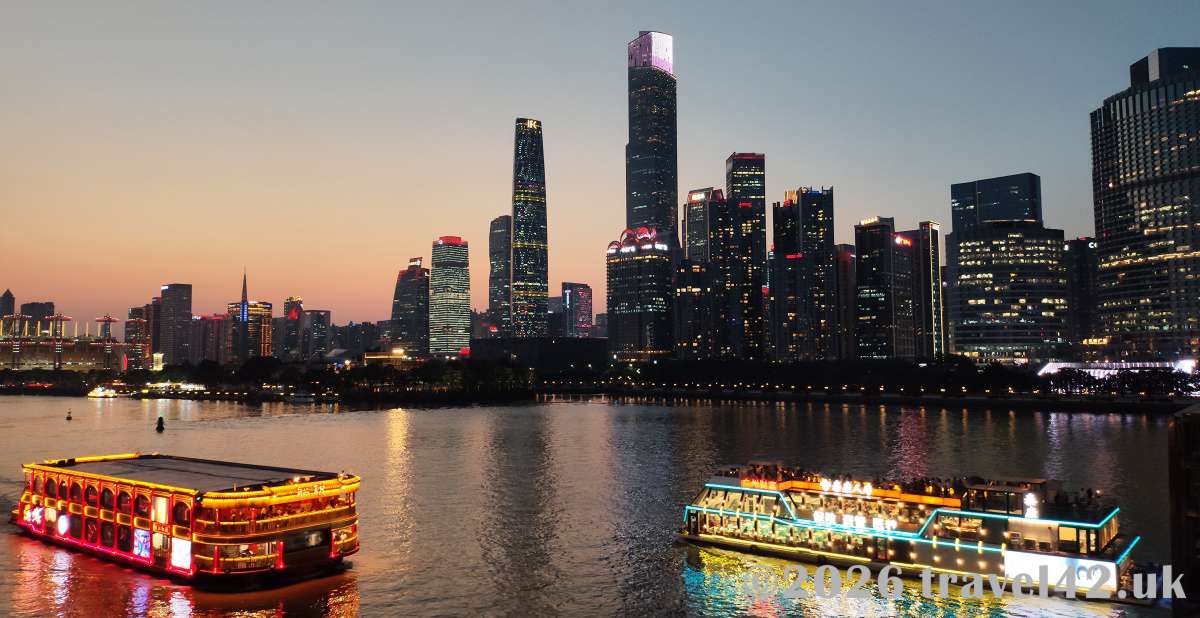
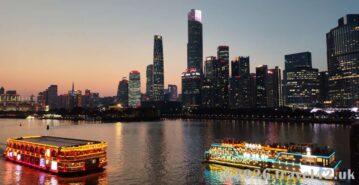
We first saw Canton Tower from a bridge across the Pearl River, and then again from the riverfront promenade. Locally nicknamed Slim Waist (小蛮腰) for its distinctive silhouette, it is genuinely breathtaking at night.
The tower stands 600 metres tall – the tallest TV tower in China and one of the tallest structures in the world. Its main body reaches 454 metres, with a 146-metre antenna mast rising above. It was designed by Dutch architects Mark Hemel and Barbara Kuit of Information Based Architecture, working alongside the engineering firm Arup, and opened in 2010 in time for the Asian Games hosted by Guangzhou that year. After sunset, hundreds of thousands of LED lights illuminate the structure in shifting colours, producing a light show that rivals anything we saw elsewhere in China.
We chose not to go up the tower itself, as we had already visited Shanghai Tower earlier in the trip and felt we had experienced that kind of viewpoint. However, for couples who have not yet had that experience elsewhere, Canton Tower is absolutely worth adding to your Guangzhou itinerary.
At the time of our visit, standard observation deck tickets cost around £16 per person, while a combo ticket including the Bubble Tram – a horizontal Ferris wheel rotating near the top of the tower – was approximately £32.50 per person.
Tickets were released roughly two weeks before the date of entry and sold out quickly, particularly for sunset time slots. If you plan to visit, book as soon as they become available.
Huacheng Square, the Library and the Opera House
After our walk along the river, we explored Huacheng Square – a large public plaza in the Zhujiang New Town district that sits at the heart of Guangzhou’s modern civic centre. The surrounding buildings are some of the most architecturally ambitious in the city, and the contrast between the open, manicured space and the towers encircling it is genuinely striking.
One building that stopped us completely was the Guangzhou Library, designed in a bold futuristic style that somehow feels both monumental and inviting. It forms part of a cultural quarter that also includes the Guangdong Museum, and together they represent a confident civic vision for what a modern Chinese city can look like.
The undisputed highlight of the area, however, is the Guangzhou Opera House – designed by Iraqi-British architect Dame Zaha Hadid and completed in 2010. Hadid’s concept was inspired by two pebbles worn smooth by the Pearl River: a poetic idea that translates into a building which appears to grow from the landscape rather than simply being placed upon it.
The twin-boulder form, clad in granite and glass panels, is extraordinary from every angle. Inside, an 1,800-seat auditorium is lined with glass-fibre reinforced gypsum moulded into fluid, seamless curves, creating an acoustic and visual effect unlike anything in a conventional concert hall.
We had lunch at a restaurant just outside, where live Chinese pop music drifted across the terrace, and found the building just as compelling from a table as it had been from a distance. We walked the full perimeter searching for the best angles for photographs.
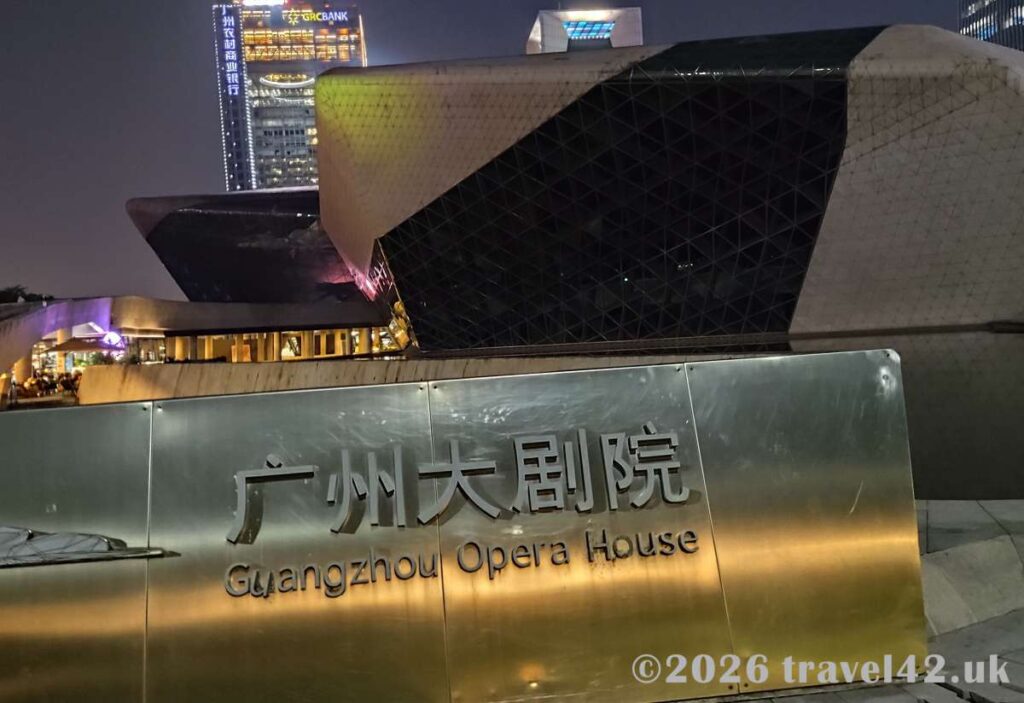
We should also admit that seeking out Zaha Hadid’s buildings wherever we travel has become something of a quiet tradition for us. Her work genuinely feels unlike anyone else’s, and there are still many more we hope to see.
Day Two: Old Guangzhou – Temples, Pedestrian Streets and Rooftop Views
Dafo Temple
We visited Dafo Temple (大佛寺) first thing in the morning, which turned out to be a wise decision. The temple sits in the heart of Yuexiu District, a Buddhist sanctuary that has somehow endured – and remained active – in the middle of a vast modern city. Its origins date back to the Southern Han dynasty (917–971 AD), though it has been rebuilt and expanded many times over the centuries.
Arriving early, we had the space largely to ourselves before the crowds began to gather. Incense was already burning, and worshippers were quietly carrying out their rituals. The shift in atmosphere from the busy streets outside is immediate and complete.
One of the most striking things about Dafo Temple is the way it exists alongside contemporary skyscrapers surrounding it. The contrast between centuries-old courtyards and the modern skyline pressing in on all sides is something you really have to see in person to appreciate fully.
Shangxiajiu Pedestrian Street
Shangxiajiu Pedestrian Street, in the Liwan District of western Guangzhou, was one of the most enjoyable places on the trip simply to wander.
The street stretches for around 1,200 metres and blends old and new effortlessly – lined with traditional Qilou arcade-style shophouses dating back to the early 20th century, alongside modern shops, street food stalls, and the kind of unhurried commercial bustle that has characterised Liwan for generations.
Historically the heart of Guangzhou’s merchant culture, the area has managed to retain its identity without becoming a sanitised heritage attraction. It still feels like a real, working neighbourhood. We passed countless food stalls with growing temptation but resisted, knowing we already had lunch plans elsewhere – though it was not easy.
LN Garden Hotel Five Rooftop Bar
For lunch, we stopped at the rooftop bar of LN Garden Hotel Five, which offers stunning panoramic views across the Pearl River. It is the sort of place that would be easy to overlook if you were not specifically searching for it, but we would encourage any couple visiting Guangzhou to seek it out.
Two things from that meal remain particularly vivid in our memory. The first was a baijiu cocktail – baijiu being China’s famously strong national spirit, often between 40% and 60% ABV, which somehow becomes surprisingly approachable in cocktail form. The second was turtle soup, which appeared on the menu rather innocently and turned out to be memorable in every possible sense.
This was one of the pricier experiences we had in Guangzhou, but we have absolutely no regrets about it.
Evening: Cocktails and an Unexpectedly Excellent Italian Dinner
Our second evening took us to a cocktail bar in a lively neighbourhood, followed by an Italian restaurant where the food was, we have to say, genuinely authentic. We had gone in with modest expectations and left thoroughly impressed.
Italy, it turns out, is very well represented in southern China.
Day Three: Shopping at YiSen Leather Market
Our final morning in Guangzhou – a slower and later start this time – was spent at YiSen Leather Market, also known as YiSen International Leather City, which describes itself as one of Southeast Asia’s largest leather goods distribution centres.
The claim is easy to believe.
Multiple floors of stalls sell bags, luggage, wallets, belts, and accessories at prices that make comparable items back home feel faintly absurd. We spent far longer there than intended and left with considerably more than we had planned to buy.
It rewards patience and a willingness to browse, and couples who enjoy shopping together will find it dangerously easy to lose several hours there. One particularly useful detail: English is spoken routinely by many of the sellers, making the experience far less intimidating than some large Chinese markets can feel.
We should mention that our hotel choice had partly been shaped by the market’s location, since we always intended to visit it on foot while exploring the surrounding area. In truth, the streets outside the park did not offer a huge amount of additional interest – but Yuexiu Park itself more than compensated, and the location worked exactly as we had hoped.
Getting Around Guangzhou as a Couple
Guangzhou’s infrastructure genuinely deserves a mention of its own because it is impressive by any international standard.
The metro is fast, clean, beautifully signposted in both English and Chinese, and covers all the major areas of the city. We returned to the hotel by metro every evening with complete ease.
For shorter journeys between districts, we occasionally used taxis booked through the DiDi app – China’s equivalent of Uber – which we had already been using since our time in Yangshuo. By the time we reached Guangzhou, booking a taxi through DiDi felt as routine as ordering food back home.
The combination of metro and DiDi covered everything we needed.
As for language, English is less widely spoken in Guangzhou than in Beijing or Shanghai, but it was rarely an issue, particularly in tourist areas. We carried a translation app but barely used it. On one occasion, when a DiDi driver called to confirm our location, we simply handed the phone to a nearby security guard, who kindly explained exactly where we were waiting.
Solutions always seemed close at hand.
What We Skipped – and Why That Matters
We had planned to go up Canton Tower but ultimately chose not to, having already experienced Shanghai Tower earlier in the trip. We had also planned a Pearl River cruise but skipped it for similar reasons – by the time we reached Guangzhou, we had already enjoyed several memorable river experiences elsewhere in China.
Neither decision left us with any regrets. But they do illustrate something important: Guangzhou comfortably contains more than two or three days’ worth of experiences.
Had we arrived here without everything that came before on this trip, we would almost certainly have stayed longer.
Departing from Guangzhou Baiyun International Airport
Our final morning ended with a taxi ride to Guangzhou Baiyun International Airport for our flight back to Shanghai.
The airport is enormous, modern, and – despite being one of the busiest in China – surprisingly calm in atmosphere. There is simply enough space for the crowds to disperse. Our departure experience was smooth and, unexpectedly, rather relaxing.
Before the flight, we had breakfast at the airport. There are plenty of dining options, ranging from fast food to smaller, more considered cafés and restaurants. We tried one of each and quickly realised we should probably have gone straight to the second option.
Something to remember for next time.
Practical Tips for Couples Visiting Guangzhou
When to Visit
Guangzhou has a subtropical climate. Spring (March to May) and autumn (October to November) are the most comfortable seasons. Summers are hot, humid, and occasionally affected by typhoons between June and September.
Getting There
Guangzhou is extremely well connected by China’s high-speed rail network, with direct services from Beijing, Shanghai, Shenzhen, and Hong Kong. Guangzhou South Railway Station is one of the country’s major transport hubs. Baiyun International Airport also has extensive domestic and international connections.
Train Tickets
Train tickets are typically released around two weeks before travel. Sleeper berths on popular routes sell out extremely quickly, so it is wise to have a backup plan. Flights between major Chinese cities are often affordable and straightforward.
Canton Tower Tickets
Observation deck tickets cost around £16 per person, while the Bubble Tram combination ticket is approximately £32.50 per person. Sunset slots sell out quickly, so book immediately once tickets are released.
Guangzhou Young Tram
Tram Line 1 runs from Wanshengwei to Canton Tower across 11 stops and 7.7 kilometres. It is comfortable, inexpensive, and a genuinely enjoyable way to see the central riverfront districts.
Bio Island Robobus
The autonomous Robobus on Bio Island is free of charge and operates two routes around Guangzhou International Biological Island. It was unlike anything we had experienced before and remains one of the most memorable things we did in China.
Getting Around
The Guangzhou Metro is exceptional. Download the DiDi app before arriving in China if you plan to use taxis regularly.
Payment
WeChat Pay and Alipay are accepted almost everywhere. Carrying a small amount of cash is still sensible as a backup, particularly in markets.
Language
English is less widely spoken than in Beijing or Shanghai, but in tourist areas it is rarely a serious obstacle. A translation app is useful to have, though you may find yourself relying on it less than expected.
Is Guangzhou Worth Visiting as a Couple?
Without a doubt, yes.
Guangzhou is not the version of China that dominates glossy travel magazines. It does not have the imperial grandeur of Beijing or the cinematic futurism of Shanghai. What it offers instead is something more layered: a city shaped by centuries of trade and culture, one that has embraced technology and ambition while still preserving temples, historic streets, and riverfront neighbourhoods that feel beautifully human after dark.
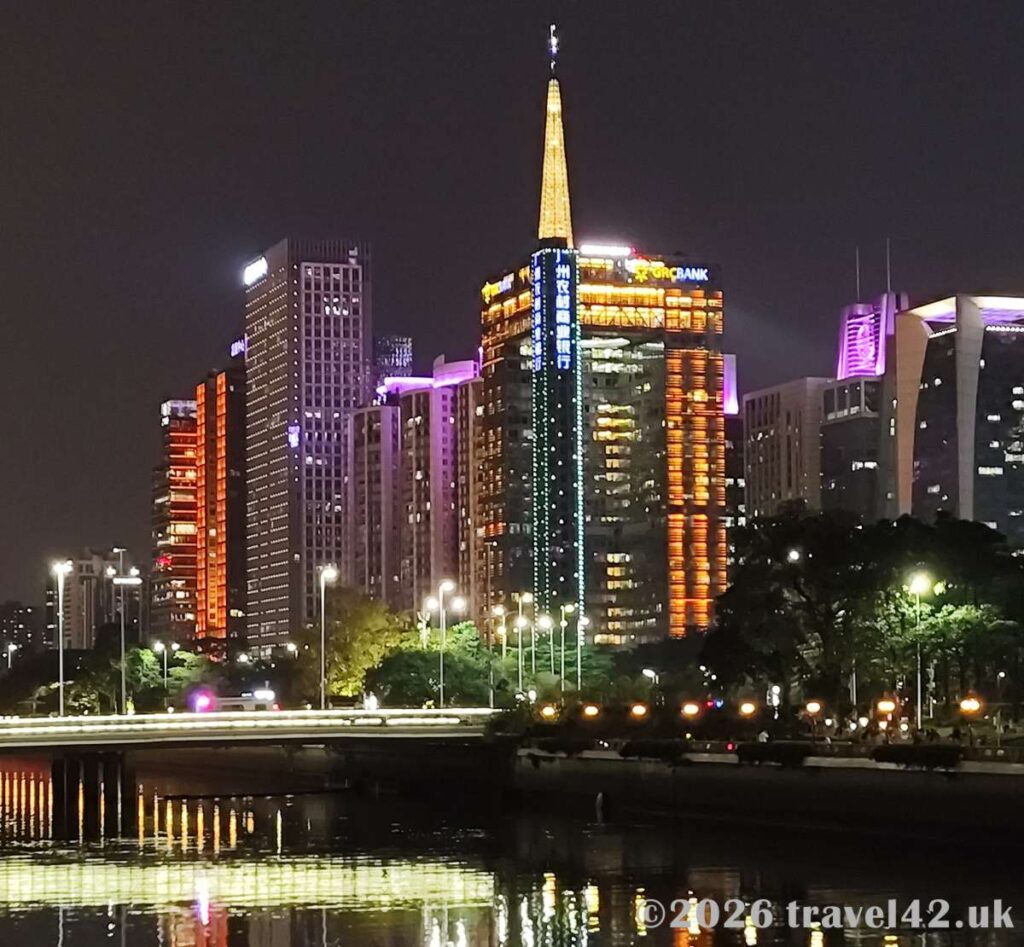
For couples who have already visited China’s more obvious destinations, Guangzhou offers something genuinely different. And for couples arriving here as part of their first China itinerary, it will probably surprise them in all the right ways.
We left wishing we had stayed longer. More than anything else, that is the mark of a city worth visiting.
And we are quite sure we will return.
Travel42 UK is a couples travel journal dedicated to immersive road trips, slow travel, and destination storytelling.
Explore More of China:
–



The long way round, as a couple
About the Author
The author, ainarsbl, is a Level 7 Google Local Guide, Master Reviewer and expert travel reviewer focused on scenic landscapes, UNESCO sites and meaningful couples travel experiences.