Part of our 12-Day Morocco Road Trip from Agadir to Tafraout & the Anti-Atlas
After a wonderful walk through Paradise Valley – one of the undisputed highlights of the early part of our road trip – we pointed the car east towards Taroudant. It turned out to be one of the most memorable stops of the entire journey, though not quite for the reasons we had planned.
Getting to Taroudant from Agadir
Leaving Paradise Valley
Taroudant sits roughly 80 kilometres east of Agadir in the heart of the Souss Valley – around an hour’s drive on a good day. That said, our own journey took considerably longer.
Trusting Google Maps rather than our instincts, we followed a route that turned out to be anything but straightforward. The road quickly deteriorated into something barely deserving of the name – no tarmac, no markings, and eventually a bridge in a state of decidedly questionable structural health. We crossed the riverbed rather than risk the bridge, only for things to get progressively worse.
It took a local man waving us down and an exchange conducted entirely without a shared language to make the situation clear: this road was not going to take us to the N10. We turned around, drove back towards Agadir, and joined the main road heading east – arriving at our guesthouse late in the afternoon, just in time for dinner.
The lesson? Stick to the N10 from Agadir, or use the N11 and R122 if approaching from elsewhere, rather than looking for mountain shortcuts. The main roads are well surfaced, straightforward to navigate, and genuinely scenic as the Souss Valley opens out before you, framed by the High Atlas to the north.
Arriving in Taroudant
Our guesthouse was on the outskirts of town. GPS navigation helped us find it, though some creative interpretation was still required – not every track shown on the map leads quite where you expect. The final challenge was recognising that the large metal gate at the end of a dusty lane, flanked by substantial stone walls, was actually where we needed to be.
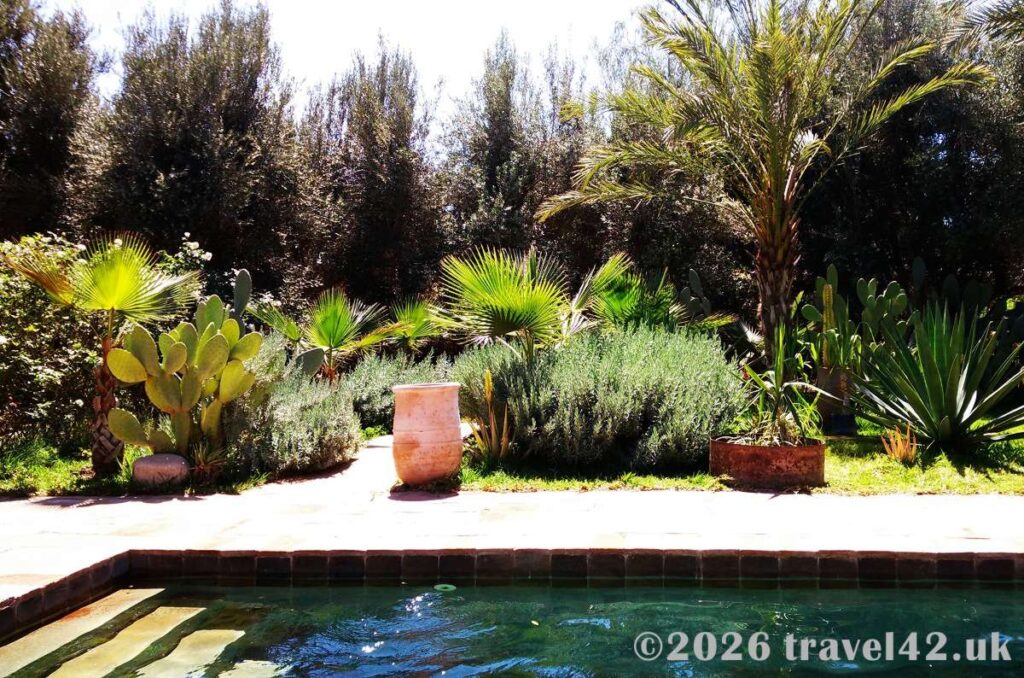
Once we’d settled in, the place turned out to be genuinely wonderful: shaded gardens, comfortable private bungalows, a large swimming pool, a dedicated dining terrace, breakfast served among the flowerbeds, peacocks wandering the grounds (mercifully quiet, contrary to all expectation), a family of tortoises ambling between the plants, a reassuringly large guard dog, and horses grazing at one end of the property.
One further detail worth mentioning: a good bottle of French wine was always available. Sometimes the small things matter.
About Taroudant
If you arrive expecting another Agadir – beach bars, seafront promenades, and tourists in sunglasses – you’ll be pleasantly surprised.
Often nicknamed the “Grandmother of Marrakech“, Taroudant is a small fortified market town on the old caravan routes, regarded by many travellers as one of the most beautiful towns in Morocco, yet attracting only a fraction of the visitors drawn to its more famous neighbour. And that, frankly, is a large part of the reason we wanted to visit.
With a population of around 80,000, Taroudant sits in the fertile Souss Valley between the High Atlas to the north and the Anti-Atlas to the south. There are no international coffee chains, no shopping malls, and very little aimed specifically at foreign tourists. What you get instead is a city that looks and feels as though it lives entirely on its own terms – a working Moroccan market town largely untouched by mass tourism.
The history here stretches back centuries. In the 16th century, the Saadian dynasty briefly used Taroudant as its capital before relocating the royal seat to Marrakech. The city prospered under Saadian rule, trading in sugar, cotton, indigo, and rice, before settling into its long-standing role as a commercial centre for the surrounding Amazigh (Berber) communities.
Much of the old city remains enclosed within its historic walls to this day – a living reminder of that prosperous period.
The City Walls
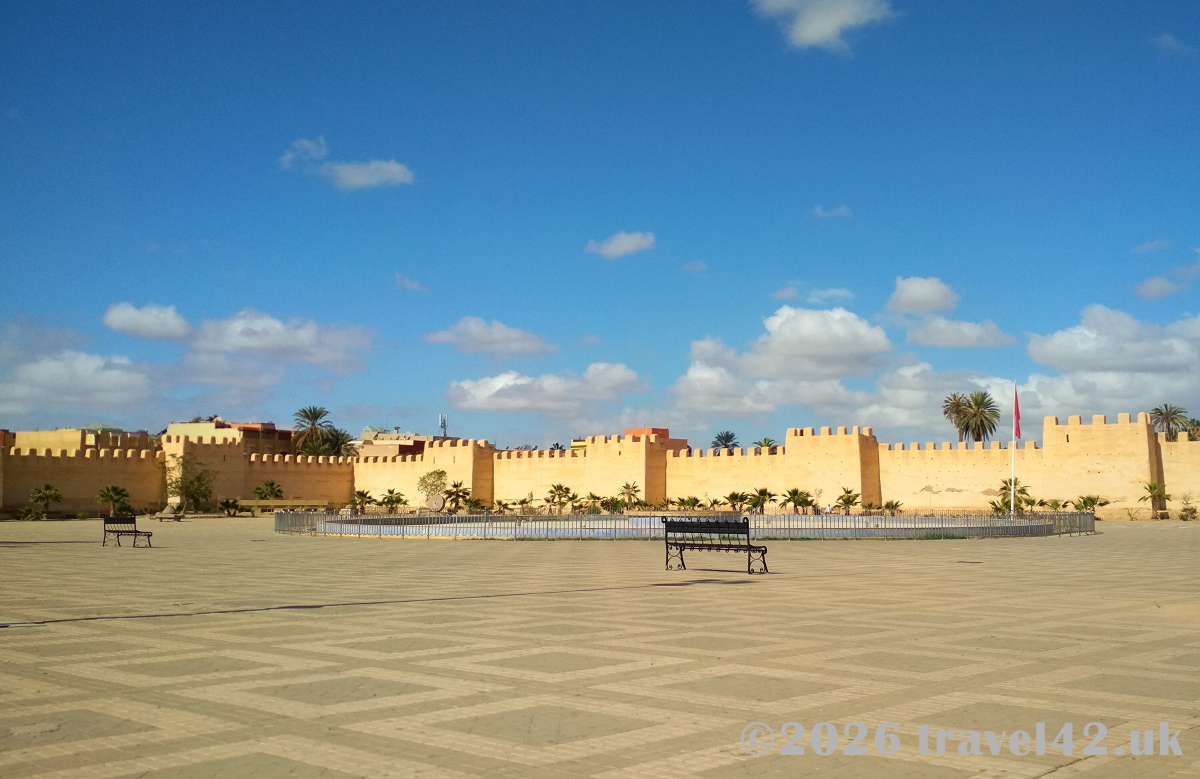
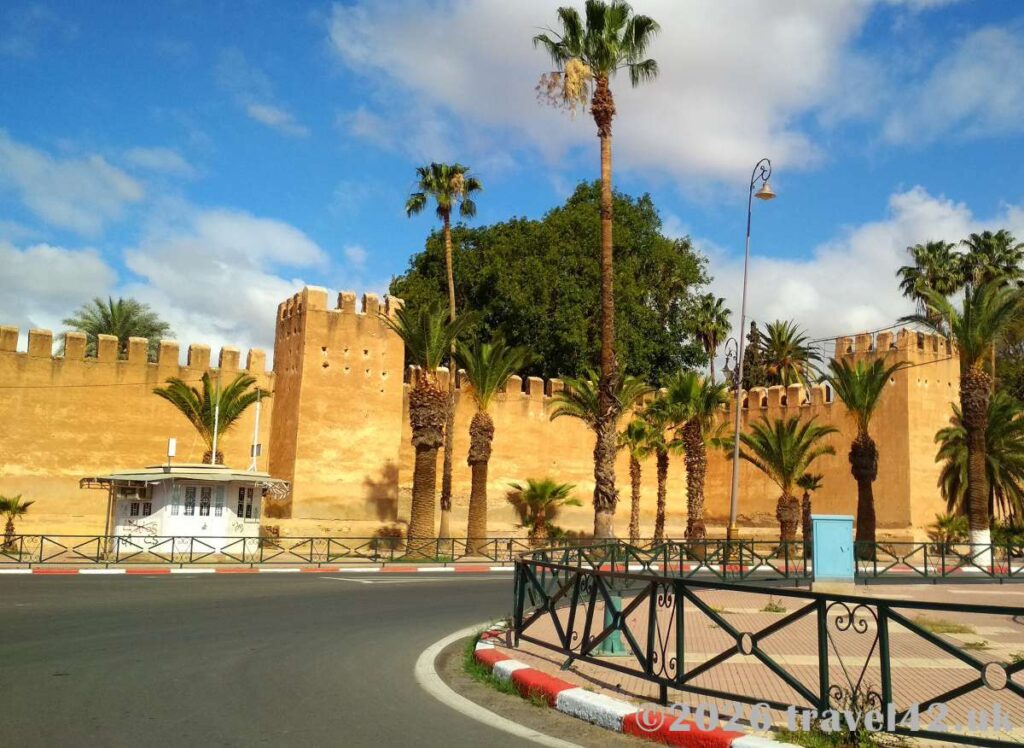
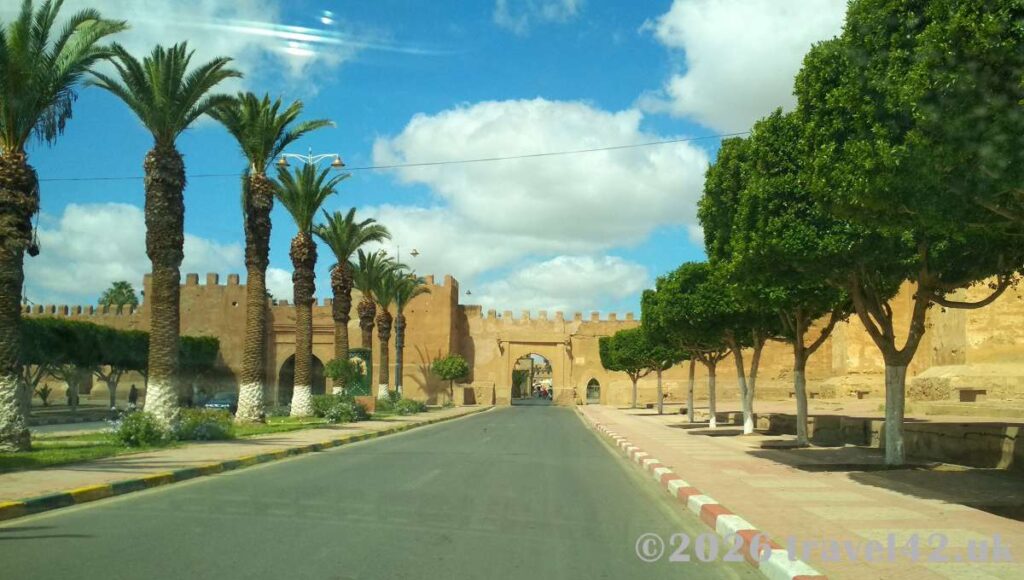
The walls are Taroudant’s single most dramatic feature, and they deserve far more than a passing glance.
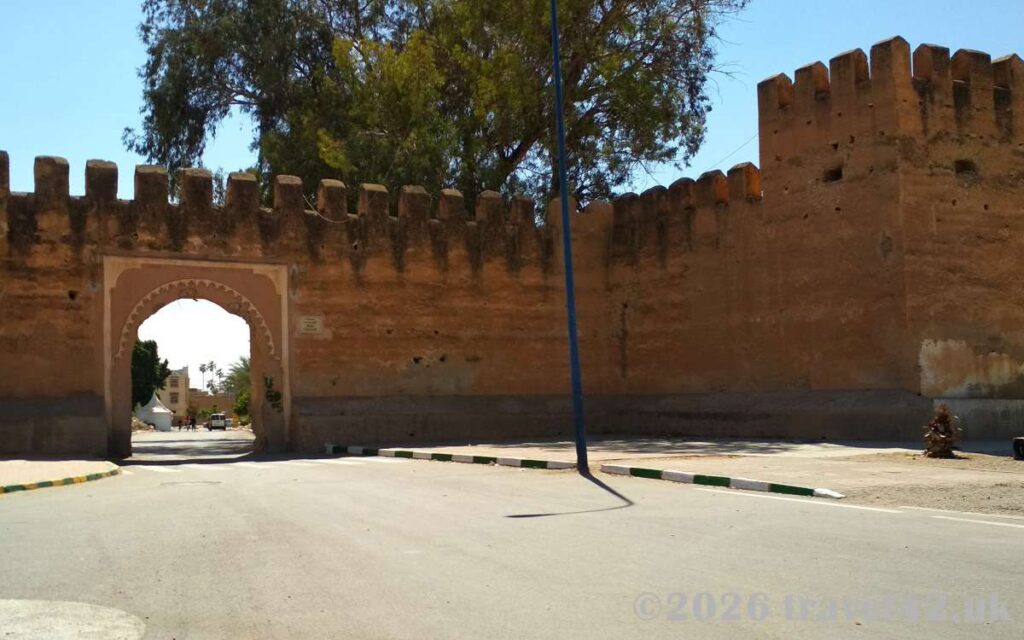
Built during the Saadian period in the 16th century, the ramparts form a complete circuit of approximately 7.5 kilometres around the old city. Constructed from pisé (rammed earth), they are punctuated by bastions, towers, and monumental gateways.
Nine gates – known locally as babs – provide access to the medina.
The two most impressive are Bab Targhount on the northern side and Bab El Kasbah to the east. Stepping through either of them for the first time is one of those travel moments that stops you mid-stride. Their scale, colour, and sheer presence are difficult to appreciate fully until you’re standing beneath them.
The magic begins even before you reach the gates themselves. Driving around the outside of the city, you pass long stretches of ochre-coloured wall interrupted by gateways framed by attractive plazas and gardens, each section slightly different from the last.
The classic way to explore the circuit is by horse-drawn carriage (calèche), which can be hired near the city centre and typically takes around an hour. The best time to go – whether by carriage, bicycle, or on foot – is late afternoon, when the setting sun transforms the walls into deep shades of amber and gold.
Do note that access to the top of the walls is generally restricted. Fortunately, the views from outside and the atmosphere around the gates more than compensate.
Step through one of those ancient entrances and the city immediately comes alive on the other side.
The Souks
Beyond the walls, Taroudant’s heart beats in its souks.
The city has two principal markets within the medina, both centred around Place Assarag (often referred to locally as Place en Nasr).
The Berber souk serves everyday local needs, offering spices, fresh produce, clothing, textiles, carpets, and household goods. The Arab souk focuses more on traditional crafts, including jewellery from Anti-Atlas villages, leather goods, carpets, and silverwork.
On this particular trip, we didn’t explore the shopping in great depth – there are only so many hours in a day – but even a brief wander revealed a market that feels refreshingly authentic.
There is also a large Sunday market outside the city walls, where mountain produce, livestock, herbs, spices, and second-hand goods are traded alongside food stalls and cafés.
What strikes many visitors is how little tourist-oriented merchandise there is. No endless rows of souvenir T-shirts, very little aggressive selling, and none of the intensity you occasionally encounter in Morocco’s busiest tourist centres.
Shopping here feels relaxed, local, and entirely genuine.
Our Experience of Taroudant
If we’re honest, our time in the city itself was relatively brief.
We had, after all, chosen Taroudant primarily as a base for exploring the surrounding region – heading north into the mountains on one day and out towards Agadir Inoumar on another.
Yet even our limited time left a strong impression.
The moment that stays with us most vividly is walking through one of the vast city gates for the first time, seeing the medina unfold ahead of us, and realising that we had stepped into a place still largely untouched by international tourism.
Because our guesthouse was located outside town, we used the car each time we visited. On the way back, we’d often stop at local shops to pick up snacks and drinks that were both remarkably inexpensive and remarkably good.
Since we had full board at the guesthouse, these detours were driven entirely by curiosity rather than necessity. It was a small but telling reminder that in places not yet shaped around tourism, everyday life often remains refreshingly affordable.
Taroudant deserves more time than we gave it.
If you’re following our 12-Day Morocco Road Trip itinerary, we’d recommend allowing at least one full day – ideally two. Walk beside the walls at sunset. Get pleasantly lost in the souks. Sit in the main square with a glass of mint tea and watch the city go about its business.
There’s a particular kind of quiet magic here that’s becoming increasingly rare in Morocco’s more heavily visited destinations.
Practical Information for Visiting Taroudant
Getting There
The most straightforward route from Agadir is via the N10 heading east. The journey is approximately 80 kilometres and usually takes around one hour.
How Long to Spend
A full day is the minimum. Two nights is ideal if your itinerary allows. We stayed longer and used Taroudant as a base for exploring the surrounding region.
What to See
- The city walls
- Bab Targhount
- Bab El Kasbah
- The Arab and Berber souks
- The Sunday market outside the ramparts
Getting Around
Horse-drawn calèche tours of the walls remain one of the most enjoyable ways to experience the city and are easy to arrange locally.
Where to Stay
We stayed at a private guesthouse outside town – a genuinely lovely property with gardens, horses, bungalows, and a swimming pool. Accommodation just beyond the city walls often offers excellent value and a much more peaceful atmosphere.
Where Next?
From Taroudant, our road trip continued south towards Tafraout and the Anti-Atlas Mountains – a spectacular journey that deserves its own post entirely.
Why Taroudant Should Be on Your Morocco Itinerary
Morocco is full of famous destinations: Marrakech, Fez, Chefchaouen, Essaouira. Taroudant rarely appears on that list.
And that’s precisely its appeal.
This is a city where life still feels local, where centuries-old walls continue to define the skyline, and where the souks serve residents first and visitors second.
For us, Taroudant offered something increasingly difficult to find in popular destinations: authenticity without performance.
If you’re travelling through southern Morocco, don’t rush past it.
Travel for Two is a couples travel journal dedicated to immersive road trips, slow travel, and destination storytelling.
Explore More of Morocco:
–



The long way round, as a couple
About the Author
The author, ainarsbl, is a Level 7 Google Local Guide, Master Reviewer and expert travel reviewer focused on scenic landscapes, UNESCO sites and meaningful couples travel experiences.