
Some places you stumble upon by accident. Tafraout, we had planned from the very beginning. Tucked into a high valley of the Anti-Atlas Mountains some 150 kilometres south-east of Agadir, it was always going to be our final stop on this southern Morocco road trip – and in the end, it turned into something far longer and more immersive than we’d ever imagined. We fell properly, helplessly in love with the place.
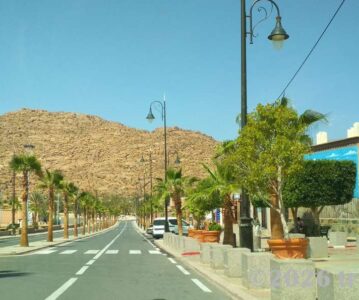
Arriving at dusk after a long mountain drive, the first surprise was a roundabout in Ammelne decorated with LED lights – a small, unexpected welcome that gave the whole arrival a certain magic. All around us, the mountainous landscape was fading into darkness, and the main street ahead drew us gently through the outskirts and into the town centre where our guesthouse was waiting.

Getting to Tafraout
The drive itself deserves its own mention. We came in via narrow mountain roads cutting through the Anti-Atlas Mountains, and while the route demands concentration, it rewards you at every bend. At 1,200 metres in altitude, Tafraout sits in a bowl-shaped valley encircled by fertile gorges of date palms, almond trees, and argan trees, with dramatic pink granite peaks rising on all sides.
If you’re following our 12-day Morocco road trip itinerary, we arrived from Taroudant via the mountain route with a slight detour through Ida Ougnidif and Thmani (coordinates: 29.759337, -9.156876).
This way demands solid driving confidence on narrow, winding roads – don’t rush it. There were a couple of moments where we genuinely wondered whether the route would open up ahead of us, but it always did, and the payoff was extraordinary: tremendous landscapes, remote Berber villages, and the last light of the day catching the mountains just as we rolled into Tafraout.
An easier and more straightforward alternative is the route through Tifghalt (coordinates: 29.741237, -8.863084).
The Anti-Atlas region experiences hot, dry summers and cool winters, with the best conditions for visiting and hiking falling between September and May. We’d recommend arriving with at least three nights blocked out – it’s a substantial drive from wherever you’re coming from, and this is very much a place that reveals itself slowly.
About Tafraout
Tafraout is a small Amazigh (Berber) town of around 7,000 people, completely encircled by enormous boulders of pink granite that glow like embers at sunrise and sunset. It’s the kind of place you have to specifically choose to visit – there’s no passing trade, no coach tours grinding through – which is exactly why it remains so wonderfully, quietly itself. On the edge of town, a large camping ground draws European motorhome travellers who tend to stay for weeks rather than nights, giving the place a pleasantly unhurried, community-like feel.
The name Tafraout is said to mean “water source” in the Tamazight language, reflecting the town’s historic importance as a vital resource in this semi-arid landscape. It belongs to Tiznit Province in the Souss-Massa region and has been a stronghold of Amazigh culture for centuries.
Women’s cooperatives here produce argan oil through traditional methods – we had the chance to watch how the oil is extracted by hand, which genuinely gives you pause. It is hard, slow, remarkably physical work, and the patience it requires is humbling. The cooperatives sell a wide range of argan-based cosmetic products in town, and it’s well worth buying directly from them. The surrounding valleys have been cultivated by Berber families for generations, producing almonds used in amlou – a local speciality of ground almonds, argan oil, and honey that you’ll want to eat at every meal.
If you’re visiting in late January or February, you may be treated to one of the valley’s most spectacular annual events: thousands of almond trees across the Ameln Valley and surrounding hillsides burst into simultaneous bloom, blanketing the landscape in clouds of pink and white blossom against the famous rose-granite backdrop. We were there in the warmer months and missed it – reason enough to come back.
The Painted Rocks
The most famous attraction in the Tafraout area sits around three kilometres south of town near the village of Agard Oudad: the Painted Rocks of Tafraout. In 1984, Belgian artist Jean Vérame used an estimated 18 tonnes of paint to transform an enormous field of granite boulders into a surreal land-art installation, painting them in vivid shades of blue, red, violet, and black.
We were fortunate with our timing – the paint had recently been renewed before our visit, and the colours were as striking as they must have been when Vérame first completed the work. Over the years, sun, wind, and rain take their toll, so the vibrancy you’ll find does vary depending on when you go.
We have a full post dedicated to the Painted Rocks as part of this Morocco series – including practical tips on the best routes and times of day to visit, and what to combine it with.
Napoleon’s Hat and the Ameln Valley
Just outside town near Agard Oudad, a distinctive granite formation known as Napoleon’s Hat (Chapeau de Napoléon) has become one of Tafraout’s most-photographed landmarks – a boulder that genuinely does resemble a bicorne hat balanced on the hillside, particularly striking at sunrise when the granite glows rose-gold.
Tafraout sits nestled in the Ameln Valley, a lush oasis of cultivation surrounded by towering mountains and dotted with small Berber villages, each with its own character. Cycling through the valley’s 26 villages is one of the most popular ways to explore the area – bikes can be hired locally for around 100 MAD per day, and the relatively flat valley floor makes it manageable even if you’re not a committed cyclist. Our guesthouse offered bicycle hire too, though on this occasion we explored on foot and by car.
We have a full dedicated post on a day hike from Tafraout coming soon – so watch this space.

Where to Stay in Tafraout
Finding the right base matters here – particularly if, like us, you’re planning more than a night or two. We stayed at Maison de Vacances Tafraout, a privately run guesthouse apartment on the main street, close to the market and local shops. Central location, a decent kitchen, solid WiFi, and our host Jamal proved genuinely helpful with local recommendations and logistical advice. The property has a sun terrace with views of the granite peaks, and being positioned centrally means the souk, cafés, and restaurants are all within easy walking distance, while the trailheads for hiking into the mountains are barely minutes away.

One particularly charming detail of staying central: from our window, we regularly watched goats making their way through the streets below. More than once, they clambered onto parked cars to reach overhanging branches – clearly a more dignified alternative to hanging from argan trees, which is what they tend to do in the countryside. We enjoyed it enormously. We were so taken with the place, and with Jamal’s hospitality, that we put together a short video for his Facebook page after our adventures in the surrounding area – you can also watch it on our YouTube channel.
Beyond Maison de Vacances, Tafraout has a reasonable spread of accommodation ranging from simple family-run guesthouses to small hotels. For something more immersive, La Maison Traditionnelle, located in the nearby village of Oumesnat in the Ameln Valley, offers a spectacular setting in traditional Amazigh buildings and has been highly praised for its food – a lovely alternative if you’d prefer to be away from the town centre and closer to the valley villages.
Eating and Drinking in Tafraout
Local cuisine in Tafraout follows traditional Amazigh patterns – slow-cooked tagine with mountain herbs, couscous with lamb or chicken, and the unmissable amlou: a thick, fragrant paste of ground almonds and argan oil sweetened with honey, eaten with warm bread. It’s rich, earthy, and deeply satisfying in a way that makes you want to buy a jar to take home (we did).
Although the main market operates daily, the Wednesday souk is worth planning around if your dates allow – a proper local affair rather than anything tourist-facing, with produce, spices, livestock, and the kind of organised chaos that makes Moroccan markets so pleasurable to wander.
Tafraout for Couples
Tafraout isn’t showy. There are no grand monuments to tick off, no riad rooftops designed for Instagram, no mint-tea ceremonies staged for tour groups. What it offers instead is something rarer: a genuine Amazigh mountain town surrounded by some of the most extraordinary scenery in southern Morocco, where you can walk out of your accommodation in the morning and immediately find yourself in the mountains.
For couples who travel for landscapes, quiet roads, and the pleasure of going somewhere most people don’t bother – Tafraout delivers completely. It gave our Morocco road trip something to anchor itself to in the memory; a place we still talk about and fully intend to return to.
Tafraout is covered in detail as part of our 12-Day Morocco Road Trip from Agadir on www.travel42.uk – including practical logistics, driving routes, and how to combine it with Taroudant, Paradise Valley, and the Anti-Atlas. See also our dedicated posts on the Painted Rocks and a self-guided Anti-Atlas hiking loop from Tafraout.
Travel for Two is a couples travel journal dedicated to immersive road trips, slow travel, and destination storytelling.
Explore More of Morocco:
–



Travel for Two – from wild roads to romantic evenings
About the Author
The author, ainarsbl, is a Level 7 Google Local Guide, Master Reviewer and expert travel reviewer focused on scenic landscapes, UNESCO sites and meaningful couples travel experiences.