We’d been warned. Before we even set off towards the Painted Rocks, we’d scrolled through enough online reviews to know exactly what the sceptics thought: faded paint, overhyped, an insult to an otherwise spectacular natural landscape. Morocco has no shortage of people telling you what isn’t worth seeing, and the Painted Rocks had accumulated quite a following of the unconvinced.
We went anyway – and we’re very glad we did. Not just once, either. We visited on foot and explored the area by car too, which tells you something.
Rather than spending our first afternoon simply ticking the box of “we were there”, our initial visit was a quick drive out from Tafraout. It’s a slightly longer route by road, but it takes far less time than walking and brings you directly to the site.
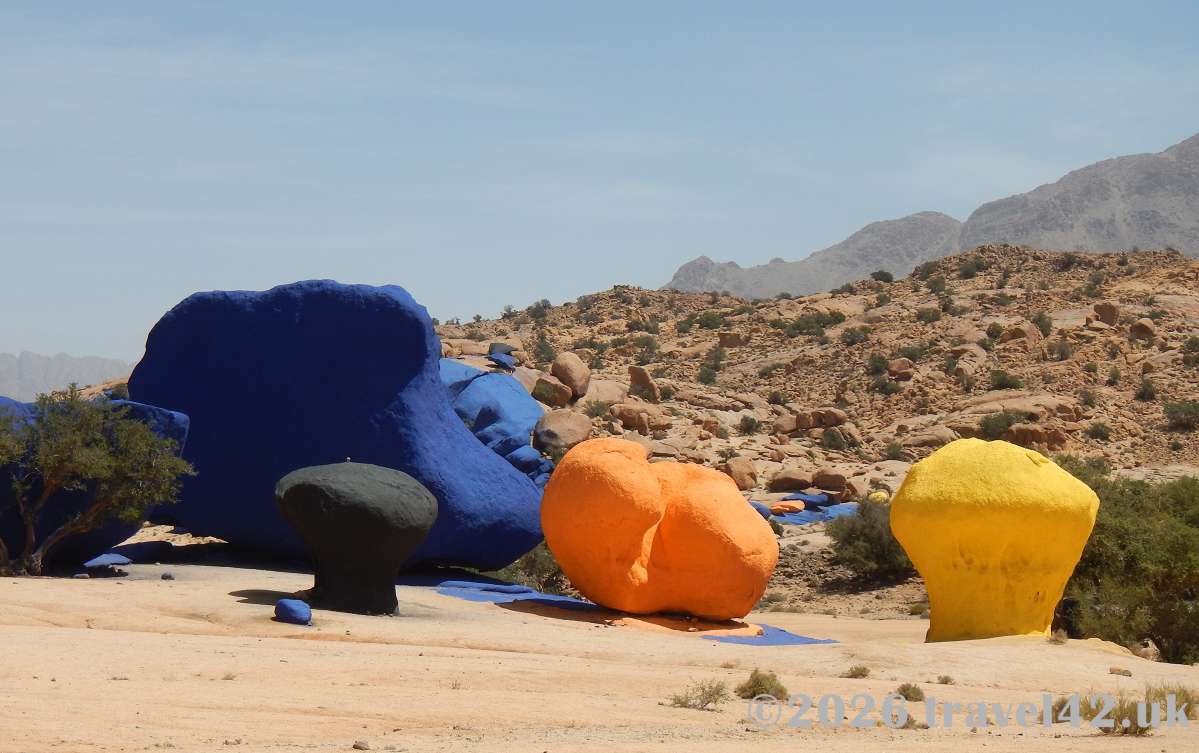
Our first impression was a genuinely happy surprise. The painted boulders glow with colour that you can spot from a considerable distance, and because they’re scattered across several separate clusters rather than gathered in one place, the whole installation has a wonderful slow-reveal quality. You notice one group of rocks, look around, and then discover another – and another beyond that.
We parked beside one of the formations and wandered over for a closer look. That was the moment we realised this place deserved far more than a quick stop – we’d need to come back on foot to experience it properly.

What Are the Painted Rocks?
The Painted Rocks are the work of Belgian artist Jean Vérame, who in 1984 – with the help of the Tafraout fire brigade and an estimated 18 tonnes of paint – transformed a vast cluster of granite boulders into one of Morocco’s most unusual outdoor artworks. The installation is widely said to have been created as a tribute to his late wife.
Most people refer to them simply as Morocco’s Blue Rocks, but they’re actually far more colourful than that. Alongside the famous blue boulders are rocks painted in vivid shades of pink, red, black, yellow and orange. In French, the installation is known as Les Rochers Peints de Tafraout.
Standing among these enormous boulders, you gain a real appreciation of the sheer scale of the undertaking. It’s one of those places that encourages you to slow down, wander together, and keep discovering another favourite viewpoint.
It’s worth acknowledging from the outset that the Painted Rocks remain genuinely controversial. Using a natural landscape as a canvas raises an obvious question: is this environmental vandalism or an extraordinary piece of land art? Opinions remain firmly divided. The Whole World Or Nothing is one of several travel blogs that openly discusses this tension between artistic vision and preserving nature, and it’s a debate that’s far more interesting once you’re standing in front of the rocks yourself. We’ll leave you to decide where you stand.
As for the condition of the paint, the installation has been restored in recent years after decades of fading. When we visited, the colours were vibrant, and the deterioration described in some older reviews simply wasn’t as noticeable as we’d expected.
There may be similar large-scale landscape art elsewhere in the world, but this installation left a lasting impression on us. Whatever your view of the art-versus-nature debate, it’s impossible not to admire the ambition behind it – and for us, it became one of the most memorable places we visited in southern Morocco.

Getting to the Painted Rocks
The Painted Rocks lie near the village of Agard Oudad, around three kilometres south of Tafraout town centre – close enough to reach easily, yet far enough away to feel completely immersed in the surrounding granite landscape.
There are three practical ways to visit.
By Car
This is the quickest option.
From Tafraout town centre, head south on the R107 following the signs for Rochers Peints. Alternatively, after approximately 2.5 kilometres on the R104, turn left shortly after passing Aday Mosque on your right. Continue along the main track for around five kilometres until the painted rocks appear on your left.
The final section is unpaved but perfectly manageable in an ordinary car. The surface is smooth, with no large rocks or deep ruts to negotiate.
One tip: don’t stop too early. After a bend that briefly feels as though you’ve gone the wrong way, the track curves back and suddenly reveals several separate clusters of painted rocks spread across the landscape. Some aren’t immediately obvious, so take your time looking around.
There’s plenty of free parking and numerous tracks linking the different formations if you’d like to explore further by car.
One practical point: overnight parking isn’t permitted and is checked occasionally. If you’re travelling by motorhome or campervan, use one of Tafraout’s campsites instead.
By Bike
If you’re staying in Tafraout for several nights – something we’d wholeheartedly recommend – hiring a bicycle is one of the most enjoyable ways to reach the rocks.
Bikes can be rented locally for around 100 MAD per day, and the ride to Agard Oudad is straightforward on quiet roads. It’s approximately six to seven kilometres each way, taking around half an hour at an easy pace.
Cycling allows you to stop whenever something catches your eye, and that’s probably the greatest advantage. Rather than rushing between viewpoints, you can explore each cluster at your own speed and discover your own favourite corners.
We didn’t hire bikes ourselves, but it looked like one of the best ways to experience the site. If you’re using a mountain bike, the hill path described below is also rideable in places, although you’ll almost certainly need to push the bike over some of the steeper sections.
On Foot
This was our favourite option, simply because we love hiking.
Walking transforms the Painted Rocks from a destination into part of a much larger experience. Instead of arriving by car, you’re gradually immersed in Tafraout’s extraordinary granite landscape.
There are two main walking routes from town. The easier follows the road south towards Agard Oudad, remaining mostly flat while the painted rocks slowly come into view. The second leaves the southern edge of Tafraout on hiking paths, climbing steadily over rocky ridges before descending towards the installation.
If you’re walking or cycling, we’d recommend combining both routes: follow the road on the outward journey, then return via the hill path for spectacular views across the valley and a much more varied walk.
Bring plenty of water and something to eat, as there are no facilities at the Painted Rocks themselves. A small picnic makes a lovely addition to the day.
Download offline maps before setting off because mobile reception can be unreliable, and avoid walking during the hottest part of the afternoon if possible. Although sections of the route pass beneath trees, shade is limited and this isn’t a walk to rush.

What to Expect When You Arrive
The Painted Rocks are spread across a surprisingly large area rather than concentrated in one place, and no photograph quite captures the experience of standing among them. The sheer size of the granite boulders, the vivid colours against the pale stone, and the remarkable stillness of the surrounding valley combine to create something that’s difficult to convey in pictures alone.
It’s also worth stepping back occasionally. Some of the best views come from a distance, where the painted clusters emerge unexpectedly from the natural landscape.
If you’re exploring by car, consider combining your visit with nearby Aït Mansour Gorge, around 30 kilometres further south. We didn’t have time to include it on this trip, but it’s an easy extension if you’re continuing through the Anti-Atlas.
As elsewhere in Morocco, early morning and late afternoon offer the most beautiful light. We visited on a clear morning and found the colours particularly striking against the warm granite – conditions that are fairly typical in this part of the Anti-Atlas.
Combining the Painted Rocks with Napoleon’s Hat
While you’re here, it’s well worth combining the Painted Rocks with a visit to Napoleon’s Hat, the distinctive granite tor near Agard Oudad that appears on countless Tafraout postcards.
The village lies only around two kilometres south of Tafraout beneath the famous rock formation, making both attractions easy to visit within the same half-day outing, whether you’re walking, cycling or driving. Keen scramblers can even climb to the top for panoramic views across the valley.
We didn’t visit the village itself this time, but we enjoyed excellent views of Napoleon’s Hat from the mountain trails above Tafraout on our return hike.
Whether you come to admire Jean Vérame’s artwork, to debate whether it belongs in such an extraordinary landscape, or simply to enjoy one of the most unusual walks in southern Morocco, the Painted Rocks are far more rewarding than many online reviews suggest. For us, they became one of those rare places that improved with every visit – first by car, then on foot – and we’d happily return again.
If you’re planning a longer stay, don’t miss our complete Tafraout travel guide, covering where to stay, local food, hiking trails and practical tips, or our 12-Day Morocco Road Trip from Agadir to the Anti-Atlas, where you’ll find everything you need to plan this unforgettable corner of Morocco.
Travel42 UK is a couples travel journal dedicated to immersive road trips, slow travel, and destination storytelling.
Explore More of Morocco:
–


The long way round, as a couple
About the Author
The author, ainarsbl, is a Level 7 Google Local Guide, Master Reviewer and expert travel reviewer focused on scenic landscapes, UNESCO sites and meaningful couples travel experiences.