
When we planned our China itinerary, Zhangjiajie Grand Canyon was listed as an optional extra – a “just in case we have a spare day” kind of place. We almost skipped it entirely.
It turned out to be the most relaxing, romantic and unexpectedly magical day of our entire China trip.
We were spending four nights (three full days) in Wulingyuan, and this was our final full day before heading to Fenghuang the following morning. If we were going again, we would stay at least one more day.
What Is Zhangjiajie Grand Canyon & Glass Bridge?
Zhangjiajie Grand Canyon is a separate attraction from the famous Avatar mountains of Wulingyuan – a fact that surprises many visitors. While the National Forest Park draws the biggest crowds, the Grand Canyon offers something quieter and arguably more intimate: a deep gorge carved through ancient karst rock, draped in forest, threaded with streams, and home to one of the most extraordinary bridges ever built.
The canyon sits around 30 kilometres from Wulingyuan town – roughly a 35 to 45-minute taxi ride – and is located in Cili County, Hunan Province. It is a relatively recent development as a tourist destination, which partly explains why it still feels far less frantic than the main forest parks.
We booked a taxi shortly after 7am and arrived near the entrance around 8am, though opening hours are worth checking in advance as they vary by season. As it was still early in our trip, we asked our hotel staff to help arrange the taxi.
The canyon landscape is a mix of green mountains, sheer cliffs, cascading waterfalls, caves and the clearest mountain stream we saw anywhere in China. At the bottom, wooden boardwalk trails wind beside the water for the full length of the gorge.
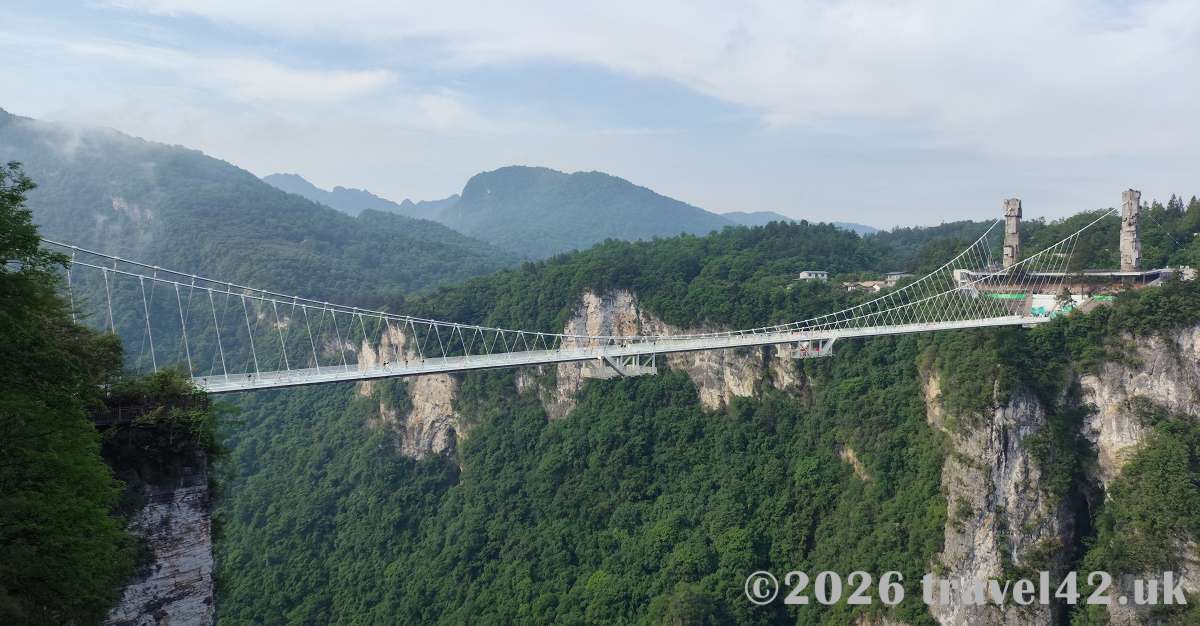
And then, suspended 300 metres above it all, there is the glass bridge.

The Glass Bridge: A Brief Love Story in Engineering
The Zhangjiajie Grand Canyon Glass Bridge – also known locally as Yuntiandu, meaning “a ferry across the clouds” – opened in August 2016 and immediately became a sensation. It was designed by Israeli architect Professor Haim Dotan, who described his intention to make the bridge almost invisible: a thin white ribbon disappearing into the mist between the cliffs.
The numbers alone are staggering. The bridge spans 430 metres in total length, stretches 6 metres wide, and hangs 300 metres above the valley floor – roughly the height of an 85-storey building. Its transparent deck is made from 99 individual panes of high-strength laminated glass, each tested to support the weight of a tank. The steel structure itself is an engineering feat: just 0.6 metres deep across a 385-metre span, a depth-to-span ratio that broke Chinese records at the time of construction.
CNN listed it as one of the eleven most spectacular bridges in the world. In 2018, it won the International Bridge Conference’s Arthur G. Hayden Medal. On its opening day alone, it attracted far more visitors than its designed daily capacity of 8,000 – so many that it had to close just 13 days later for upgrades before reopening the following month.
The bridge holds a maximum of 800 visitors at one time, and entry is allocated by timed ticket – which is exactly why arriving early matters.
We had booked tickets online, though a minor issue with one of our tickets meant a brief trip back to the ticket office. Navigating it took a little longer than expected; at that point in our trip we were still getting to grips with translation apps, and the language barrier made things slightly more complicated than they needed to be.
💡 Tip: We recommend downloading preparing Google Translate in offline mode before your visit and familiarising yourself with the camera translation feature – it makes situations like this considerably easier.
Arriving Early – Why It Made All the Difference
China’s Golden Week national holiday had ended just days before our visit, meaning the country-wide surge of domestic tourists had dispersed. We were among the very first visitors at the entrance when the gates opened and barely paused at ticket control before we were in.
A short walk from the entrance and we were at the bridge.
The first impression genuinely surprised us. A long, wide glass structure suspended across a deep gorge – even described that way, it does not quite prepare you for the reality of standing in front of it. We wanted to step on immediately, but first came the shoe covers: protective slip-ons worn over your own footwear to prevent scratching the glass surface. A small ritual, but one that somehow adds to the sense of occasion.
The biggest surprise was that we were not scared. There was no vertigo, no gripping the railing – just a huge rush of excitement as we looked down into the depths of the canyon.

Stepping Onto the Bridge
When we walked out onto the glass, the gorge was still wrapped in morning fog. Wisps of mist drifted between the cliffs on either side, softening the view and making the whole scene feel almost dreamlike – the kind of moment you do not quite believe is real until you are standing in it.
The fog cleared steadily as the morning went on, giving way to brilliant sunshine and the full panorama of the canyon below. Through the glass beneath your feet, you can see the stream, the forest canopy and the vertical cliff faces dropping away all at once. Some visitors barely moved. Others strode across purposefully, glancing down with a grin. Either reaction makes complete sense.
The walk across takes around 20 minutes if you stop frequently for photos and viewpoints. On the far side, there are cafés and viewing areas where the canyon opens up ahead of you. In practice, most of our time on the bridge was spent photographing everything and sending images straight to friends and family – it is the sort of thing you want to share immediately.
The Canyon: Zipline, Lifts and the Long Walk Down
After crossing to the far side of the bridge, the canyon itself opened up in front of us – and there is a lot of it.
We took the sightseeing elevator first to descend properly into the gorge, then explored along the cliffs, looking up at the bridge we had just crossed from below. The canyon walls here are extraordinary: sheer vertical rock faces draped in vegetation, with waterfalls appearing unexpectedly between the cliffs.
Then came the zipline.
If you enjoy even a mild taste of adrenaline, do not skip this. The zipline crosses the canyon at height, giving you a fleeting but unforgettable bird’s-eye view of the gorge below. After the zipline, the only route to the canyon floor is the slideway – a multi-level chute that drops you from the zipline end-point down to the valley floor. It is the fastest way down and, as it turned out, genuinely entertaining. We had not expected to enjoy it quite as much as we did.
One observation worth sharing: the zipline felt very secure – you are attached with multiple harnesses – and for anyone nervous about this kind of activity, that extra security is genuinely reassuring. For those seeking maximum adrenaline, the sheer number of safety lines may feel like it takes the edge off slightly. Either way, it is absolutely worth doing.
From the bottom of the canyon, the main hike begins.

The Canyon Hike: More Walk Than Trek, Completely in the Best Way
We want to be upfront about what the canyon hike actually involves, because some descriptions make it sound more strenuous than it really is.
This is not a challenging mountain trail. The path along the bottom of the gorge is a well-maintained wooden boardwalk that winds beside the stream for approximately three kilometres. It is wide, even and accessible to most people. The effort lies in the distance, not the terrain. Some visitors may find the cumulative time on their feet tiring, but the path itself requires no special fitness level or footwear. The walking up and down before the trail begins is, if anything, more demanding than the trail itself.
What the hike offers is something rarer than difficulty: shade, stillness and beauty in equal measure.
We visited in early May, and the weather was significantly warmer and sunnier than is typical for that time of year – good for us, but worth remembering that conditions can vary considerably. On a hot, sunny day – which ours absolutely was – walking at the base of vertical cliffs beside a cool mountain stream is one of the most physically pleasant things imaginable. The temperature at the bottom of the gorge is noticeably cooler than at the top. The sound of running water is constant. The cliffs block the direct sun. Every turn in the trail reveals another view of rock, water and forest.
It felt, unexpectedly, like the most restorative few hours of our entire China trip.
The Boat Ride Out
At the far end of the canyon trail, the path reaches a small pier on Shenquan Lake – a serene turquoise stretch of water enclosed by cliffs. From here, a boat carries you to the exit point on the other side, covering the final stretch of the canyon in quiet, effortless style.
The boat ride is included in the standard combined ticket, which made it feel like a gift at the end of an already generous day. Shared with a handful of fellow travellers, it was peaceful, beautiful and exactly the right note on which to finish.
From the exit, a shuttle bus brings you back to the main entrance area – also included.
Returning by Local Bus: An Unexpected Bonus
Rather than taking a taxi back, we decided to return to Wulingyuan by local bus – partly out of curiosity, partly because it seemed like a fitting way to end the day.
With the help of some fellow tourists – Chinese and American – we found the right bus and boarded. It was not a comfortable modern coach: a basic vehicle with limited seating, making its way through small towns and villages across the valley. But that turned out to be part of the pleasure. The journey took under an hour, and watching the local landscape between Cili and Wulingyuan gave us a completely different perspective on the area we had been exploring for days.
By the time we arrived back in Wulingyuan, we had become something of an informal guide for our American companion – pointing out the entrance to the Avatar mountain area and sharing what we had learnt during our stay.
One thing that struck us throughout this part of the trip was how friendly and generous people were, whether Chinese or international travellers. On quite a few occasions, people approached us specifically to practise their English – sometimes just a few words – and every interaction left us feeling genuinely welcomed. It was a warmth we noticed across this whole area of China.

What We Paid: Zhangjiajie Grand Canyon Costs
Here is a summary of what we spent on the day, in approximate pound sterling equivalents at the time of our visit:
| Item | Cost |
| Combined ticket (glass bridge + grand canyon) for two | ~£35 |
| Sightseeing elevator | Included in our ticket |
| Zipline (per person) | ~£5.50 |
| Slideway to canyon floor (per person) | ~£3 |
| Optional photos from zipline & slideway | Extra (optional) |
A note on ticket types: the sightseeing elevator is included in the standard Route B combined ticket. Visitors who purchase a different ticket type may pay around £3 per person extra for the elevator.
The slideway is the only direct route from the zipline end-point to the canyon floor – the alternative is walking back to the bridge and returning the long way around – so we would recommend factoring the additional cost into your planning from the outset.
One delightful surprise: after paying for the zipline and slideway photographs via a Chinese payment app, the images appeared in our phone’s camera roll almost instantly – no emailing, no website to visit later. A small but impressive detail, and one we noticed in several places across China.
💡 Tip on payments: We strongly recommend setting up WeChat Pay or Alipay before arriving in China. Both apps are widely accepted and make cashless payments like these extremely straightforward for international visitors.
Practical Tips for Couples Visiting Zhangjiajie Grand Canyon
Arrive early
The bridge has a maximum capacity of 800 people at any one time, and entry slots are timed. Arriving at or before opening gives you the bridge with far fewer visitors – and the morning mist, if you are lucky.
Book tickets in advance
During peak seasons (July-August and national holidays), tickets should be reserved online. Outside peak season, you may be able to buy on the day, but advance booking is always safer.
Wear comfortable shoes
You will be on your feet for at least three to four hours if you complete the full canyon walk. Shoe covers are provided for the bridge and worn over your own footwear, so any comfortable walking shoes work perfectly well.
Allow a full day
The glass bridge alone takes around 20 minutes, but combining it with the zipline, sightseeing elevator, canyon walk and boat ride easily fills five to six hours. It became one of the most complete and memorable days of our China itinerary.
Check the weather forecast
The bridge may close in poor weather. A clear, sunny day transforms the experience – both visually and practically. Morning mist adds drama to the bridge; sunshine makes the canyon walk especially enjoyable.
Getting there from Wulingyuan
For couples, the most practical option is a taxi, which takes around 35 to 45 minutes and costs approximately £7–£8. Local buses depart regularly from Wulingyuan Bus Station and are a much cheaper alternative – and, as we discovered on the way home, an adventure in themselves. Later we also used taxi from Wulingyuan to get to the Zhangjiajie China High-Speed Rail station.
Is Zhangjiajie Grand Canyon Worth Visiting as a Couple?
Without question.
What surprised us most was not the adrenaline of the bridge or the zipline – though both delivered – but the atmosphere of the day as a whole. There is something about the scale of the canyon, the cool air at the bottom, the sound of the stream, and the feeling of being somewhere genuinely extraordinary that makes the entire experience feel unlike a typical tourist attraction.
Peaceful, beautiful and unexpectedly romantic, it became our favourite day in China.
What’s Next?
After our final evening in Wulingyuan – including a night walk through the town – we packed and prepared for an early departure. The next morning, we left for Fenghuang Ancient Town, where a completely different kind of beauty was waiting.
If you are planning the full Zhangjiajie itinerary, our Zhangjiajie Travel Guide for Couples covers Tianmen Mountain, the Avatar mountains and Wulingyuan in detail. For everything you need in one place, our China Travel Guide resource hub is the best place to start.
Have you visited Zhangjiajie Grand Canyon as a couple? We would love to hear how it compared to your expectations – drop a comment below.
Travel for Two is a couples travel journal dedicated to immersive road trips, slow travel, and destination storytelling.
Explore More of China:
–




The long way round, as a couple
About the Author
The author, ainarsbl, is a Level 7 Google Local Guide, Master Reviewer and expert travel reviewer focused on scenic landscapes, UNESCO sites and meaningful couples travel experiences.