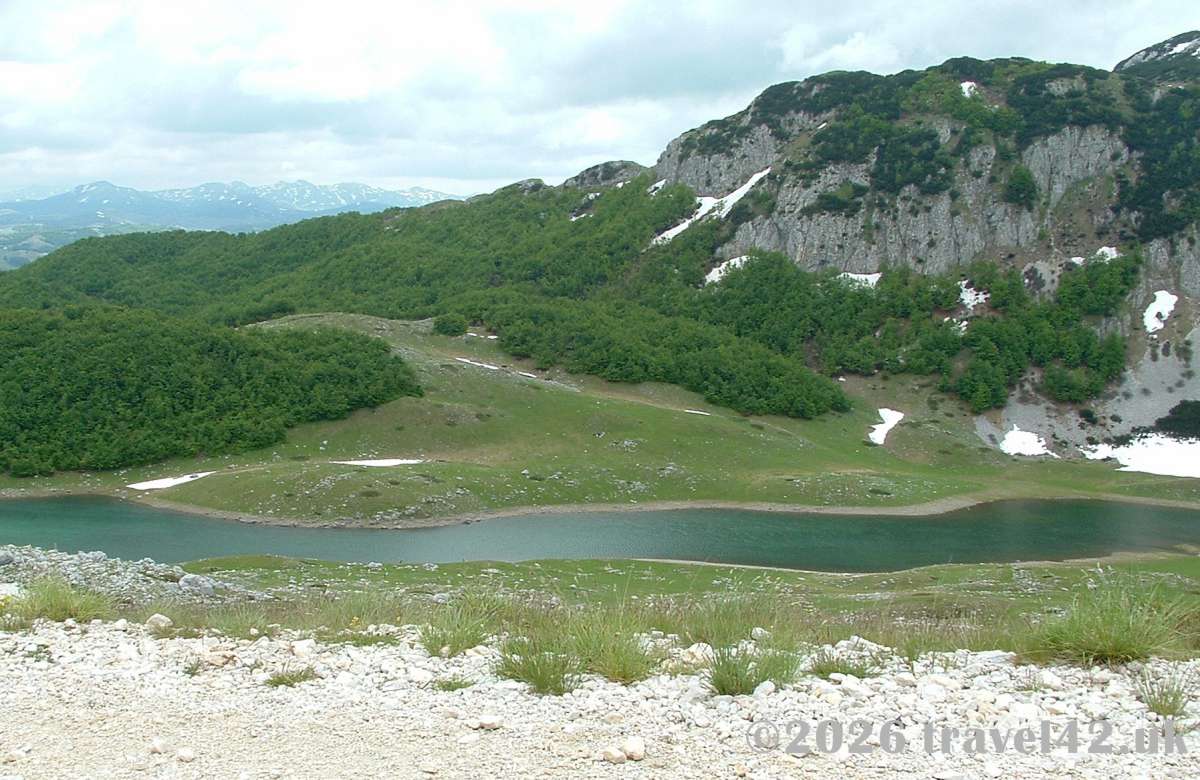

Montenegro means Black Mountain, and by the time we’d spent a day driving through it, the name felt entirely earned. At the start of June, we set off with friends to see Durmitor National Park and the Adriatic coast, neither of us having visited the country before. It’s a small place to carry so much scenery – under 14,000 square kilometres and fewer than a million people – but Durmitor alone filled an entire day of driving, wandering and one fairly serious wrong turn.
On this occasion, we were two couples, each driving our own car, with one clear aim: reach the coast and see as much as possible along the way.
Getting There: From Riga to the Black Mountain
We drove the whole way from Riga, Latvia, through Lithuania, Poland, Slovakia and Hungary, crossing into Montenegro from Serbia. It’s the kind of drive that turns a couple into a well-oiled team: one navigating, one driving, both silently agreeing not to mention how many hours are still left.
The first stop after the border was, unexpectedly, a petrol station – and it’s the sort of small detail that tells you something about a country before you’ve properly arrived. We hadn’t expected the forecourt and rest area to be quite so clean and well kept, with enough space around it to actually stretch our legs after the long haul through Serbia.
It was already late afternoon and we had no accommodation booked, so after a short break we pressed on, racing the sunset towards Žabljak.
A Lucky Find on the Road to Žabljak: Motel Ravnjak
Driving from Mojkovac towards Žabljak, we came across Motel Ravnjak, a small set-up of separate bungalows at the 18th kilometre of the Mojkovac–Žabljak road (tel. 084 472 144). Tired and without a booking, we counted ourselves fortunate – and the next morning’s breakfast turned out to be one of those meals that quietly redeems an entire long drive.
Even if you’re not staying the night, it’s worth pulling in for lunch or dinner if you’re passing.
Žabljak: The Highest Town in the Balkans
We reached Žabljak the next morning, and it’s worth a proper look before heading straight for the lake. Sitting at around 1,450 metres above sea level, it’s the highest town in the Balkans, ringed by 23 peaks over 2,200 metres.
It has the feel of a place built for a short, intense season – busy with skiers in winter, hikers in summer, and rather more restrained everything in between.
Crno Jezero: Durmitor’s Black Lake
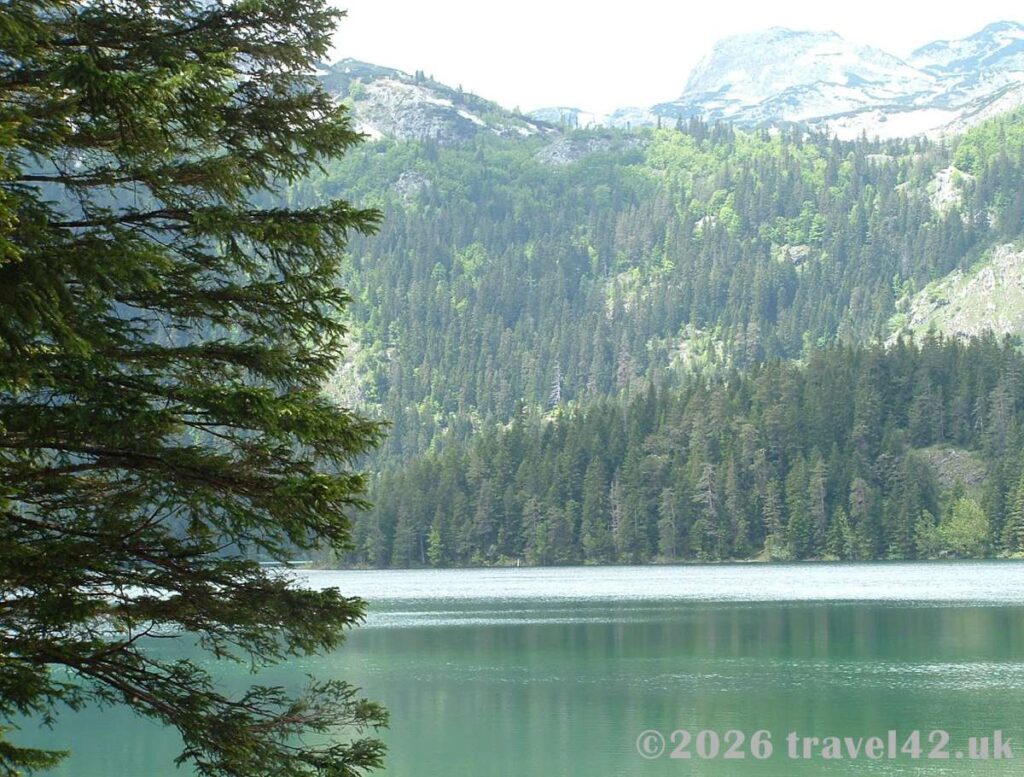
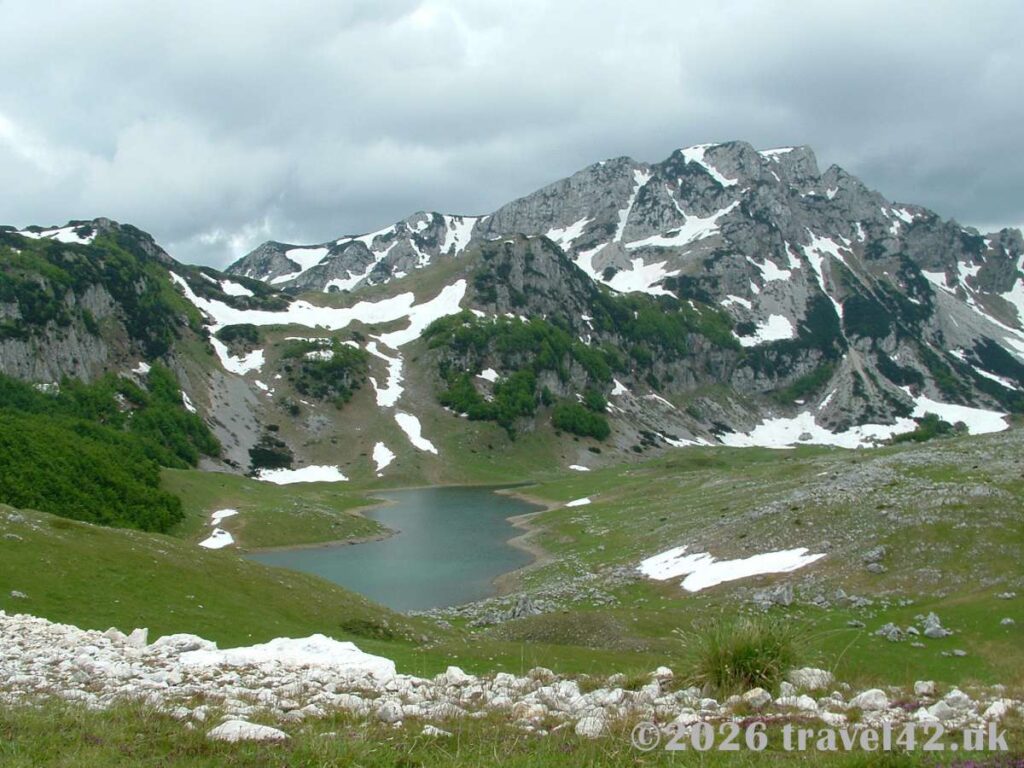
From Žabljak it’s a short hop – about three kilometres – to Crno Jezero, the Black Lake, and around 25 kilometres from the Tara Bridge. Durmitor National Park holds eighteen glacial lakes in total, and Crno Jezero is both the largest and the deepest of them, sitting at the foot of the Međed massif. It’s actually two connected lakes, Big Lake and Small Lake, formed as the glaciers that once covered this massif slowly withdrew.
A 3.5-kilometre path circles the whole lake, though we only managed part of it – there was too much else nearby worth lingering over. Car access stops about a kilometre short of the water, after which the path is asphalted and easy walking, past a lakeside restaurant and right up to the shore.
We spent well over three hours here, in no particular hurry, before pulling ourselves away to see the rest of the park.
What we can say with certainty is that no photograph we took quite matches standing at the water’s edge with the Međed massif rising straight out of it – the kind of view that makes you stop mid-sentence.
The Đurđevića Tara Bridge and Europe’s Deepest Canyon
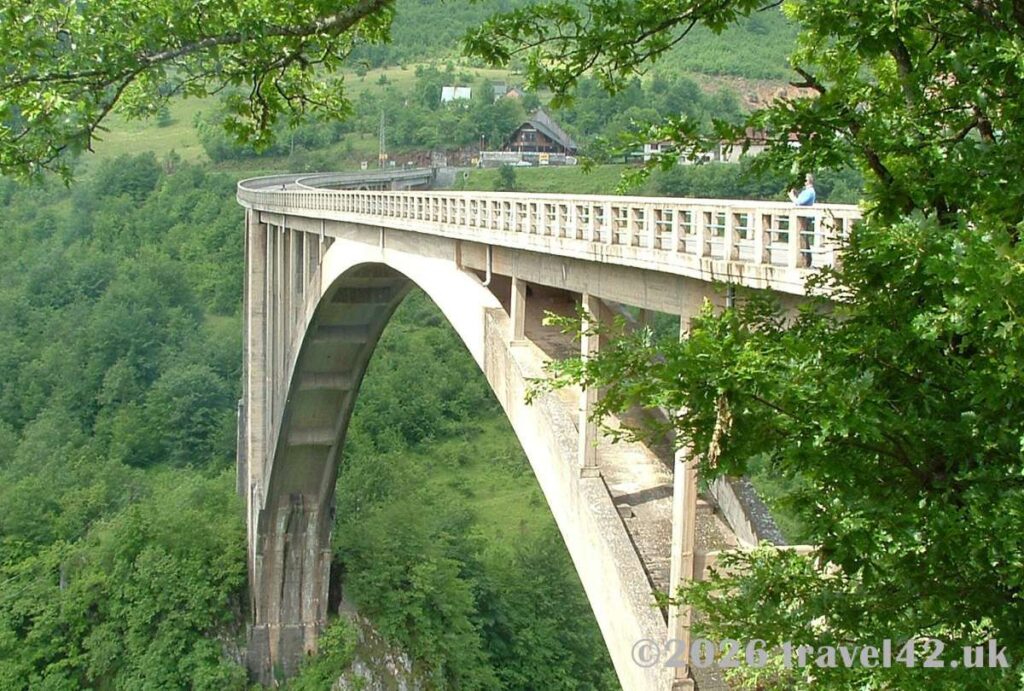
Our next stop was the Đurđevića Tara Bridge, the structure most closely associated with the Tara River – and the gateway, in a sense, to the canyon it crosses. The Tara River Canyon is the longest in Montenegro and in Europe, and by most measurements the second-longest in the world after the Grand Canyon in Arizona. Sources disagree slightly on the exact figure – some put it at 78 kilometres, others closer to 82 – but everyone agrees on the scale: at its deepest point, it drops around 1,300 metres, making it the deepest gorge in Europe.
The canyon falls within Durmitor National Park, which has held UNESCO World Heritage status since 1980. The bridge itself was built in the late 1930s and completed in 1940, then rebuilt in 1946 after wartime damage – a small, sobering footnote to what is otherwise a fairly cheerful sightseeing stop.
It stretches 365 metres across five arches, the largest spanning 116 metres, with the roadway standing 172 metres above the river below. Photographs rarely do it justice; standing on it, watching the Tara thread its way through the gorge far beneath, is a proper full-body kind of view.
We walked across the bridge twice, taking in the canyon and the blue water of the river far below each time.
Off-Road over Sedlo Pass – and Three Metres of June Snow
Rather than heading straight to the coast, we decided to add a little adventure and cross the mountains first. It turned out to be more adventure than planned.
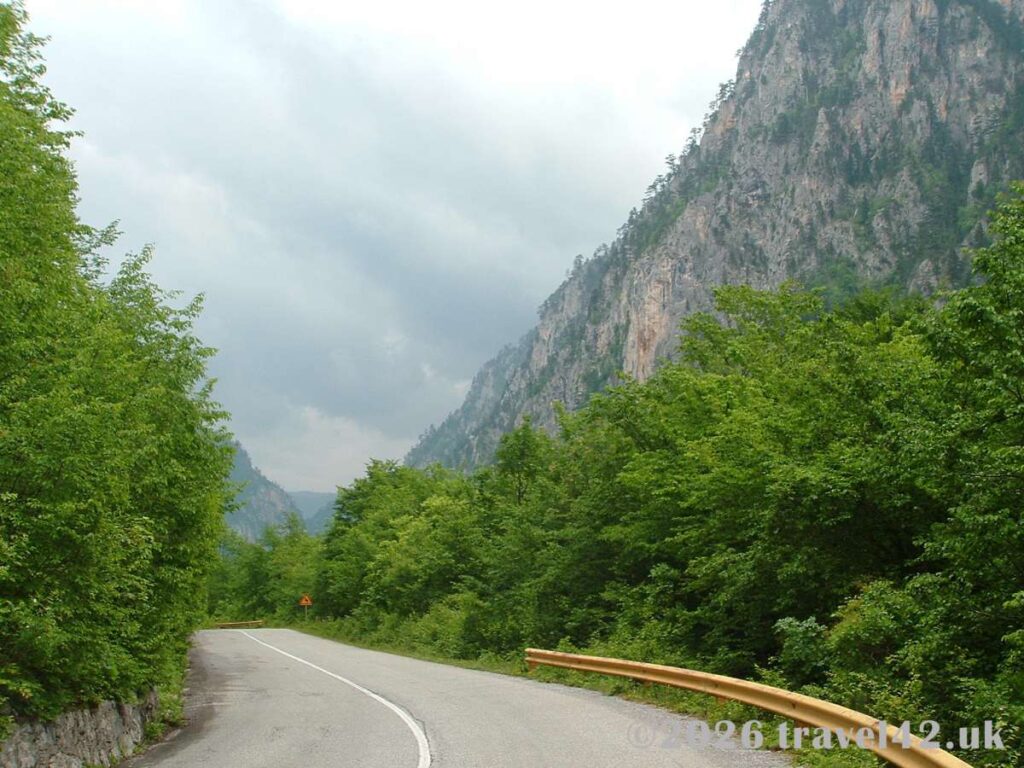
The road climbed through patches of asphalt and patches of last winter’s melting snow, and we made it as far as Sedlo Pass, at 1,907 metres, before the road simply stopped being passable. A few kilometres short of the crossroads, heavy machinery was still clearing snow that, remarkably, was still three to four metres deep – this on 12 June.
We got chatting with a local newspaper reporter who was covering the clearance work, which felt like a small, slightly surreal moment of village-newspaper fame we hadn’t been expecting. The road crew reckoned it would be at least another day before that stretch reopened, so we turned around and rerouted towards Podgorica instead.
On a few stretches, we felt a 4×4 would have coped better, though our Corollas got us through in the end.
Down to the Coast: Dobrota, near Kotor
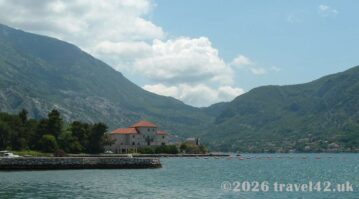
We reached the Adriatic coast late in the afternoon and carried on to Dobrota, a small town just outside Kotor, where we’d booked a guest house for the week.
After a day of glacial lakes, wartime bridges and unseasonal snow, the idea of sunny beaches, good food and considerably less off-roading felt like exactly the right next chapter.
More on Dobrota and the Adriatic coast in our Montenegro coast post.
Good to Know Before You Go
- Durmitor’s high mountain passes can hold snow well into June – check road conditions locally before planning a cross-park drive.
- Crno Jezero’s lakeside path is asphalted and manageable in normal walking shoes; allow half a day if you want to properly explore rather than rush it.
- Žabljak makes a sensible overnight base if you’d rather split Durmitor and the Tara Bridge across two unhurried days instead of one long one.
- Don’t assume the mountain roads will be open in early summer. Our experience on 12 June was a useful reminder that snow conditions at altitude can be very different from those on the coast.
Where This Fits in Our Balkans Trip
Durmitor was the mountain beginning to our Montenegro trip, before we descended towards the Adriatic and spent the following days around Kotor and the coast. It also makes a useful contrast with our later Bulgaria and North Macedonia road trips: Montenegro packs dramatic mountains, deep canyons and the coast into a remarkably compact area.
Final Thoughts
Durmitor was one of those places where the unexpected parts became as memorable as the things we’d actually set out to see. The Black Lake and Tara Canyon were the obvious highlights, but it was the failed attempt to cross Sedlo Pass – complete with metres of snow in June and an unexpected conversation with a local reporter – that gave the day its character. Travelling as two couples also made the long drive and the inevitable wrong turns more enjoyable; there was always another car ahead or behind, someone to share the view with and, eventually, a good story to tell over dinner by the Adriatic.
Part of our Balkans travel cluster – see also our guides to Montenegro’s Adriatic coast and Montenegro seafood.
Travel42 UK is a couples travel journal dedicated to immersive road trips, slow travel, and destination storytelling.
Explore More of Balkans:

The long way round, as a couple
About the Author
The author, ainarsbl, is a Level 7 Google Local Guide, Master Reviewer and expert travel reviewer focused on scenic landscapes, UNESCO sites and meaningful couples travel experiences.