A couples’ road trip through southern Morocco – Agadir, Paradise Valley, Taroudant, Agadir Inoumar, Tafraout, and the Painted Rocks.
Part of our Morocco series – see also: Moroccan Cooking Class Near Marrakech: A Day at Faim d’Épices, Safari to the Sahara: Our 3-Day Desert Tour from Marrakech, and our Marrakech Travel Guide for Couples
Morocco is one of those countries that gets under your skin. There are the obvious draws – the souks, the tagines, the medinas – but venture south of Agadir and you’ll find a Morocco that most visitors never discover: a land of pink granite mountains, fortified Berber granaries, painted rocks, and small market towns that feel entirely untouched by mass tourism. This itinerary traces the route we took through the Souss Valley and the Anti-Atlas Mountains, covering Agadir, Paradise Valley, Taroudant, Agadir Inoumar, Tafraout, and the famous Painted Rocks.
The choice of route was, in truth, beautifully simple: EasyJet flies from the UK to Agadir at prices that are hard to argue with, and from there the south of Morocco opens up like a secret. Based on that – and our shared love of road trips in a locally hired car – we built an itinerary that turned out to be one of the best we’ve ever put together. It did require a fair amount of research, and what follows is the distilled version of everything we discovered.
Bear in mind that this is an intense itinerary – we tend to travel that way when time is short. If you’d prefer a slower pace, simply add an extra day after any of the hikes or longer driving legs.
The Route at a Glance
- Day 1 – Arrival in Agadir
- Day 2 – Exploring Agadir
- Day 3 – Car hire and drive to Paradise Valley
- Day 4 – Hiking in Paradise Valley
- Day 5 – Journey to Taroudant; evening to settle in
- Day 6 – Day trip to Agadir Inoumar
- Day 7 – Scenic mountain drive
- Day 8 – Leaving Taroudant and arrival in Tafraout
- Day 9 – The Painted Rocks
- Day 10 – Full-day mountain hike near Tafraout
- Day 11 – Rest day in Tafraout; local market
- Day 12 – Drive back to Agadir; afternoon in the city and return home
Day 1: Arriving in Agadir
We touched down at Agadir Al-Massira International Airport just before midnight. The airport sits roughly 15 miles (20 km) from the city centre, so we had pre-booked a private taxi transfer – something we’d strongly recommend, as negotiating a cab at that hour with luggage and an unfamiliar city ahead adds unnecessary stress to the start of any trip.
One practical note: although we had international SIM cards, we couldn’t make calls on the local network on arrival. If you need to contact your transfer company after landing, don’t be shy about asking a local to make the call for you – Moroccans are, in our experience, genuinely willing to help.-
Practical tip: As soon as you can, pick up a Moroccan SIM card with a data allowance (you’ll need to show your passport). WhatsApp is the universal means of communication in Morocco – taxi firms, guesthouses, tour guides, everyone uses it for both messages and voice calls. It will make your entire trip considerably smoother.
Day 2: Getting to Know Agadir
About Agadir
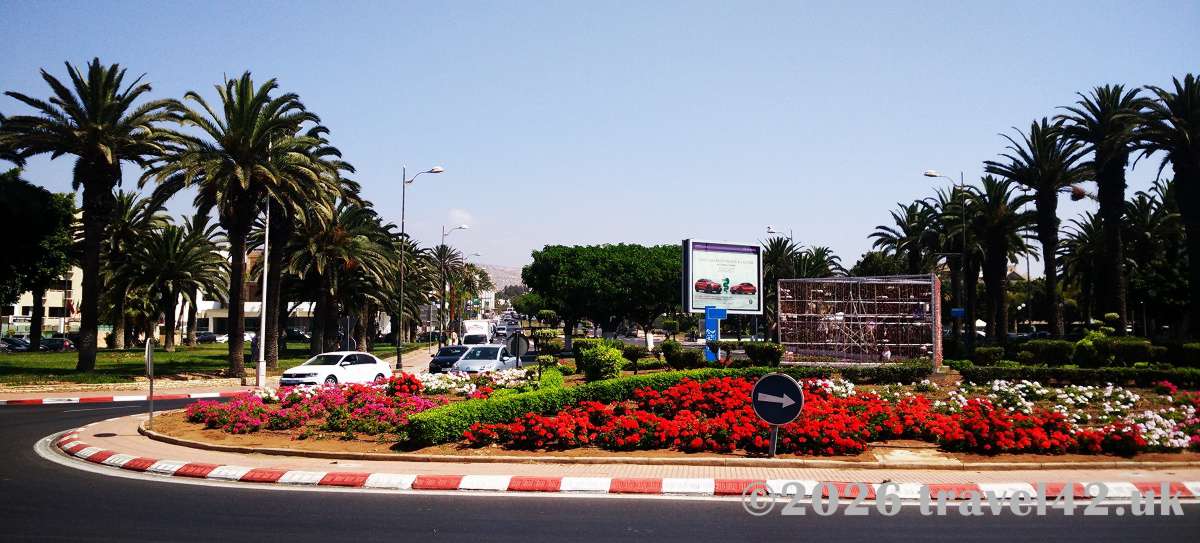
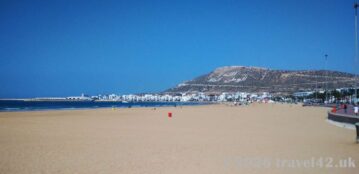
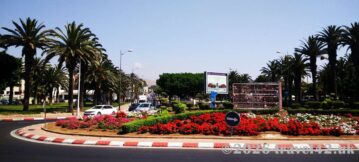
Agadir is unlike any other Moroccan city. There’s no ancient medina, no crumbling kasbah, no narrow warren of medieval alleyways. The reason is striking: on 29 February 1960, a devastating earthquake killed between 12,000 and 15,000 people – roughly a third of the city’s population at the time – and left at least 35,000 homeless. Agadir had to be rebuilt almost entirely from scratch, and the result is a modern, spacious city of wide boulevards, a long beach promenade, and a distinctly European atmosphere.
It’s sometimes compared to the Miami of Morocco and, whilst that might be a slight exaggeration, the comparison makes sense when you’re sitting on its immaculate beach watching the Atlantic rollers come in.
Sightseeing in Agadir
We wandered along the beach and harbour promenade, explored the souk, and visited Agadir Birds Valley – a free attraction just a short walk from the centre, with pleasant paths winding through gardens populated by a surprisingly diverse range of bird species. It’s an easy hour’s stroll and a lovely way to get your bearings.
The beach promenade is somewhere we still think about long after the trip. The beach itself is broad and generous, and the cafés lining its length mean you can stop for a drink or a bite to eat whenever the mood takes you – a perfect setting for an unhurried morning together.
Visiting Hammam in Agadir
The highlight of the day, though, was a visit to Argan Phyto House, a private hammam we’d booked before leaving home. We opted for the Neroli ritual followed by two-hour relaxation massages – the whole experience for two came to around 1,200 DHS (approximately £95–100 at the time of our visit). Afterwards, we sat on the balcony with mint tea in a state of complete contentment. If you do nothing else in Agadir, book a hammam – it’s one of those experiences that makes you feel you’ve properly arrived somewhere.
Our acommodation in Agadir
We stayed at Odyssee Park Hotel, a four-star property conveniently located near the beach promenade and the main shopping area. Rooms are spacious with individual terraces, and the staff are genuinely welcoming. There’s live music around the pool in the evenings from a very talented musician. It makes an excellent base for the first couple of nights.
One more thing worth doing before leaving Agadir: stock up. The city has large supermarkets with an impressive range of drinks – water, juices, and everything stronger – and once you head south into the mountains and valleys, you won’t find anything remotely comparable. Carrying plenty of water throughout this trip is not optional; it’s essential.
Days 3-4: Paradise Valley
Car hire in Agadir
On the morning of Day 3, we collected our hire car. Finding a reliable rental agency in Morocco takes some research – we settled on Samicar, a local provider who exceeded expectations at every turn: communicative, helpful, and straightforward to deal with.
Having your own vehicle is genuinely transformative in southern Morocco. Public transport exists, but it’s limited if you want to reach the more remote and rewarding places and, as a rule, the best scenery lies well beyond any bus route.
Arrival in Paradise Valley
We drove in the direction of Tizgui, staying at Hotel Restaurant Tifrit (coordinates: 30.599090, -9.497355) – a small, good-value hotel in the mountains near Paradise Valley with lovely views of the surrounding hills. Before leaving Agadir, we’d stocked up with food and water for the days ahead, knowing there would be no worthwhile shops in this area.
Hiking in Paradise Valley
Day 4 was dedicated to hiking. We drove about 5 km from the hotel to our starting point, which has a large informal car park by the roadside (coordinates: 30.596774, -9.522854). There’s a general information board, though the distances and timings shown are approximate – treat them as guidance only.
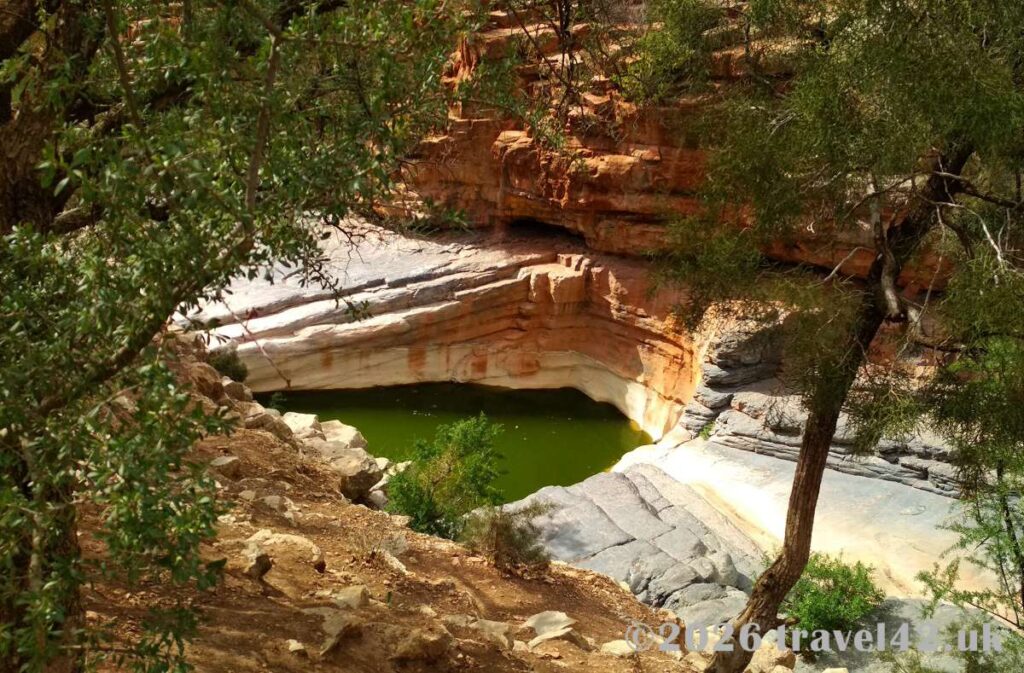
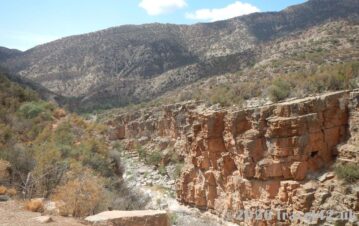
A word on navigation: after crossing the first small hill from the car park, we nearly went the wrong way. Once you descend to the small rural road (approximately 30.594959, -9.523113), turn left and follow it until you reach a sign pointing right towards Paradise Valley (approximately 30.593968, -9.520802). From there you’ll mostly descend to the river valley (30.588606, -9.526019) and then follow the river east for about a mile (1.4 km) to reach the main attraction – a beautiful canyon where you can rest, take photographs, and enjoy a picnic if you’ve brought food along.
The scenery left us speechless, particularly in the canyon itself: sheer cliffs rising on both sides, the silence broken only by birdsong. There were quite a few dogs ambling about, clearly used to hikers, and various birds overhead, but no other wildlife to speak of.
The total round trip was about 7 kilometres (4.5 miles), though the path is anything but straight. Water is essential: we carried 1.5 litres each and found it barely enough. Take more than you think you’ll need, particularly in spring and early summer when the river itself may hold little or no water.
Read more in our dedicated Paradise Valley hiking post.
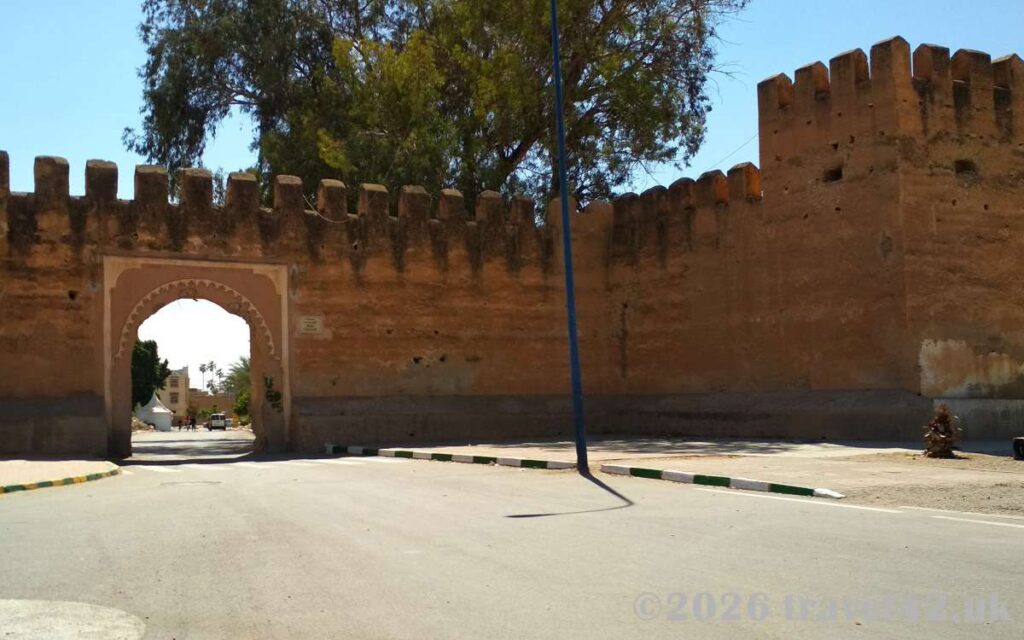
Day 5: Driving to Taroudant
After breakfast at Hotel Tifrit, we headed south towards Taroudant – a journey of roughly two to two and a half hours in good conditions.
One word of warning: don’t blindly follow Google Maps. The app routed us down an increasingly rough road that eventually ended at a collapsed bridge. After a short exchange with a local – conducted largely through mime and goodwill – we understood we’d have to turn back and approach via Agadir instead. It added time, but it also gave us an extra hour of scenery and a story to tell.
About Taroudant
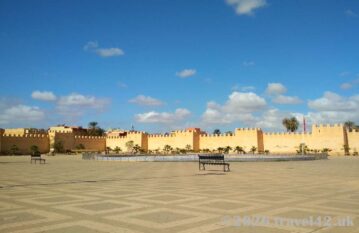
Taroudant appears from a distance as a vision of ochre-coloured walls rising from the Souss Valley plain, with the peaks of the High Atlas visible beyond. The town saw its golden age under the Saadian dynasty – particularly during the reign of Mohammed ash-Sheikh, who built the city walls and the great mosque in 1528.
For a period, Taroudant served as the Saadian capital, used as a base for attacks on the Portuguese in Agadir. Today it’s often called “Little Marrakech” for its honey-coloured sandstone ramparts and bustling souks, though we think that comparison undersells it – Taroudant feels far more authentically Moroccan than Marrakech’s tourist-heavy medina.
The city walls stretch for nearly 6 kilometres, set with bastions and punctuated by nine gates that remain intact to this day. No fewer than 130 towers and 19 corner bastions are woven into the ramparts. Walking – or even better, hiring a horse-drawn calèche – along the outside of the walls as the sun drops and the stone turns gold is one of the most quietly romantic moments of this entire journey.
Our accommodation in Taroudant
We’d booked Les Trois Paons, a guesthouse a few miles from the city centre, with a large pool, beautiful gardens, a spacious bedroom and bathroom, and a covered outdoor terrace. Full board was prepared by a local Moroccan chef – a wonderful mix of traditional tagines, harira soup, and the occasional French touch from our host, who was French.
If you’re spending time near Taroudant, a private guesthouse of this kind is far preferable to a standard hotel: the intimacy and quality of the cooking more than justify any additional cost.
Day 5 ended with a long welcome dinner and a good bottle of French wine. We were exactly where we wanted to be.
Read more in our Taroudant travel post.
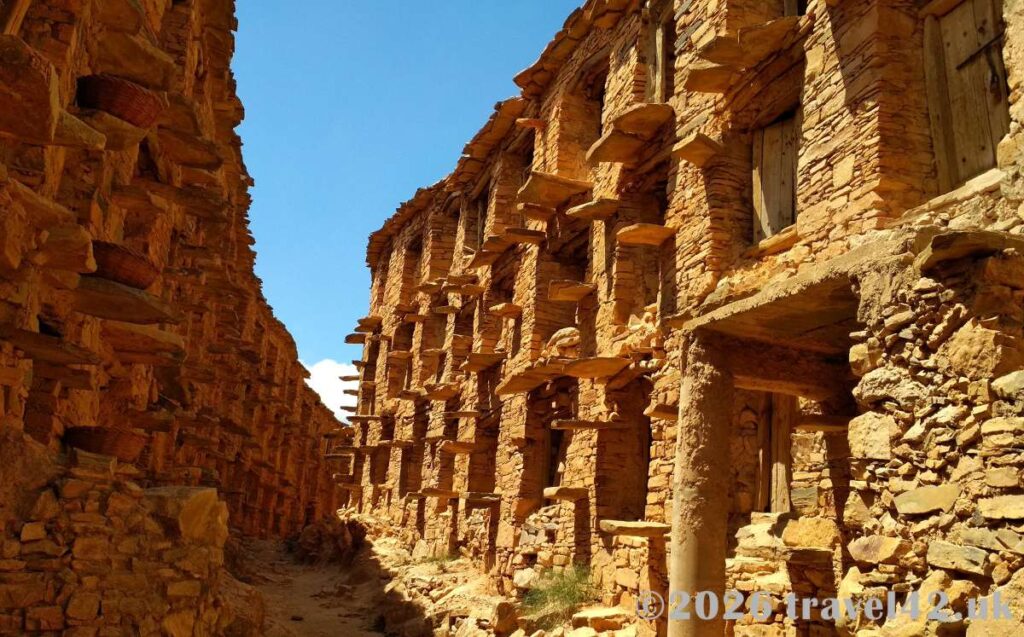
Day 6: Agadir Inoumar
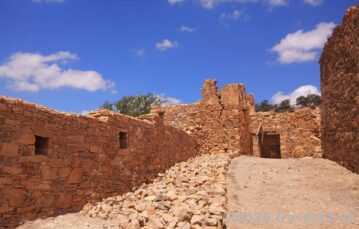
In the early morning, we drove out to Agadir Inoumar – and it’s worth explaining what that means, because there are many places in Morocco called “agadir”. In the Berber (Amazigh) language, agadir means fortified building or enclosure; historically, these served as communal granaries where entire villages stored grain and valuables, often built in high, defensible positions.
Most have long since fallen into ruin, but Agadir Inoumar has been partially renovated and is genuinely worth seeking out.
The site is located near Afaïane (precise coordinates: 30.163274, -9.108826). If arriving from Taroudant, be aware that you’ll cross a dry riverbed near the Ciments du Maroc plant (coordinates: 30.196085, -9.176542) – normally passable, but potentially impassable after heavy rain as the bridge there collapsed some years ago (it may since have been repaired, but it’s worth checking).
Arriving from Agadir via Biougra and Imi Mqourn (the R105) avoids the river crossing entirely. Google Maps is of limited help on the final stretch; the road is good but may not be fully mapped.
Park near the site (informal parking at 30.166697, -9.107983) and walk about 600 metres downhill towards the south-west. A guide on site – who speaks French and Berber, with limited English – will show you around the renovated interior, explaining the storage system, the social organisation of the community that depended on it, and the history of the building.
We came away with a far deeper appreciation of Berber culture than we’d expected. A contribution of around 50 MAD per person is welcomed; the Agadir Inoumar website has further information in English.
Read more in our Agadir Inoumar post.
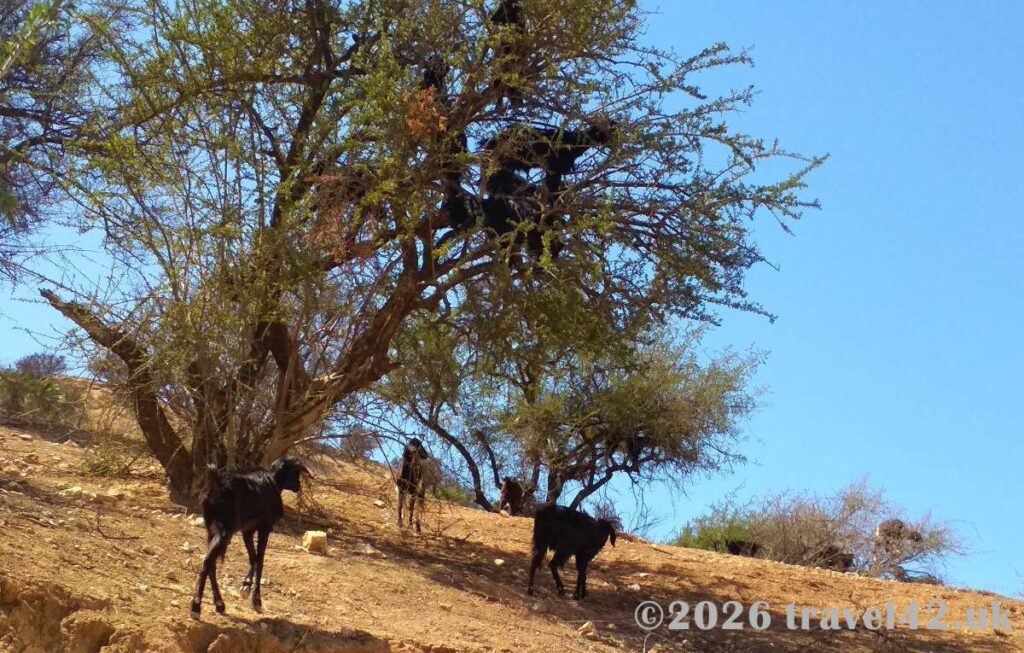
Day 7: A Mountain Drive
The second morning in Taroudant was for a more leisurely outing: a scenic mountain drive into the foothills in the opposite direction, stopping at viewpoints to photograph the extraordinary landscape.
This wasn’t a hike – it was sightseeing from the car with the windows down and the music on – but the views were genuinely stunning: deep valleys, argan trees dotting the hillsides, and Berber villages perched improbably on ridges.
One of the more surreal sights was a hillside covered in goats, several of them balanced high up in the branches of argan trees – something Morocco is famous for, and something that never quite makes sense however many times you see it. How a heavy animal can balance on spiny branches whilst calmly eating argan nuts remains, to us, one of life’s great mysteries.
The best viewpoint of the day was near Afenssou during the first part of the loop. The full route is around 100 kilometres and makes a satisfying round trip, but allow five to six hours given the winding mountain roads and the inevitable stops.
Here is the full route on Google Maps.
Day 8: The Road to Tafraout
In the morning, we packed up, said farewell to Les Trois Paons, and set off for Tafraout. We chose the dramatic mountain route rather than the longer road around – narrow, winding, and slow, but the payoff in scenery was enormous.
Passing through the Anti-Atlas foothills, with their extraordinary formations of pink and orange granite, felt like driving through another planet. Allow at least three hours for this journey, even if the map suggests less.
Tafraout announces itself suddenly: a small town cradled in a valley of rose-coloured rock, the jagged ridgeline of the Anti-Atlas rising on all sides. It belongs to the Tiznit Province of the Souss-Massa region, has a population of around 5,000, and is as close to off-the-beaten-track as you can get in Morocco without a 4×4 and a guide.
We based ourselves at Maison de Vacances Tafraout, a private guesthouse on the main street, close to the souk and all amenities. It has a kitchen (essential for a longer stay), a comfortable sitting room, reliable WiFi, and the kind of location that makes stepping out for an early-morning walk into the mountains effortlessly easy.
We settled in, found a table at a local restaurant, ordered tagines, and let the mountains close around us.
Day 9: The Painted Rocks
One of the most striking attractions in the whole of southern Morocco lies just a short distance from Tafraout: the Painted Rocks (Les Rochers Peints), a series of large boulders and cliff faces in a wide mountain valley daubed in vivid blues, pinks, reds, and purples.
They were first painted in 1984 by Belgian artist Jean Vérame, who has undertaken similar projects in France, Egypt, and Chad. Erosion and grazing animals take their toll on the paintwork over time, but when freshly retouched, the effect is genuinely surreal – a bold pop-art intervention in an ancient landscape.
How to Reach the Painted Rocks
By car: Head south on the R104 towards the Tafraout Valley. After 1.5 miles (2.5 km), once you’ve passed Aday Mosque on your right, turn left. Follow the main road for approximately 3 miles (5 km) and you’ll see the rocks on your left. There’s ample parking, and you can wander freely.
By bike: Tafraout has several bike hire options in town. Cycle south through Aguerd Oudad, then follow the valley road to the painted rock formations. Cycling is arguably the best way to cover the area, as the rocks are spread across several separate formations.
On foot: We visited the Painted Rocks twice on foot, and hiking was our favourite approach. The route via Aguerd Oudad is the easier option going out, and we preferred returning via the more demanding path through the southern mountain range – a sustained uphill push, but the views are more than enough compensation.
The first sight of the rocks was genuinely breathtaking – we’d expected something modest and found ourselves astonished by the intensity of the colours. You spot one painted formation, then another, and then realise the valley is full of them.
We ended up visiting more than one cluster and were glad we had the whole morning free. Early morning or late afternoon is preferable: the light is better and the heat more manageable, so bring plenty of water.
Read more in our Painted Rocks post.
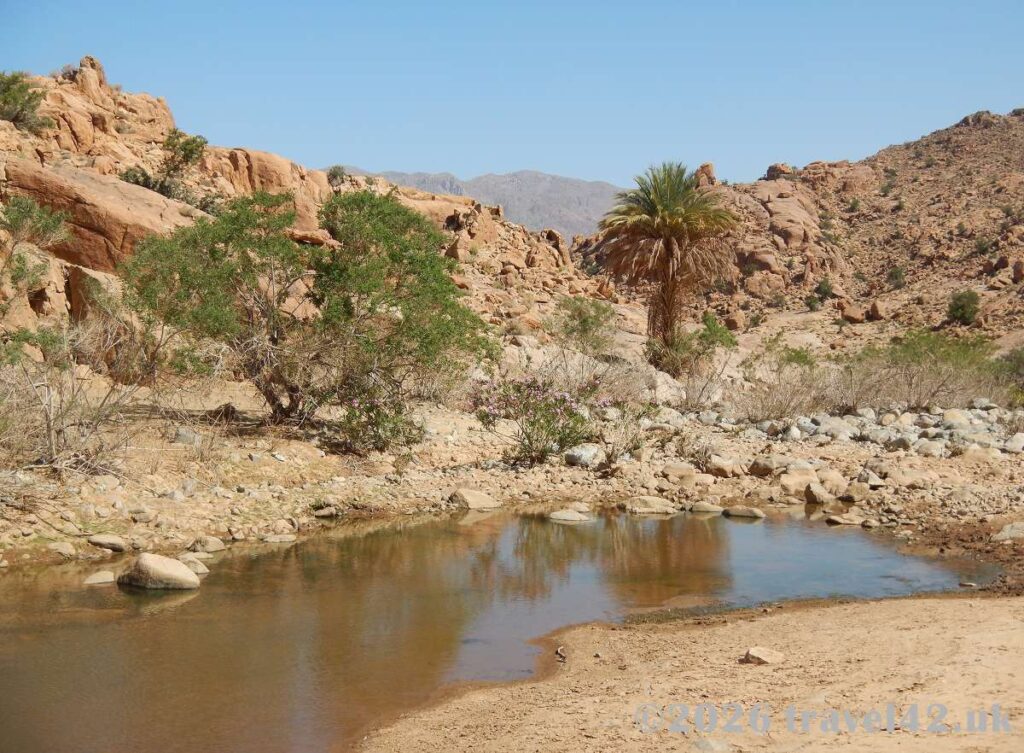
Day 10: A Full-Day Hike in the Mountains
Without question, this was one of the most memorable days of the entire trip.
We set off on foot from Maison de Vacances into the hills to the north-east, then turned south once we reached the mountain range. The route took us through a series of valleys across dramatic rocky terrain, the highlight being the approach – at the very end of the loop, just after reaching the main road – to Napoleon’s Hut rock formation, a natural granite structure that, viewed from the right angle, genuinely resembles a small stone building perched on the hillside.
From there, we followed the main road back to the guesthouse.
Together with nature
One of the most quietly magical discoveries of the day came along the dry riverbeds. In an area where rivers can disappear entirely in the heat, we were surprised to find small, still pools of water at intervals along the valley floor – places where, for reasons of geology or shade, the water simply remains.
Frogs called from the banks, fireflies drifted above the surface in the early evening light, and we sat for a long while watching a world that had nothing whatsoever to do with tourism. It was honestly one of the most peaceful moments of the entire trip.
The distance was approximately 8 kilometres, but allow four to five hours: the terrain is rocky and uneven, and the heat demands frequent stops. We made a proper picnic of our lunch break.
Navigation in Anti-Atlas mountains
There are no marked trails and no signage on most of this route – you navigate by common sense and GPS location – but finding your way back to the main road from the mountain range is straightforward if you keep your bearings.
The Anti-Atlas offers a unique combination of dramatic rock formations, hidden oases, and traditional Berber villages. What makes walking here feel so different from, say, the High Atlas is the near-total absence of other tourists.
You pass shepherds with their flocks, women in bright jellabas collecting firewood, the occasional mule and cart. The trails follow ancient Berber routes, and there’s a genuine sense of travelling through living history rather than a visitor attraction.
Day 11: A Rest Day in Tafraout
After the previous day’s exertions, Day 11 was for slow mornings and easy wandering.
Tafraout’s weekly market draws traders and buyers from across the surrounding mountains – it’s a proper working souk, not a tourist market, and the contrast with the curated craft shops of Marrakech or Fez is refreshing. Prices are considerably lower, the atmosphere is unhurried, and the range of goods – fresh produce, spices, livestock, household items, Berber jewellery, and leather goods – is endlessly fascinating to browse.
Tafraout is known for its distinctive embroidered slippers (babouches) and Berber silver jewellery, and because you’re buying directly from the region of production, quality tends to be higher and prices more honest than in the larger cities.
In the afternoon, we settled on the roof terrace of the guesthouse with mint tea and watched the mountains change colour in the fading light. Sometimes the best thing you can do in a beautiful place is absolutely nothing at all.
Day 12: The Drive Back to Agadir
The drive from Tafraout to Agadir takes around three hours on the main road – a very different experience from the mountain route we’d taken on the way in, but satisfying in its own way as the Anti-Atlas gradually gives way to the Souss plain and the Atlantic eventually glitters into view in the distance.
We arrived in Agadir with an afternoon to spare before the hire car had to go back and spent it on the promenade: coffee, the sea, and the last of the Moroccan sun.
There’s a particular kind of bittersweetness to the final hours of a road trip that has gone well, and this was no exception. Then came Agadir Al-Massira Airport, the flight home, a very full camera roll, and a strong desire to come back.
Essential Tips for This Itinerary
Getting around
A hire car is non-negotiable for this route. We used Samicar and found them excellent throughout. Communicate via WhatsApp, clarify the excess insurance terms before signing anything, and read reviews carefully before booking any car hire in Morocco.
Navigation
Google Maps can be unreliable in rural southern Morocco, occasionally routing you down tracks that a standard car simply cannot handle. Always cross-check with an offline map and ask locally if anything looks doubtful.
Money
Carry Moroccan dirhams in cash. Rural areas have limited ATM access, and many guesthouses, local restaurants, and market traders don’t accept cards. Even when you do find an ATM, there’s no guarantee it will accept foreign cards – many are configured primarily for locally issued accounts.
Language
French is far more useful than English in this region. Even a few phrases go a long way and are genuinely appreciated. Those selling to tourists will often speak reasonable English, but away from the market stalls, French – and mostly Berber – is the working language of southern Morocco.
Water
Take more water than you think you’ll need on any hike. In spring, rivers in the Paradise Valley area may carry little or no water.
When to go
Although we visited the area in May, October to April is generally considered the ideal time to visit this region. Summer temperatures in the Anti-Atlas can be intense and, whilst winters are usually mild in the valleys, it can become surprisingly cold at higher altitudes.
One of the most beautiful times to visit is February, when the almond blossom transforms the valleys around Tafraout into something that looks almost too pretty to be real – a wash of white and pink against the rose-coloured rock.
All coordinates are given in decimal degrees (DD) format, compatible with Google Maps. Distance conversions are approximate.
FAQ: Morocco Road Trip in the Anti-Atlas
Yes – we found southern Morocco very safe for independent travel. Roads are generally in good condition, locals are welcoming, and traffic outside the cities is light. The main challenge is navigation in rural areas, so offline maps and careful route planning are essential.
No, we completed the entire route in a standard hire car. However, some roads in the mountains can be narrow and winding, so confident driving is helpful. Avoid driving after dark where possible.
We’d recommend at least 10-12 days to properly enjoy Agadir, Paradise Valley, Taroudant, Tafraout, and the Anti-Atlas Mountains without rushing every stop.
The best time is between October and April, when temperatures are comfortable for hiking and sightseeing. February is especially beautiful thanks to the almond blossom season around Tafraout.
Absolutely. Even when water levels are low, the canyon scenery alone makes Paradise Valley worth the trip. It’s one of the most beautiful hiking areas near Agadir and an excellent contrast to the coastal cities.
Travel for Two is a couples travel journal dedicated to immersive road trips, slow travel, and destination storytelling.
Explore More of Morocco:
–



The long way round, as a couple
About the Author
The author, ainarsbl, is a Level 7 Google Local Guide, Master Reviewer and expert travel reviewer focused on scenic landscapes, UNESCO sites and meaningful couples travel experiences.