Part of our 12-Day Morocco Road Trip from Agadir to Tafraout & the Anti-Atlas series
Agadir was never meant to be more than a brief stopover – a city to sleep in, pick up a hire car, and leave. We had bigger plans ahead: mountain roads, painted rocks, ancient kasbahs. But even in our short time there, this Atlantic city made an impression. Modern, colourful, unhurried, and a world apart from the Morocco of postcards, Agadir is a destination very much worth understanding before you arrive.
Getting to Agadir: The Airport Transfer
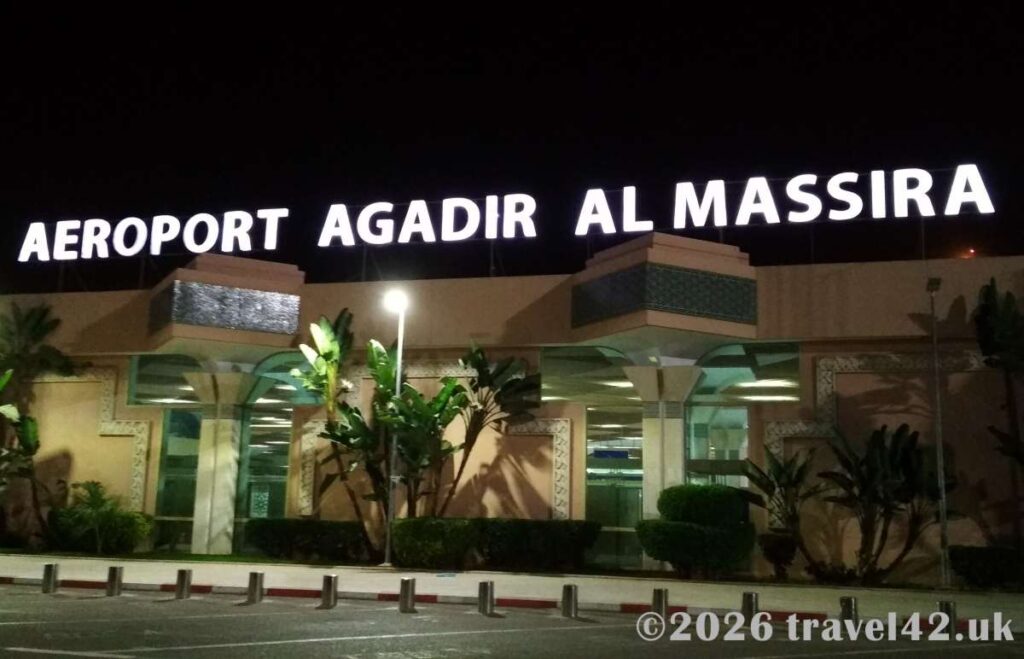
We landed at Agadir Al-Massira International Airport late in the evening, shortly before midnight. The airport sits roughly 25 kilometres south-east of the city centre – about a 35-minute drive in normal traffic – so organising your transfer in advance is genuinely worth doing, particularly for late arrivals.
We had pre-booked a private taxi service from home, which turned out to be exactly the right decision. Our flight was slightly delayed, so we needed to contact the company to let them know – and this is where we encountered our first small snag: despite having international SIM cards, we couldn’t make calls on the local network. We ended up asking a friendly local at the airport to ring the company on our behalf, and they were happy to help without a second’s hesitation. A small reminder, if one were needed, that Moroccan warmth towards visitors is entirely genuine.
We waited about an hour in total before the taxi arrived, reaching our hotel in the city centre just after midnight.
Your Main Transfer Options from Agadir Airport
- Private transfer (pre-booked): The most convenient option, especially for late arrivals or if you’re travelling with luggage. Expect to pay in the region of 250-400 MAD (approximately £20–35) for a pre-arranged private transfer to central Agadir.
- Grand taxi: Available outside arrivals. Negotiate the fare before getting in – a private grand taxi to the city centre typically costs 300-500 MAD. Note that ride-hailing apps such as Uber and Bolt do not currently operate in Agadir.
- ALSA airport shuttle bus: The most budget-friendly option at around 50 MAD (roughly £4–5) for a one-way ticket. The journey takes approximately 50 minutes, and the bus stops near the Vallée des Oiseaux, conveniently close to the tourist area. Not ideal for late-night arrivals.
Tip for couples: For a first night in an unfamiliar city, the comfort and simplicity of a pre-booked private transfer is hard to argue with. Arriving close to midnight is not the moment for negotiating fares on the kerb.
Where We Stayed: Odyssee Park Hotel
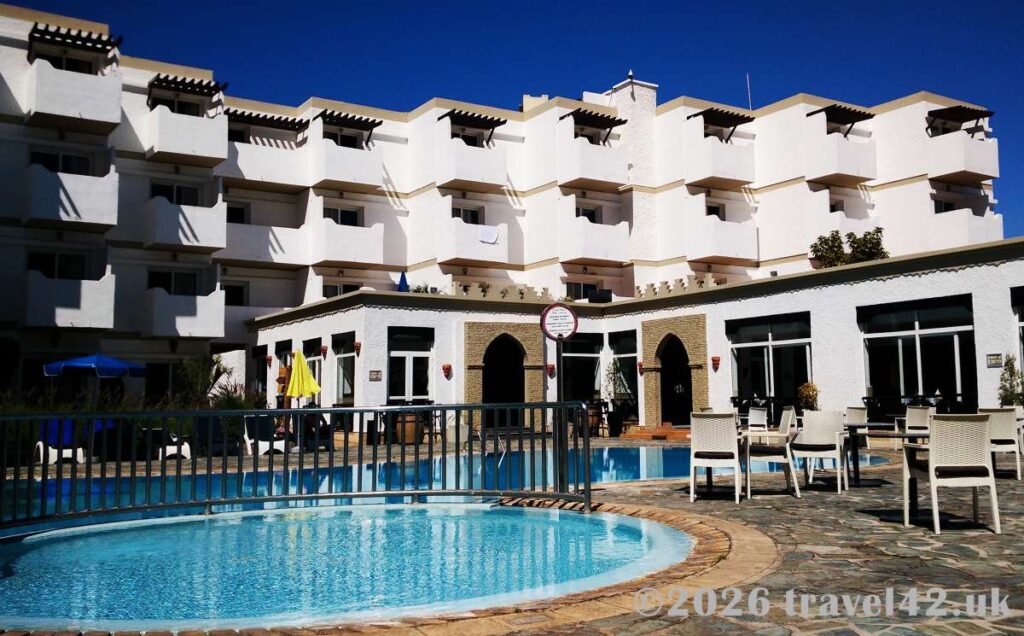
For our nights in Agadir, we chose the four-star Odyssee Park Hotel. Its location is genuinely excellent – within easy walking distance of both the beach promenade and the main shopping streets, making it a practical base for exploring the city on foot.
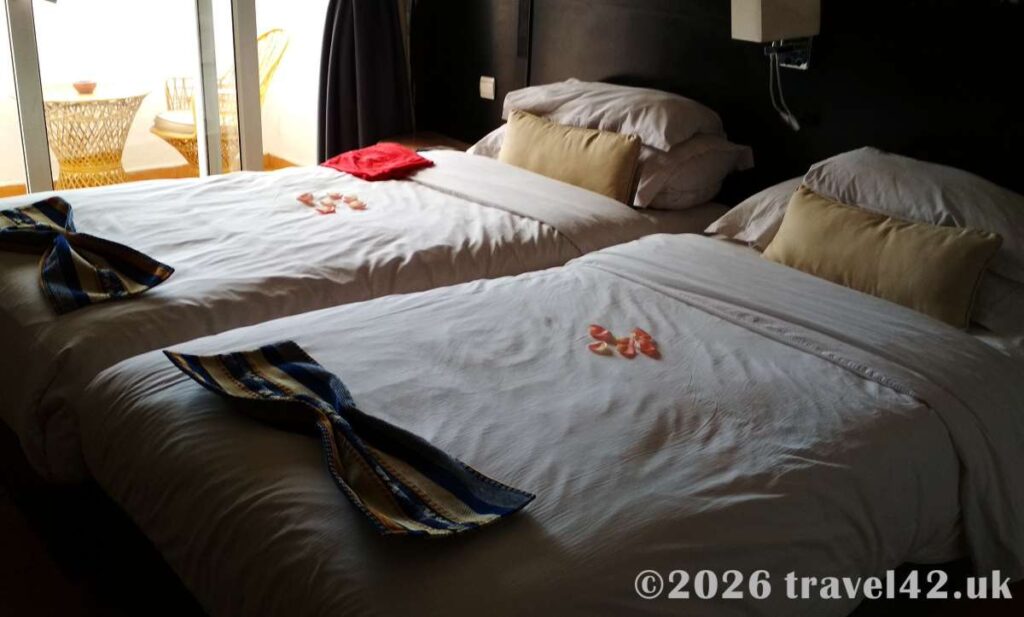
The rooms are spacious, each with its own terrace, and whilst the hotel may not meet every expectation of four-star luxury in every detail, the staff are warm, attentive, and clearly take genuine pride in their work – which, frankly, counts for a great deal. Our room was comfortable, if a little dim; though given the warm air outside, the shade was quietly welcome.
There is live music around the pool in the afternoons and evenings, which adds a lovely, unhurried atmosphere after a day of exploring.
If you’re looking for alternatives, Agadir has a wide range of accommodation options to suit different budgets, from boutique guesthouses to large beach resorts strung along the promenade.
Practical tip: You will need your passport to purchase and register a local SIM card in Morocco. We sorted ours first thing the following morning – though finding a shop that sold SIMs took a little wandering around. Keep your eyes open and you’ll spot one soon enough. More on why this matters below.
Agadir: A City Reborn
Unlike almost every other Moroccan city, Agadir has no ancient medina, no labyrinthine old quarter, and no centuries-old souks tucked inside crumbling walls. This is not an oversight – it’s history.
On the night of 29 February 1960, a devastating earthquake measuring magnitude 5.8 struck near the city. Despite its moderate magnitude, its shallow depth caused extreme surface shaking, killing between 12,000 and 15,000 people – roughly a third of Agadir’s population at the time – and leaving at least 35,000 homeless. It remains the deadliest earthquake in Moroccan history.
What followed was a remarkable act of collective rebuilding. King Mohammed V’s emotional address to the nation transformed the reconstruction of Agadir into a project of national and international solidarity. Architects from across Morocco and beyond were brought together to design the new city simultaneously – and in remarkably little time, a new Agadir rose from the ruins.
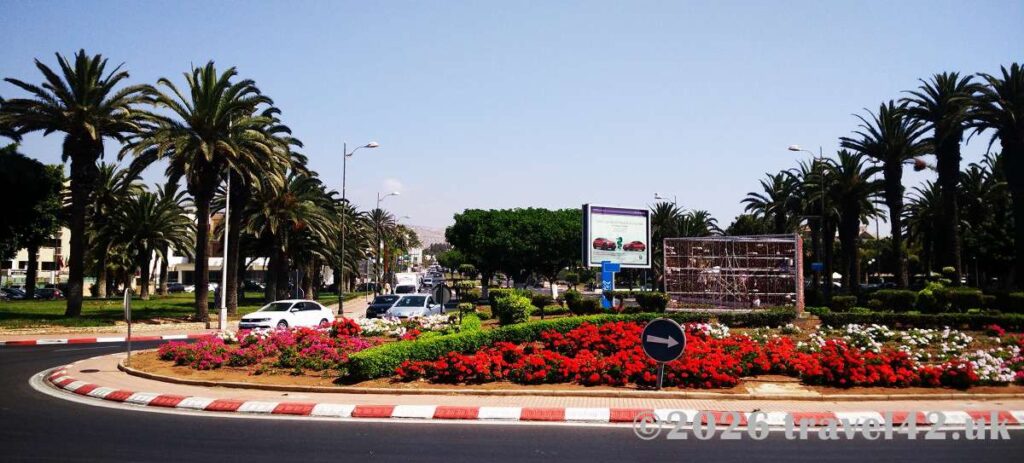
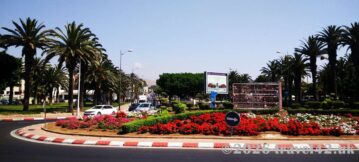
The result is a city that feels deliberately modern: wide boulevards, low-rise whitewashed buildings, a purpose-built beach promenade, and a marina that wouldn’t look out of place on the Spanish coast.
It is sometimes nicknamed the “Miami of Morocco” – a comparison that captures both its Atlantic outlook and its relaxed resort-town energy. For travellers arriving from, or heading onwards to, more traditionally Moroccan cities such as Marrakech or Fez, Agadir can feel like a gentle introduction rather than total immersion.
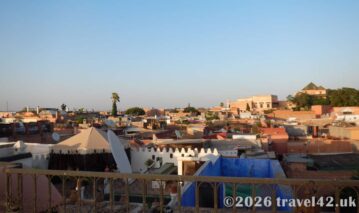
It certainly caught us by surprise. Having based our expectations on a previous trip to Marrakech, we weren’t prepared for how spacious and green the city would feel – even the centre has an easy, open quality, with trees lining the streets and plenty of shade. It felt less like a Moroccan city and more like a pleasant Mediterranean coastal town that had somehow ended up on the Atlantic. Coming here for the first time, that was quietly refreshing.
Wandering the City
The Beach and Promenade
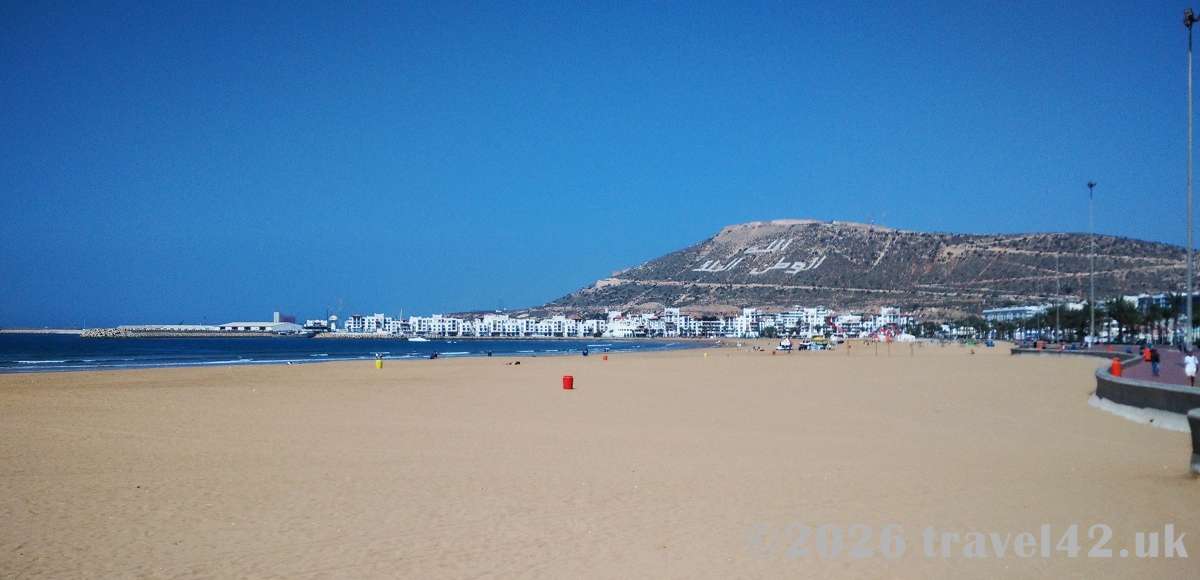
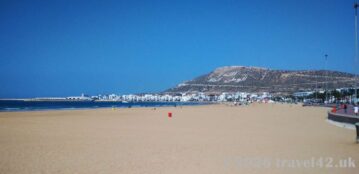
Agadir’s beach is one of the longest in Morocco – a broad sandy crescent stretching for several kilometres along the Atlantic coast. The Bord de Mer promenade runs its full length, lined with cafés, restaurants, and the sort of relaxed seaside atmosphere that makes an evening stroll thoroughly enjoyable.
We visited in early March, and the beach was nearly empty – vast because of it, in fact. There is something quietly wonderful about a great stretch of Atlantic sand with almost nobody on it.
We stopped along the promenade for coffee and sat watching the ocean, and it became one of those unhurried travel moments that stays with you long afterwards. The city was full of colour at that time of year – flowers blooming along the pavements and the light that warm, particular gold that the Moroccan Atlantic does so well.
Souk El Had
No visit to Agadir is complete without wandering through Souk El Had – and “wander” is very much the operative word, because this is a genuinely enormous place.
Covering approximately 13 hectares with over 6,000 shops and stalls, it is one of the largest urban markets in Morocco and North Africa. The name means “Sunday Market”, a nod to its origins as a weekly trading fair for merchants from the Souss region. Today, it is open six days a week, generally from around 6am to 8.30pm, closing on Mondays for cleaning, with many stalls also shutting briefly on Friday afternoons for prayers.
The souk is surprisingly well organised despite its scale, with 12 separate entrances making navigation far easier than you might expect. Gate five is best for fresh produce, spices, and Moroccan goods; gate six for bags and leather accessories; gates eight and nine for souvenirs and silver jewellery; gate eleven for furniture and books. For argan oil – one of Morocco’s most celebrated exports, produced from trees native to the Souss region – this is an excellent place to buy, though it pays to compare both quality and price carefully.
As it was our first proper day in Morocco, we went straight for the fruit – buying more strawberries than we could realistically eat before leaving the city the following day. Strawberries in March, fresh from a Moroccan market after months of European winter: honestly worth the journey on their own.
Bargaining tip: Negotiating is expected and entirely normal in Moroccan souks – approach it with humour rather than anxiety, and you’ll usually end up with both a fair price and a pleasant conversation.
Vallée des Oiseaux (Birds Valley)
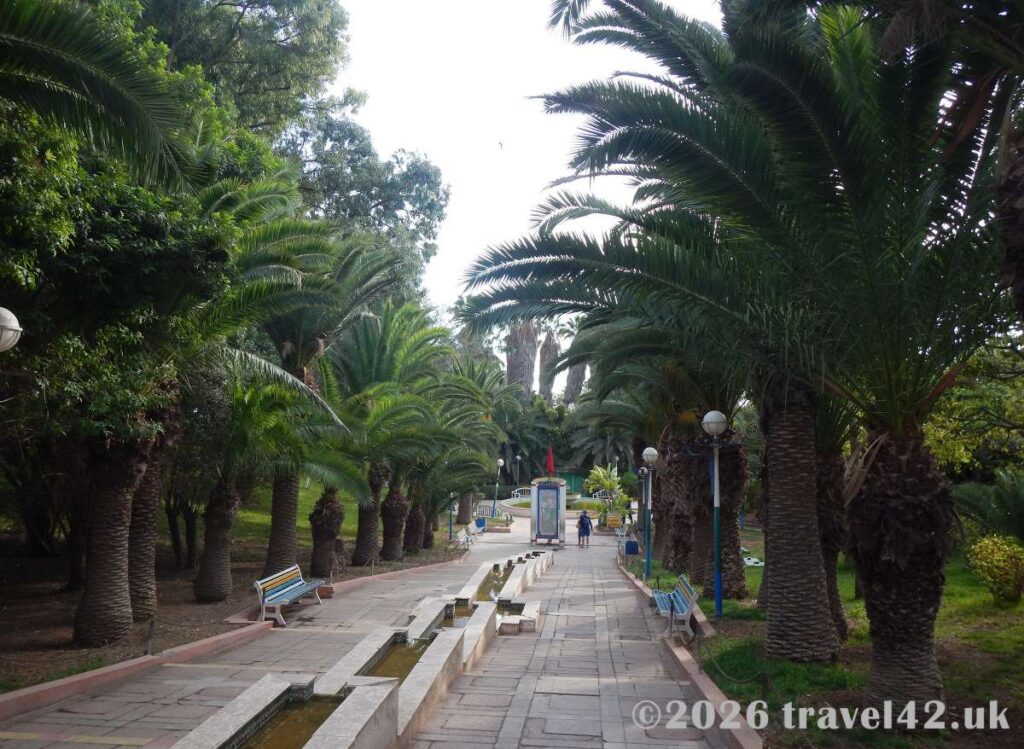
Tucked along the promenade between the city and the beach, Vallée des Oiseaux is a free-to-enter park and aviary that makes for a pleasant half-hour detour.
The park features lush botanical gardens, a central waterfall, and a variety of bird species including flamingos, ibis, parrots, and exotic birds from South America and Asia – alongside the occasional roaming goat, which is unexpectedly charming.
It is relaxed, green, and a pleasant contrast to the bustle of the souk.
It is worth noting that recent visitor reports suggest parts of the park have undergone renovation works and that some areas may still require attention. Always check current conditions before visiting. Entry is generally free, though a small fee of around 10-20 MAD per person may occasionally apply.
The Highlight: Argan Phyto House Hammam
If there is one thing we would urge every couple visiting Agadir to do, it is book a traditional hammam – and we chose Argan Phyto House, a private spa and hammam centre that we reserved online before leaving home.
Located on Rue Imam Malek in central Agadir, Argan Phyto House combines traditional Moroccan hammam rituals with a quietly contemporary atmosphere – soft lighting, essential oils, and the sort of calm that makes time seem to slow down.
We opted for the Neroli ritual followed by two-hour relaxing massages for the two of us – all for around 1,200 MAD at the time of our visit (roughly £95-110 for the pair, depending on exchange rates). Prices may have changed since, so it is worth checking in advance.
Afterwards, we sat on the balcony with mint tea, completely unwound and watching the afternoon light shift over the city. It was, quite simply, one of the finest few hours of the entire trip.
For anyone unfamiliar with the hammam experience, the traditional ritual involves steam, cleansing with black soap, and vigorous exfoliation with a kessa glove – more invigorating than it sounds, and deeply satisfying afterwards.
Treatments using organic argan oil are a particular speciality here, as you might expect from the name. The centre is generally open daily from 9am-1pm and 3pm-8pm, by appointment.
Booking in advance is strongly recommended, particularly for couples’ treatments or private rooms. Turning up without a reservation at a well-regarded hammam like this often means a long wait – or disappointment.
Essential Tips for Visiting Agadir
Hire Car
We booked through local agency Samicar, which proved to be an excellent choice – responsive, professional, and genuinely helpful throughout our time in Morocco.
Reading reviews of local car hire companies before booking is absolutely worthwhile; standards vary considerably. Once you collect the vehicle, inspect it carefully and photograph any existing damage before driving away.
SIM Card
Pick one up as early as possible and keep your passport handy – you’ll need it to register a Moroccan SIM card. Local data packages are inexpensive, and having a working Moroccan number makes an enormous difference to how smoothly you can communicate with hotels, guides, and service providers throughout the trip.
This is simply how Morocco communicates. Virtually every local business, guesthouse, guide, and service provider uses WhatsApp for both voice calls and messages. Once you have your SIM sorted, collect WhatsApp contacts as you travel – it proved indispensable throughout our journey.
Currency
Morocco’s currency is the Moroccan Dirham (MAD). Cash is still widely used, particularly in souks and smaller establishments, so always carry some with you.
ATMs are readily available in Agadir. Argan oil, leather goods, and spices are all worth buying here – often at better prices and higher quality than in the more heavily touristed cities further north.
Getting Out of Agadir
Agadir makes an excellent starting point for exploring the wider region. From here, the road east and south opens into the dramatic landscapes of the Anti-Atlas Mountains – the route we followed as part of our 12-Day Morocco Road Trip from Agadir to Tafraout & the Anti-Atlas.
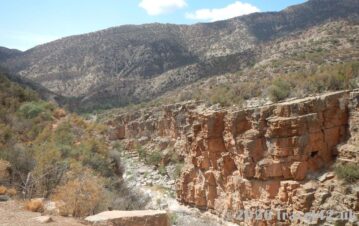
Our next stop was Paradise Valley, a lush gorge roughly 40 minutes up the coast road – in theory, at least. In practice, it is well worth pulling over several times along the way: the landscape changes quickly once you leave the city behind, and the scenery more than rewards a moment’s attention.
Travel for Two is a couples travel journal dedicated to immersive road trips, slow travel, and destination storytelling.
Explore More of Morocco:
–



The long way round, as a couple
About the Author
The author, ainarsbl, is a Level 7 Google Local Guide, Master Reviewer and expert travel reviewer focused on scenic landscapes, UNESCO sites and meaningful couples travel experiences.