During our trip to Marrakech, we had two main activities planned alongside exploring the city itself – a safari to the Sahara Desert and a Moroccan cooking class. You can read about both Marrakech and the desert trip in our other posts; this one is dedicated to our hands-on exploration of Moroccan cuisine.
Whenever we travel, one of our favourite ways to connect with a new culture is through food. We’ll happily spend an afternoon exploring local markets, seeking out family-run restaurants or – as we once did in Montenegro – buying fresh seafood straight from the boats and cooking it ourselves. So when we discovered that Morocco offers cooking classes just outside Marrakech, it felt like the perfect fit. Dining out is always a pleasure, but there is something far more rewarding about preparing local food with your own hands, and we take every opportunity to join a class wherever we travel in the world.
Moroccan Cuisine: More Than Tagine and Mint Tea
A mix of different traditions
It’s worth pausing on Moroccan food before diving into the class itself, because its complexity genuinely surprised us. Moroccan cuisine draws on a rich mix of Berber, Arab, Andalusian and Mediterranean influences, and the result is wonderfully layered – fragrant without being overpowering, and always generously spiced.
Two ingredients you’ll encounter everywhere in Morocco deserve special mention.
Argan oil
Argan oil is pressed from the kernels of the argan tree (Argania spinosa), a species found almost exclusively in south-western Morocco, particularly around Agadir and the Souss Valley. Beyond cooking, argan oil is widely used in cosmetics, and you’ll find it on sale throughout every souk. The trouble is that pure, cold-pressed culinary argan oil is expensive, and diluted or counterfeit versions are everywhere. More on how the cooking class helped us spot the difference shortly.
Saffron
Saffron is the other defining ingredient of Moroccan cooking. Derived from the dried stigmas of the Crocus sativus flower, it holds the title of the world’s most expensive spice by weight — it takes approximately 150,000 flowers to produce a single kilogram. Morocco’s primary saffron-growing region is around Taliouine, a small town in the Anti-Atlas Mountains between Taroudant and Ouarzazate, and Moroccan saffron is considered among the finest in the world. Here too, fakes and low-grade substitutes are common.
Ras el hanout
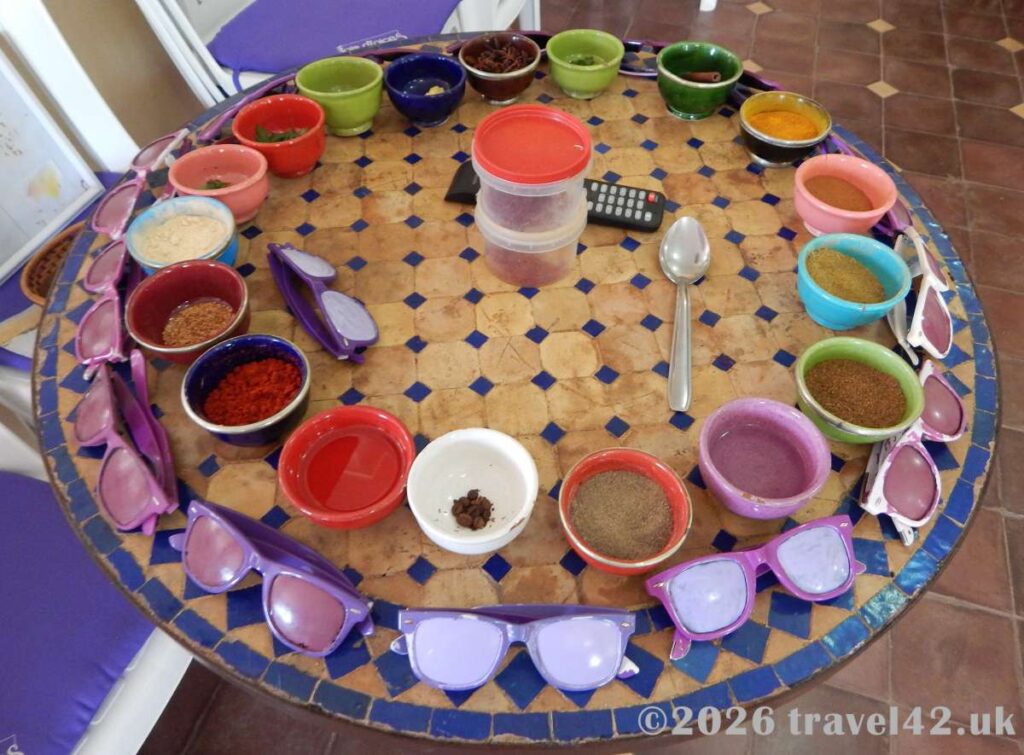
Beyond these two headline ingredients, every Moroccan household blends its own ras el hanout – a signature spice mix that can contain anywhere from a handful to several dozen different spices. Common ingredients include cumin, coriander, cinnamon, ginger, turmeric, paprika, cardamom and sometimes even dried rose petals. There is no single recipe; each family’s blend is its own closely guarded secret.
Visiting a souk and picking up different varieties of ras el hanout has become a ritual for us on every trip to Morocco – a habit that took root directly after this cooking class. You quickly learn that a blend might be tailored to a specific type of dish, and that you can often tell the difference simply by scent. The colour varies too, depending on the exact combination of ingredients. We’ll admit we were initially a little puzzled by the texture – sometimes coarser and slightly chunky, sometimes a fine powder – but that inconsistency is part of the handmade charm.
Booking a Cooking Class: Faim d’Épices
We booked our class with Faim d’Épices – French for “Hunger for Spices” – which operates from a farmhouse a short drive from the Marrakech medina. The setting alone makes it worth the journey. You’re whisked away from the sensory overload of the city into a tranquil property surrounded by olive and orange trees, and the contrast with the busy medina streets is immediately calming.
The school has been selected by Travel + Leisure as one of the best cooking classes in the world, and it isn’t difficult to see why. Classes are run by Michel and his wife Ilham, who are warm, funny and impressively knowledgeable. Pick-up is arranged from near your accommodation in Marrakech – a standard convenience in Morocco – and the drive out to the farm is pleasant in itself. Along the way, we noticed the traditional land irrigation systems used in the area; later, at the farm, we took a short walk to see how water is channelled directly to the fields to maintain soil moisture. It’s a simple thing, but one very far removed from anything we encounter back in Europe, and it left a genuine impression on us.
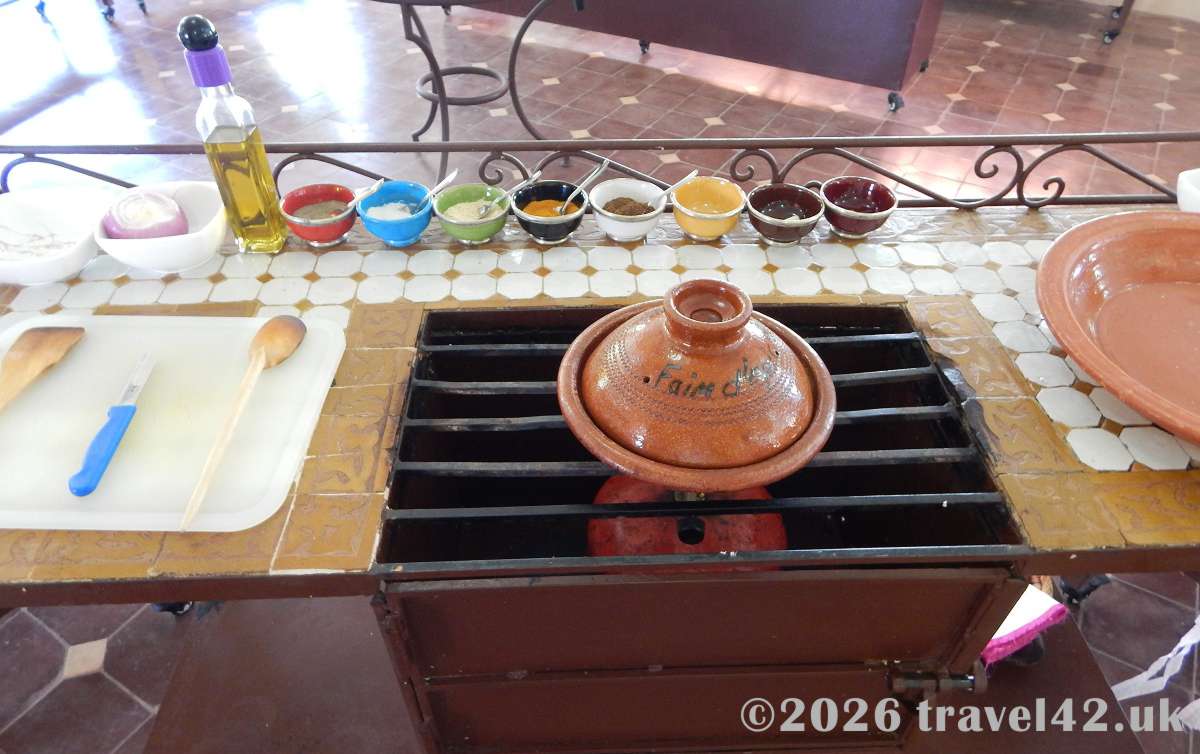
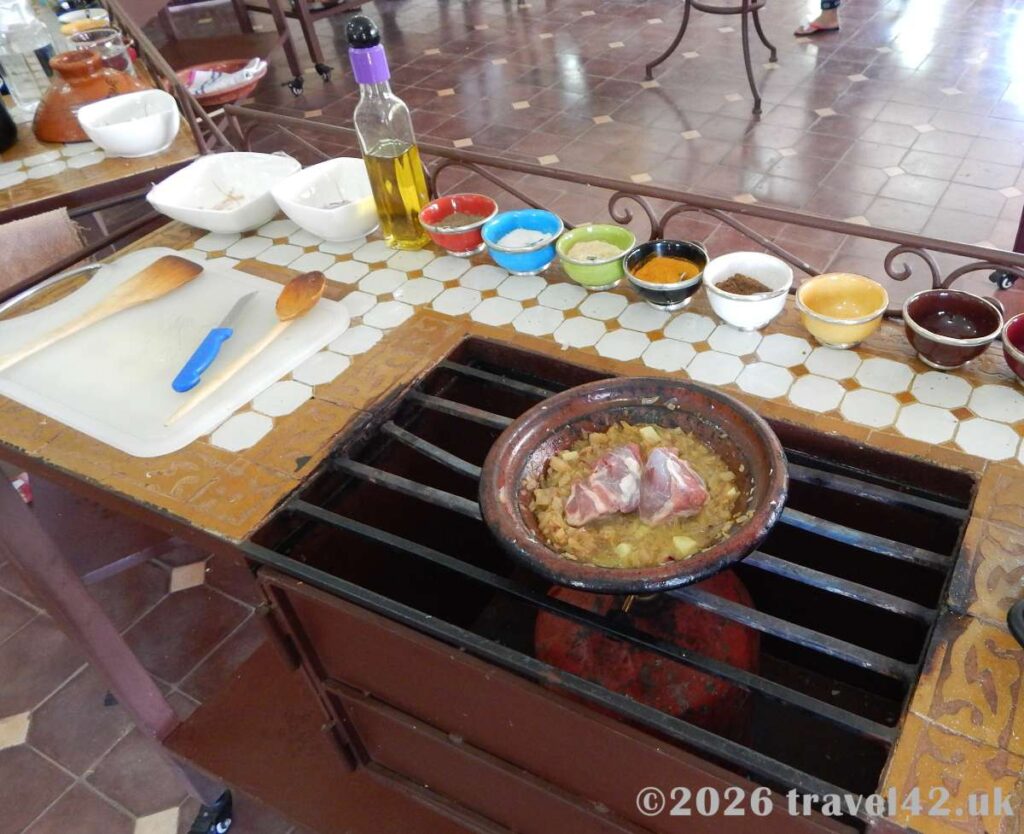
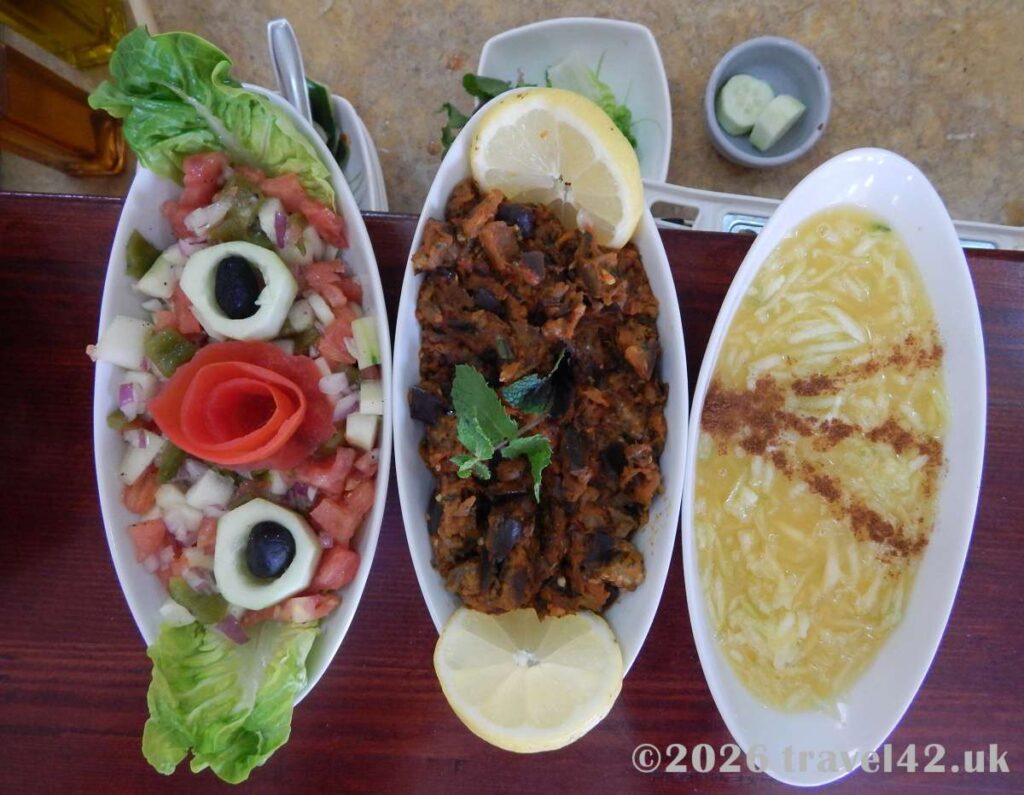
The kitchen itself was impressive – spacious and well-equipped, with individual ovens for each group of participants. And we still remember the scent of lemon blossom drifting through the room as we were shown how to prepare the Moroccan salads.
Practical Details
| Detail | Information |
| Price | ~600 MAD / €60 per person (prices were around €50 when we visited – check for current rates) |
| What’s included | Transport from central Marrakech, cooking class, spice and salad workshop, drinks throughout, and the meal you prepare |
| Payment | Cash only – no credit cards accepted; a deposit of roughly half the total is required at booking |
| Booking | Sessions sell out, especially in peak season – book in advance directly via the Faim d’Épices website |
| Duration | Roughly 9:30am – 4:00pm |
We generally prefer booking directly with providers after doing a little research, rather than using third-party platforms – it tends to be more straightforward and ensures your money goes to the people actually running the experience. That said, Faim d’Épices is also listed on Viator and TripAdvisor Experiences if you prefer that route.
What We Cooked
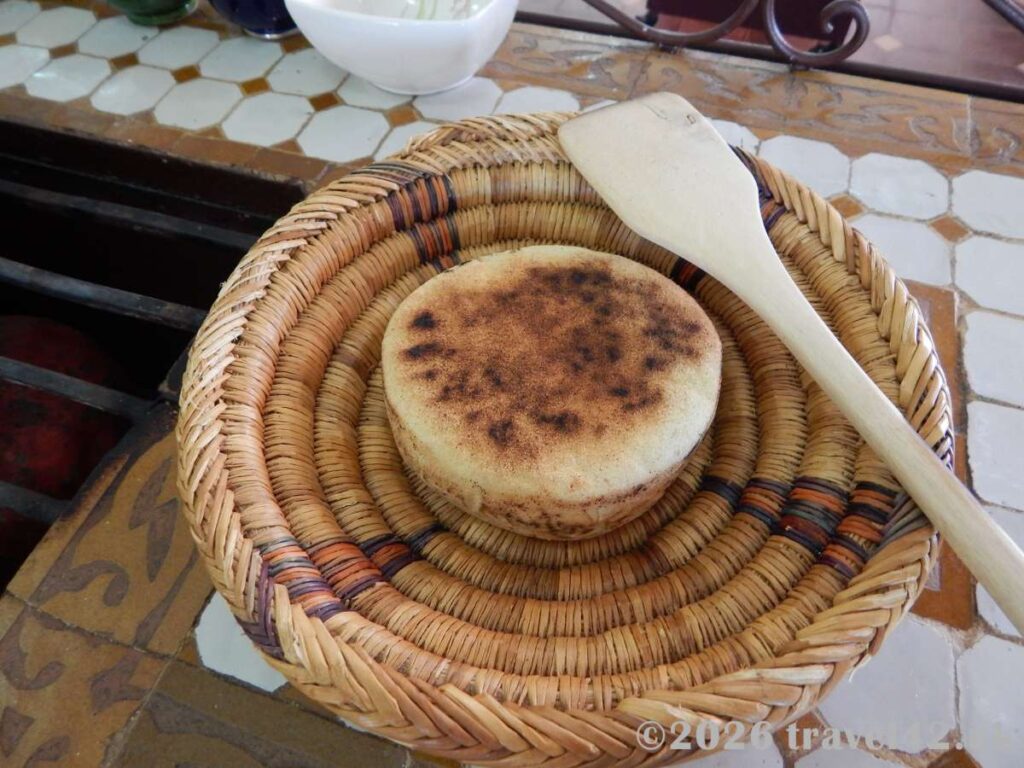
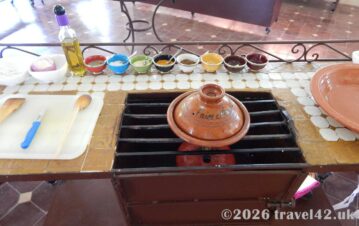
Every session at Faim d’Épices covers a complete meal: bread, salads, a tajine or couscous, and the special Moroccan flatbreads called msemen. You can indicate your preferred main course from the weekly menu when you book. On the day we visited, the centrepiece was a lamb tajine with prunes – a classic combination that balances savoury and sweet in that distinctly Moroccan way, with the meat falling apart after slow cooking in the iconic conical clay pot.
Working through the full spread, we prepared:
- Khobz – the round, slightly crusty bread that appears on virtually every Moroccan table, shaped and proved by hand before baking
- Moroccan salads – not the simple green salads you might expect, but beautifully spiced cooked preparations: roasted aubergine with cumin, grated carrots with cinnamon and orange blossom water, and others. Each one had its own wonderful aroma – something you appreciate long before the first bite
- Lamb tajine with prunes – slow-cooked in the conical clay pot, designed to circulate steam back down over the meat and keep it tender throughout the cooking process
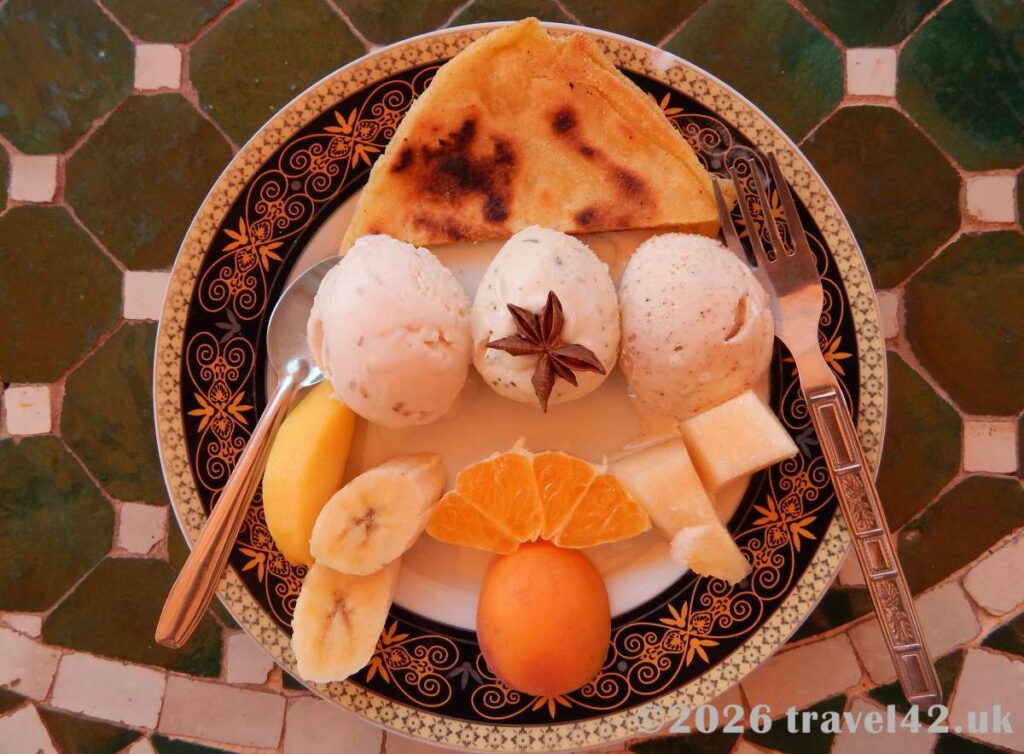
- Msemen – flaky, layered Moroccan flatbreads, somewhere between a crêpe and a paratha, traditionally eaten for breakfast with argan oil and honey
Some elements were demonstrated by Michel and Ilham; others we made entirely ourselves. The balance was just right – enough guidance to feel confident, and enough independence to feel genuinely accomplished when we finally sat down to eat.
The Spice Workshop: Telling Real from Fake
Unexpectedly, this became one of our favourite parts of the day. Between the bread-making and the main cooking session, guests take part in a spice workshop, learning about traditional Moroccan ingredients – with particular focus on argan oil and saffron.
The practical tips for identifying genuine products are invaluable, especially given how freely fakes circulate not just in the souks but back home too. Here’s a summary of what we took away:
Identifying pure argan oil: Genuine culinary argan oil has a distinctive, slightly nutty aroma and a deep golden colour. Cosmetic-grade argan oil is processed differently and has a much milder scent – so if someone is selling argan oil that barely smells of anything, it’s either heavily processed or diluted. Price is another clue: if it seems implausibly cheap, it almost certainly isn’t pure.
Identifying real saffron: Authentic saffron threads are deep red with slightly lighter orange tips. Uniformly red threads throughout are a warning sign of artificial dyeing. A simple test: place a thread in warm water – genuine saffron releases colour slowly, turning the water a rich golden yellow; fake saffron bleeds red almost immediately. The aroma should be floral and faintly medicinal, sometimes compared to honey and hay.
We picked up some argan oil at the farm before leaving – but the greater takeaway was the knowledge itself. Heading into the souks afterwards, we felt genuinely prepared and far less likely to be fobbed off with something second-rate.
Is a Moroccan Cooking Class Worth It for Couples?
Absolutely. It offers something a restaurant meal – however excellent – simply cannot: a glimpse into the domestic heart of Moroccan culture. Food here is inseparable from family, hospitality and tradition, and a day spent learning to prepare it opens a door that most tourist experiences never come close to.
It also works brilliantly as a couple’s activity. There’s plenty to do side by side – the bread-making in particular becomes a quiet, floury team effort – and the atmosphere is relaxed and sociable. You’ll most likely share the session with a small international group, which adds to the fun. And there is, inevitably, a gentle competitive streak to it: who can fold the msemen more neatly, who has more patience with the salad preparations. It was even more enjoyable than we’d anticipated, and we left with the kind of satisfaction that only comes from having actually made something together.
If you’re spending more than a day or two in Marrakech, we’d rate this as essential rather than optional.
Have you tried a cooking class in Morocco – or anywhere else in the world? We’d love to hear about your experience in the comments below.
Travel for Two is a couples travel journal dedicated to immersive road trips, slow travel, and destination storytelling.
Explore More of Morocco:
–


The long way round, as a couple
About the Author
The author, ainarsbl, is a Level 7 Google Local Guide, Master Reviewer and expert travel reviewer focused on scenic landscapes, UNESCO sites and meaningful couples travel experiences.