France in the middle of the trip
After a short rest in the thermal baths of Baden-Baden in Germany, we decided to spend part of Easter in France before heading on to Switzerland. We visited Strasbourg and then stopped in Colmar, one of the best-known towns in Alsace, on our way.
This was the French chapter of a longer spring trip. Our Baden-Baden and Mainau article covers the German ends of the journey, while our Switzerland posts tell the story of the middle part.
Alsace: a border region with two personalities
Alsace lies on the French side of the Upper Rhine, next to Germany and Switzerland. From 1982 to 2016, it was the smallest administrative region in metropolitan France, before being incorporated into the larger Grand Est region.
It is also one of the more densely populated parts of France, with around 230 people per square kilometre. For comparison, Latvia, where I’m from, has fewer than 30 people per square kilometre, while the United Kingdom has roughly 270.
Alsace has its own regional language, Alsatian, which belongs to the Germanic language family rather than the Romance family to which French belongs. It is still spoken in the region, and many places have both French and German names, reflecting Alsace’s complex history.
Strasbourg is the region’s largest city and hosts several important European institutions, including the European Parliament, the Council of Europe and the European Court of Human Rights. It is also an important port on the Rhine.
A night in Strasbourg
Hôtel Au Couvent du Franciscain
It was almost by chance that we found and booked Hôtel Au Couvent du Franciscain. The hotel occupies a historic building originally associated with Franciscan monks, close to the heart of the city. Although it has long since ceased to have a religious function, it has retained some of the charm of its former life.
It’s a small hotel of around forty rooms on a quiet street in the centre, within walking distance of the main sights.
We were pleasantly surprised by how cosy our room was. The location and price offered very good value, and the continental breakfast was unusually generous for France.
The biggest surprise came the following morning when we went down to breakfast. The dining room in the basement was stunning and completely unexpected. The food was very good, too. It’s one of those little details that stays with you long after a trip.
The old town and the cathedral
After several weeks of rain across Europe, the weather in Strasbourg finally turned sunny, making it perfect for walking. The grass was green, and the chestnut trees were beginning to flower.
The historic centre stands on the Grande Île, an island formed by branches of the River Ill, with canals winding through the city. The Grande Île has been a UNESCO World Heritage Site since 1988. We didn’t have time for a boat trip along the canals, which would have been a lovely way to see the city from a different perspective.
One of Strasbourg’s most impressive landmarks is the Cathedral of Our Lady of Strasbourg. Construction of the present cathedral began in the Romanesque period, with major Gothic rebuilding starting in the 12th century. The spire was completed in 1439, reaching a height of 142 metres.
From 1647 until 1874, the cathedral was the tallest building in the world. It remains one of the most striking churches in Europe, combining Romanesque elements with the soaring forms and intricate stonework of Gothic architecture.
Trams, shops and a last lunch
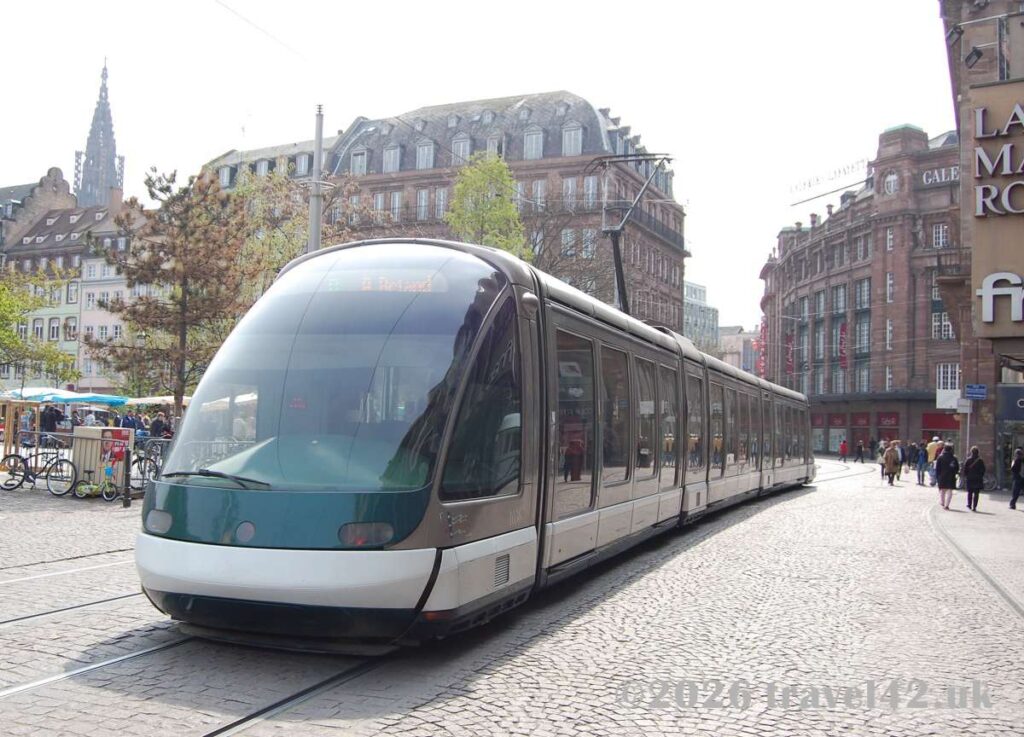
Strasbourg has plenty of other beautiful buildings, canals, squares and traditional old houses. Public transport is excellent, with modern, low-floor trams running through and around the historic centre.
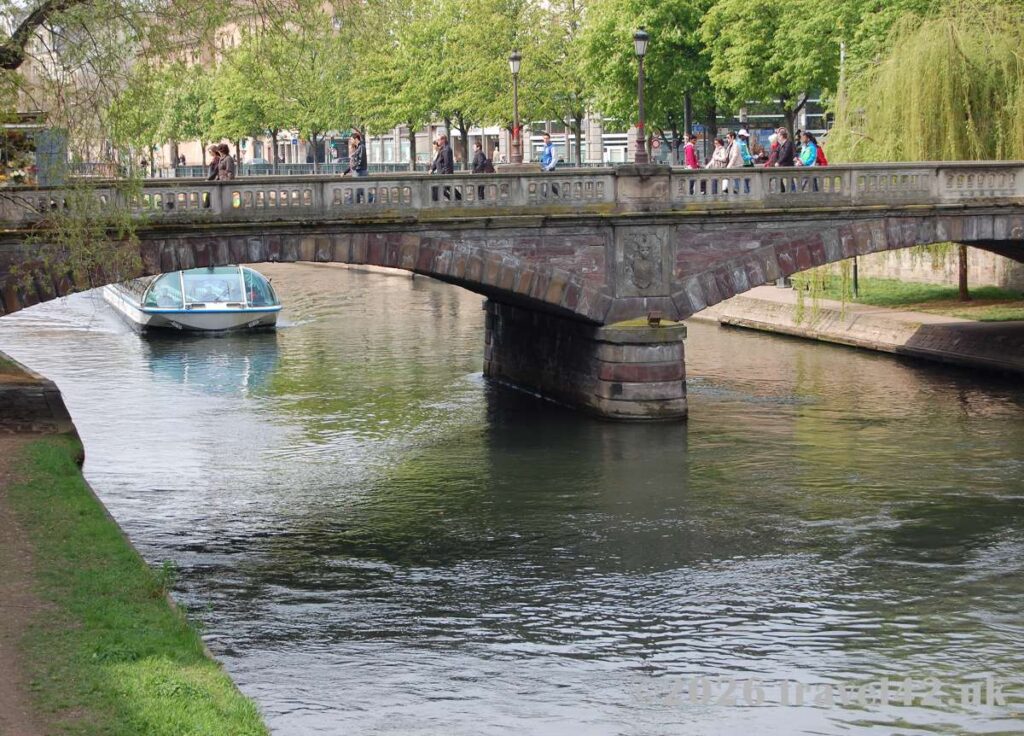
The Galeries Lafayette department store is also in the city centre. The chain began in Paris and has since expanded internationally, including to cities such as Berlin, Casablanca and Dubai. But, as in many cities, we found the smaller shops and cafés along the streets more interesting.
It has become our habit to visit Galeries Lafayette whenever we’re in a city that has one, and Strasbourg was no exception.
The first half of the day flew by, and soon it was time to drive towards Switzerland. Before leaving, we had lunch and once again found that we could get considerably more for our money in France than we had in Germany for a similar price.
One practical detail worth mentioning: our hotel allowed us to leave the car in its car park until the afternoon at no extra charge. That made it much easier to enjoy a morning exploring the old town without worrying about moving the car.
The Easter market in Colmar’s old town
We had read that Colmar holds Easter and spring markets in its historic centre, with local produce, crafts and regional specialities on sale. The town is also popular with visitors from neighbouring Germany, as the border is only a short drive away.
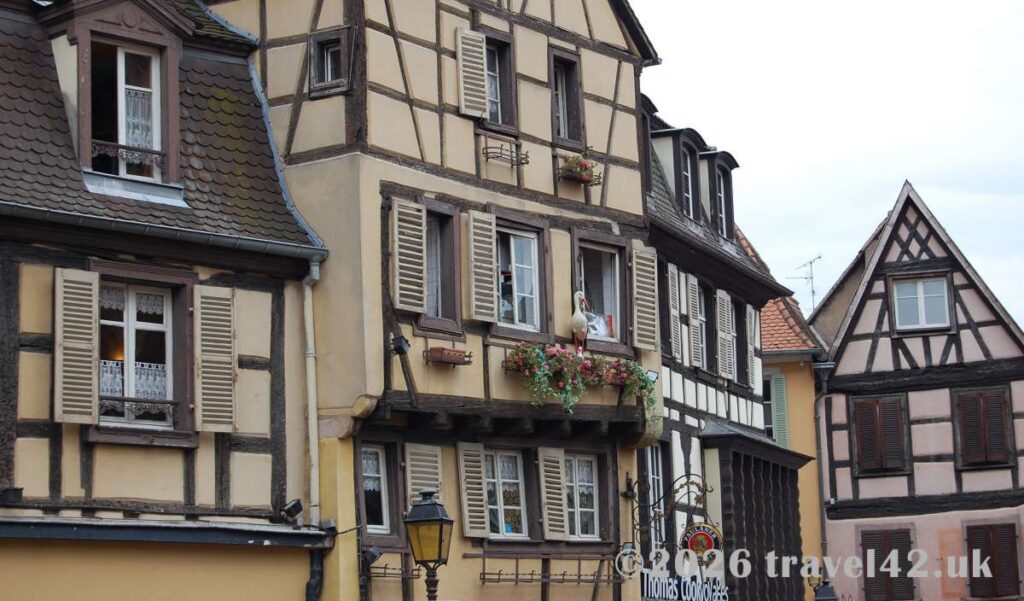
We found one of the few free car parks less than five minutes’ walk from the old town and headed towards the central square.
Near a large church, in the heart of the historic centre, we came across stalls selling all sorts of food and local products. What surprised us was that most of the sellers seemed to be speaking German. It may well have been Alsatian, the regional language, which has strong Germanic roots. Quite a few stallholders also understood English, so we could ask questions and find out what we were buying.
The market was busy, with people shopping for food and enjoying the spring atmosphere. The Easter season gave the whole place a particularly festive feel.
Homemade cheese, pâté and dried ham
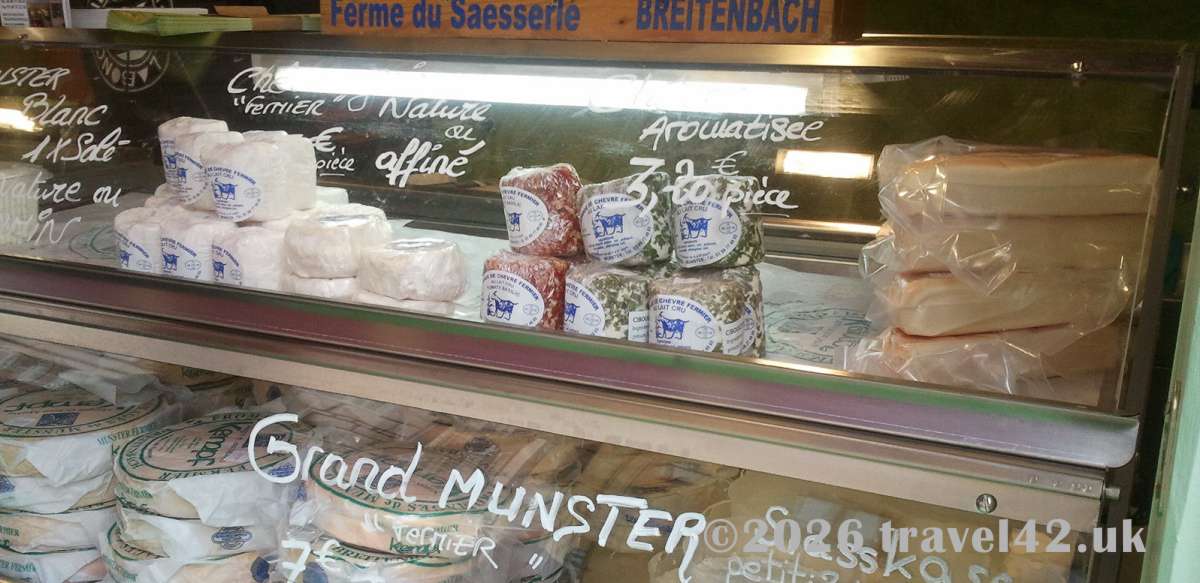
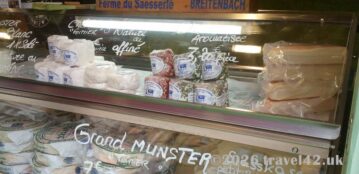
We had already tried some Alsatian produce in Germany, so at the market we picked up a few things for snacking: homemade cheese, poultry-liver pâté and dried ham, rather like Italian prosciutto.
The pâté deserves a few words because it puzzled us. For the first time in France, we couldn’t understand why products that looked almost identical came at such different prices. There were duck and goose liver specialities, other pâtés and products presented as traditional Easter treats. Some were clearly intended as delicacies, while others were much more affordable.
The explanation, as we understood it, was that the price depended largely on the ingredients and the proportion of liver in the product. A pâté made with a high proportion of duck or goose liver can cost considerably more than a mixture containing other meats and ingredients. The type of liver also matters.
If you’re looking for a particularly rich delicacy, a product with a high liver content may be what you want. If you’d rather have something to spread on bread or enjoy in larger quantities, a less expensive pâté may suit you better.
That’s my explanation as someone who isn’t a culinary expert but enjoys good food. One thing we learnt is that it’s worth asking what’s actually in the jar rather than judging by its appearance or price alone.
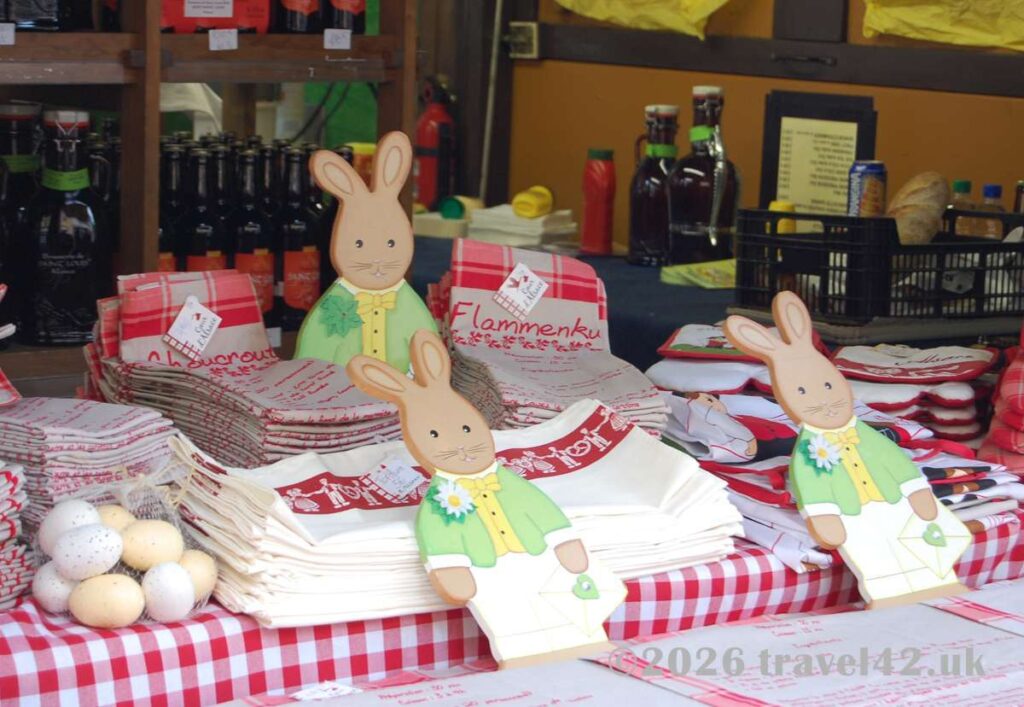
A festive town and a cheaper lunch
Easter in France isn’t celebrated in quite the same way as in Poland, where we spent Easter in another year. Even so, the open-air displays, decorations and lively town centre gave Colmar a genuine festive feel.
Lunch in France was also noticeably cheaper than in Germany during this trip. In Germany, we had seen plenty of lovely Easter decorations outside private houses, but we hadn’t come across comparable communal events in the towns we visited. In smaller places, many people were going to church.
These were our impressions of the places we visited rather than a general rule about how Easter is celebrated in either country. Nevertheless, the contrast added an interesting dimension to our journey through this part of Europe.
Practical notes for couples
- Look for parking near Colmar’s old town. We found free parking within a short walk of the centre, although availability will depend on the day and season. Check local parking signs and restrictions before leaving your car.
- Eat well for less. On this trip, we found lunch in France noticeably better value than in Germany.
- Ask about local food. Many stallholders at the Colmar market spoke some English. Asking what you’re buying is particularly useful when choosing pâtés and other regional specialities.
- One night can work well for Strasbourg. We found the historic centre compact and walkable, with good tram connections. We managed a pleasant evening and morning, although we would have liked more time for a canal boat trip.
Where the trip went next
Looking back, this part of the trip was about easy, unhurried days: a sunny morning in Strasbourg, followed by browsing a market in Colmar and sampling local food. It works well for couples because there’s no pressure to fill every hour. You can walk, taste a few things, sit in the sunshine and enjoy the atmosphere without rushing from one attraction to another.
Our Easter trip also included Baden-Baden and Mainau Island in Germany, followed by a drive through the French- and German-speaking parts of Switzerland. You can read about these experiences in our Baden-Baden and Mainau article, our spring in Switzerland article and our Switzerland road trip for couples.
Together, these stops made a varied spring journey through three neighbouring countries, with historic towns, good food, beautiful scenery and time to enjoy the trip at our own pace.
Travel42 UK is a couples travel journal dedicated to immersive road trips, slow travel, and destination storytelling.
Explore More of Western Europe:
The long way round, as a couple
About the Author
The author, ainarsbl, is a Level 7 Google Local Guide, Master Reviewer and expert travel reviewer focused on scenic landscapes, UNESCO sites and meaningful couples travel experiences.