Switzerland was our first proper European road trip, and it’s a country we’ve been back to more than once since – with another visit already in mind. This article draws almost entirely on that first journey in 1997, when we drove down from Latvia with another couple, with no GPS, no smartphones, a borrowed video camera and every intention of reaching the Italian-speaking south. A few smaller episodes come from later trips, when we based ourselves in the same corner of the Vaud Alps and went looking for altitude, and from another visit built mainly around Lake Geneva.
We’ve told it as one continuous journey rather than several separate ones, because the route was much the same each time and it reads better that way.
If you’re planning something similar as a couple in Western Europe, the short version is this: Switzerland is small enough that you can be on a lakeside promenade in the morning and standing on a glacier by lunchtime, which makes it unusually good at balancing an active day with a slow one. The same goes for the seasons. There are remarkable views and things worth doing all year round, whenever you go and whichever part of the country you choose.
The long drive in
Our 1997 trip began about 60 kilometres south of Riga, late in the evening.
It was a long time ago now, but this is the trip that deserves a place on the blog more than most, because it’s the one everything else grew out of. Without it, I’m not sure we would have become the couple who travel the way we do now. We might well have ended up as people who only ever booked all-inclusive weeks in Turkey – somewhere, for the record, we have still never been.
So this journey matters, both to us and to the existence of this blog. I’m writing it up now, after more than sixty articles about our travels have already been published, as a sort of reflection I felt was overdue.
At that point we had no experience of travelling for more than two days at a stretch, let alone abroad, so the other couple took on most of the planning.
Back to the road. We drove through the night and most of the following day – roughly 1,800 kilometres, with two of us sharing the driving – and pulled into Karlsruhe in Germany shortly before midnight.
By then, taking turns at the wheel had stopped helping. We took the first hotel we found without asking the price, got lucky with the rate, and woke up human again. After breakfast and a short walk we were back on the road. There was a light frost that morning, which was exactly as refreshing as we needed.
Some context for how different this was from the way we travel across Europe now: we needed separate visas for Germany and Switzerland, we planned the whole thing from paper road maps, and mobile phones in 1997 were bricks. Photographs went on 35mm film; video went on a Super VHS camcorder we’d borrowed from friends, because almost nobody owned one. Splitting the costs with another couple – and borrowing a little spare money from colleagues at work – was what made it possible at all.
Two hundred kilometres or so beyond Karlsruhe we reached the border at Weil am Rhein. The guards didn’t keep us long, we bought our motorway vignettes, and that was that.
First sight of the mountains
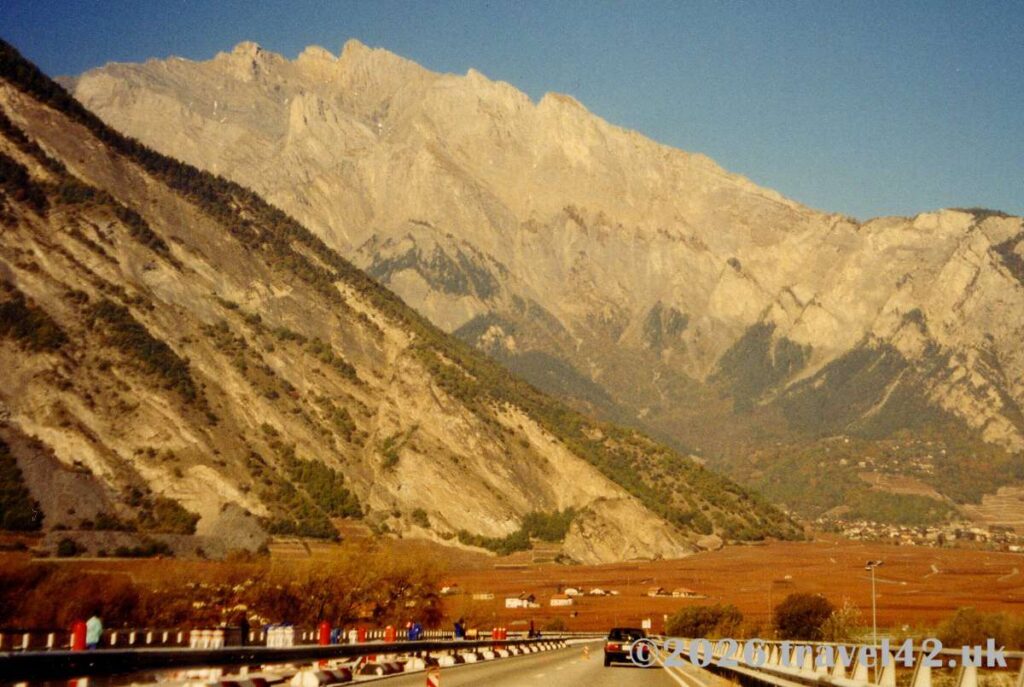
The mountains appeared almost immediately after we crossed in from Germany. We had never seen anything like them, and we sat there taking it in like people who had driven a very long way for exactly this.
Our first proper stop was near Lake Geneva, and it was better still – an enormous sheet of water on one side, mountains on every other, and all of it turned over into autumn colour.
Vevey, Aigle and the climb to Leysin
From the border we carried on to Vevey, then Aigle, and then up. Our accommodation was booked in Leysin, a ski resort above the Rhône Valley.
The serpentine road from Aigle to Leysin felt genuinely extreme at the time – rise, drop, rise, drop, all the way up. We’d say something different now, having driven far worse since, but as a first experience of mountain driving abroad it stayed with us. Aigle and Leysin are about six kilometres apart as the crow flies; the road takes roughly seventeen. Twenty minutes later we arrived in our 4×4 Audi, and everything had gone right. At the time it felt as though four-wheel drive was the only way up there, though we’ve since managed far more difficult routes in much simpler cars.
For couples: whoever isn’t driving gets the better end of this road. It’s worth agreeing in advance who takes the wheel on the mountain sections, especially if one of you enjoys hairpins considerably more than the other.
Walking down, riding back up
The next morning we decided to walk from Leysin down to Aigle. The signs along the path said two and a half hours. It took us more than four – not because it was hard, but because we kept stopping. Vineyards, valley views, the kind of descent where there’s no reason to hurry.
We had a coffee in Aigle and took the Aigle-Leysin cog railway back up. Twenty minutes to undo four hours of walking, and, more to the point, it saved our legs – which only started complaining a day later. The line climbs through the vineyards above Aigle and on through steep forest to Leysin.
The real challenge was working out from the French-speaking staff how to get back to Leysin at all. English was no help whatsoever, and our own English wasn’t much better at the time.
This is one of the best things we did as a couple on that trip, and it costs almost nothing: walk down together at your own pace, eat and drink in the valley, then ride back up without either of you having to concentrate.
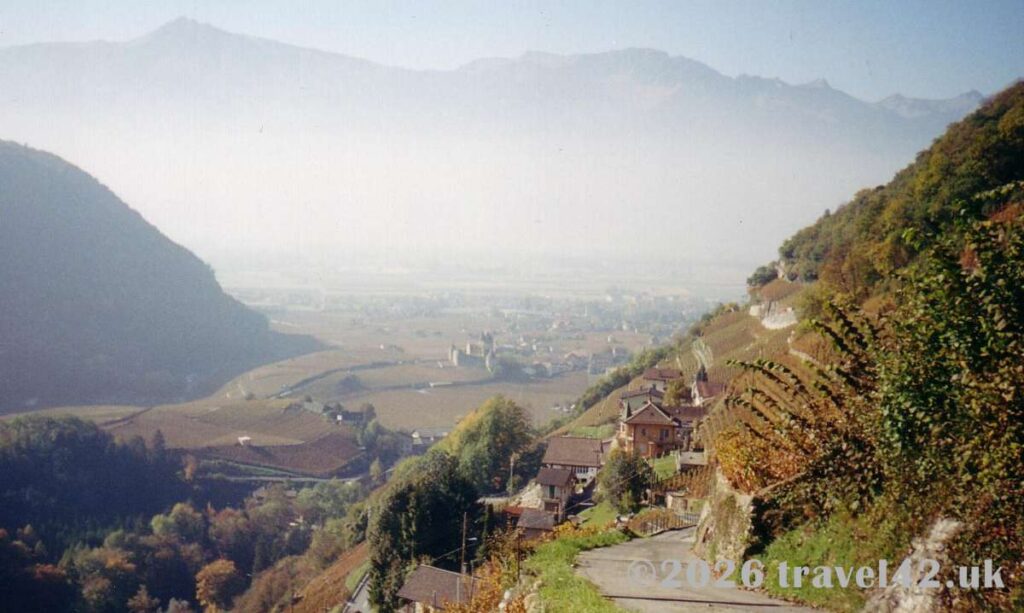
We still had the whole late afternoon and evening ahead of us, and spent it walking around Leysin.
One thing we noticed on that first trip was that, despite it being November, there was still no snow on the tops. That year turned out to be widely reported as a poor one for snow. Since we were there to travel around rather than ski, it didn’t trouble us much.
Geneva, Lausanne and Montreux
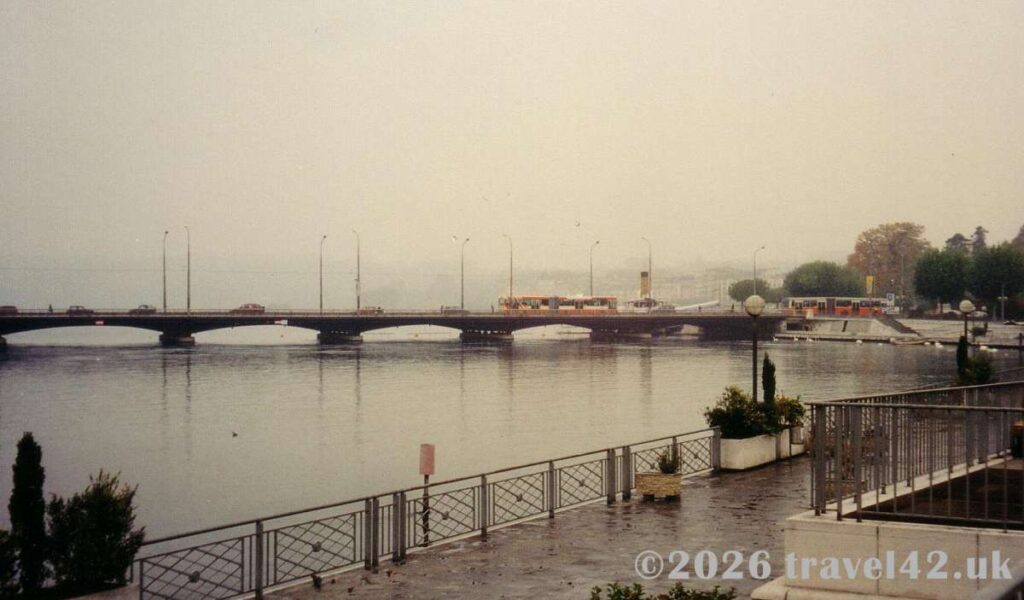
On the third day we drove to Geneva. The weather was grey and so was everything else, but the city held our interest and we came away with the obligatory Swiss souvenirs.
From there we went on to the Olympic Museum in Lausanne and walked the lakeside. Then, heading back to Leysin, we passed through Montreux – still one of my favourite places anywhere, and perhaps the most loved of all, at least in memory.
I think that’s because it was the most astonishing thing I had ever seen: after a lifetime in a completely flat country, here were a lake and mountains and a beautiful town, all at once.
Montreux stretches along the shore of Lake Geneva, and the lakeside promenade is the whole point of it. The Freddie Mercury statue stands on the waterfront in front of the covered market. He lived in Montreux and recorded extensively there with Queen.
This is the part of the itinerary that works best as a slow, unstructured evening for two – a walk along the promenade, dinner, and no fixed plan.
Bern: crossing the language line
We were staying in the French-speaking part of Switzerland, which made Bern all the more interesting – a short drive, and suddenly everything is in German.
Bern’s Old Town has been a UNESCO World Heritage Site since 1983, and it’s compact enough to see properly on foot in a day.
We spent ours wandering the narrow streets of the old town and admiring the comically small cars parked along them. Bern is one of those cities where you genuinely enjoy looking at the footprints history leaves behind – heritage, and plenty of it. After several days in the French-speaking part of the country, it also felt distinctly German.
Glacier 3000: the cable car that stopped
Another of the big days was Glacier 3000, above Les Diablerets. The cable car from the Col du Pillon climbs to the Scex Rouge summit station at around 3,000 metres: cloud below us, cloud above us, cold wind, and Alpine peaks in every direction. The installation we used in 1997 was different from the one there today, but the point was the same – getting up into the high mountains.
We had lunch at the Botta restaurant at the top. The building and restaurant have since been rebuilt following a fire in 2022, so what we saw then is no longer what visitors see today. The summit building was designed by the Swiss architect Mario Botta.
At some point we both felt the thin air, and something sugary to drink helped more than we expected. Outside the restaurant we watched people skiing.
Coming down, the lift stopped dead over a deep gorge. A power problem, perhaps; we never found out. Five minutes or more hanging there in a strong wind is a long time, and when the group of climbers sharing the cabin began to get restless, it stopped being funny. Then it started again, without warning or explanation, and we carried on down to the car park.
Practical note: Glacier 3000 is weather-dependent, and opening times and facilities can change, so check the current conditions before you drive up. Dress for real cold at the top, whatever the valley is doing – it’s genuinely hard to imagine how cold it can be up there until you’re standing in it.
Lugano and the Italian side
Every trip ends. Since Switzerland also has an Italian-speaking region, we went to see it before heading home.
Coming through the tunnels was like arriving in a different country – road signs in Italian, cliffs closing in, and very high waterfalls dropping down them. Part of the route, before arriving in the Italian-speaking part, we even boarded a train with the car to get through one of the mountains. The major experience was driving through the long Gotthard tunnel, though.
Then Lugano, which took some adjusting to after the quiet of the mountains: people talking, sports cars, remarkably loud ducks on the lake, palm trees along the street. It’s a place that seems designed for enjoying yourself in, and after a week at altitude that was exactly right.
It was much like arriving in Bern, in reverse – you can feel the Italian spirit in the same way you feel the German one up north.
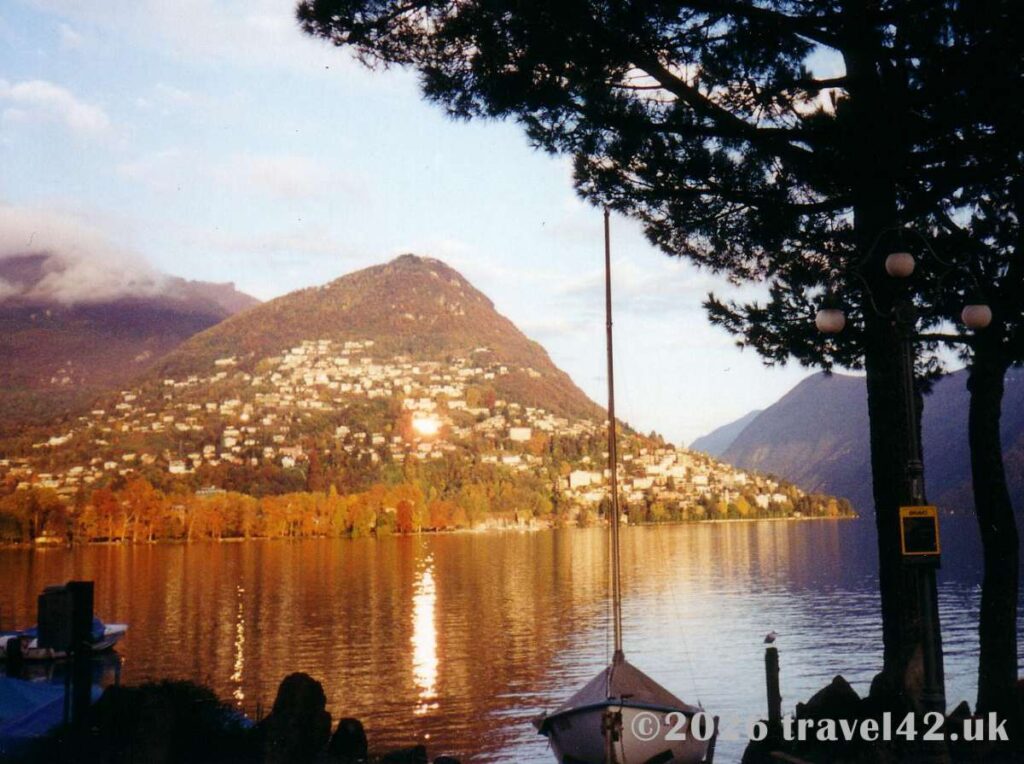
We spent the late afternoon looking around Lugano, had one last night in Switzerland, and stopped briefly in Liechtenstein the next day before crossing back into Germany.
What we’d tell another couple
Switzerland is one of those places you leave already planning to return to, and we have, several times. It can be alarmingly expensive, but we’ve never really minded: what you get back is worth considerably more than what you spend. Sardinia and Japan fall into the same category for us – costly, and worth every bit of it.
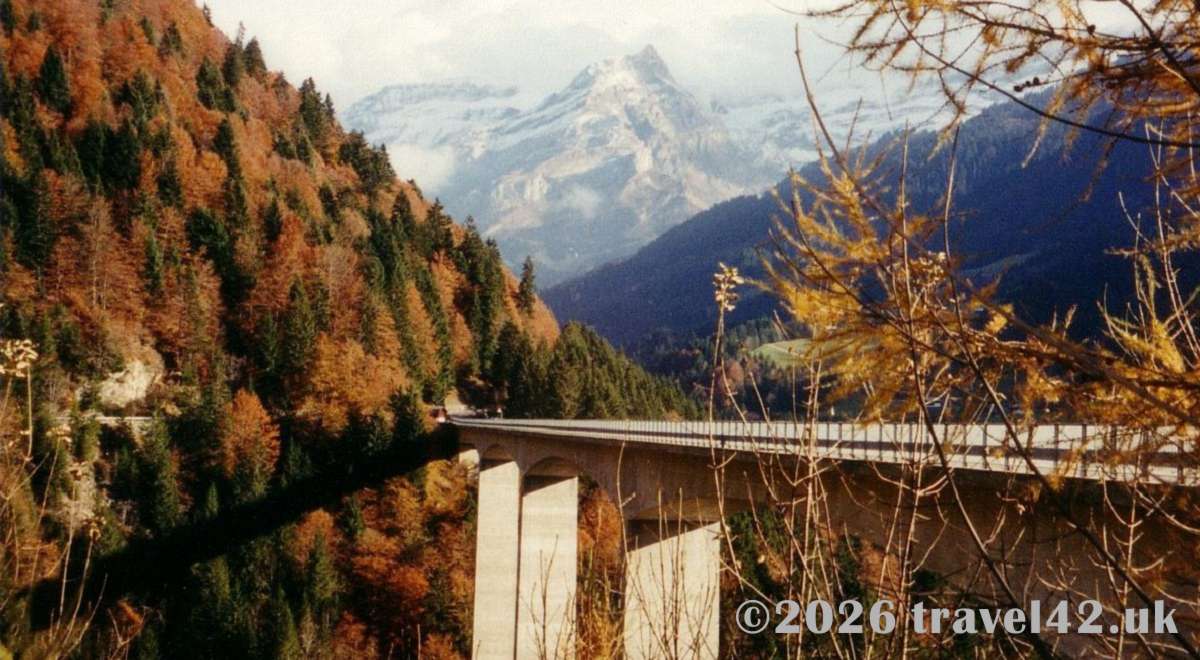
What has stayed with me most about Switzerland isn’t the scenery on its own. It’s what people have built into it. Motorway viaducts spanning gorges. Buildings on the edges of cliffs. Very long tunnels through mountains. And plain tarmac roads that occasionally hang over nothing at all.
A few things worth knowing before you go:
- The vignette. Although it was different in 1997, Switzerland now charges an annual motorway vignette rather than conventional motorway tolls. It costs CHF 40, with no short-term option, so you pay the same for one day as for a year. Since 2023 you can buy it as an e-vignette online in advance, linked to your number plate, as well as buying the traditional windscreen sticker. A trailer generally needs its own vignette. Some useful information for those driving in our Travel Kit page.
- Let the trains do some of the work. The Aigle-Leysin line is the obvious example: park the car and enjoy the climb instead of negotiating it.
- Mountain roads take longer than the map says. Six kilometres can be seventeen. Build that into your day, and don’t plan a late arrival on an unfamiliar serpentine.
- Balance the days. A glacier one day, a lakeside promenade the next. That contrast is the whole appeal of a Swiss road trip for two.
So far, all our Swiss trips have been road trips, whether for a day or for a week. Having the car with you is undeniably convenient. But the plan for next time is to find out how easy and enjoyable it is to travel around Switzerland by public transport instead – and if we do, we’ll write that one up too.
Travel42 UK is a couples travel journal dedicated to immersive road trips, slow travel, and destination storytelling.
Explore More of Western Europe:
The long way round, as a couple
About the Author
The author, ainarsbl, is a Level 7 Google Local Guide, Master Reviewer and expert travel reviewer focused on scenic landscapes, UNESCO sites and meaningful couples travel experiences.