
From Agadir to the Anti-Atlas Foothills
Part of our 12-Day Morocco Road Trip from Agadir to Tafraout & the Anti-Atlas series
After a day or two exploring Agadir’s palm-lined promenade and busy souk, we were ready to leave the coast behind and head inland. This was Day 3 of our 12-day Morocco road trip from Agadir to Tafraout and the Anti-Atlas, and the plan was refreshingly simple: collect our hire car, stock up on provisions, and drive roughly 58 kilometres (36 miles) north-east of the city to spend the night near Paradise Valley, ready to tackle the hike the following morning.
We had booked a room at Hotel Restaurant Tifrit (coordinates: 30.599090, -9.497355), a small mountain guesthouse in the settlement of Tizgui that turned out to be a genuinely good find. The room was spacious with lovely views over the surrounding hills; dinner that evening was simple, well-cooked, and fairly priced – exactly the kind of place you hope to stumble across on an independent road trip. The drive from Agadir took a little under two hours, winding into the foothills of the High Atlas and Anti-Atlas transition zone along progressively quieter roads.
Before leaving the city, we made sure to stock up on food and water. There are no convenient supermarkets near the trailhead, so arrive prepared. We were glad we did.
The drive itself was anything but dull. The scenery shifted constantly – from Agadir’s flat coastal plain, through scrubby argan orchards, to the rust-and-ochre folds of the mountains rising ahead of us. We stopped several times just to take photographs. It’s the kind of landscape that makes an hour on the road feel like the beginning of an adventure rather than merely a prelude to one.
What Is Paradise Valley?
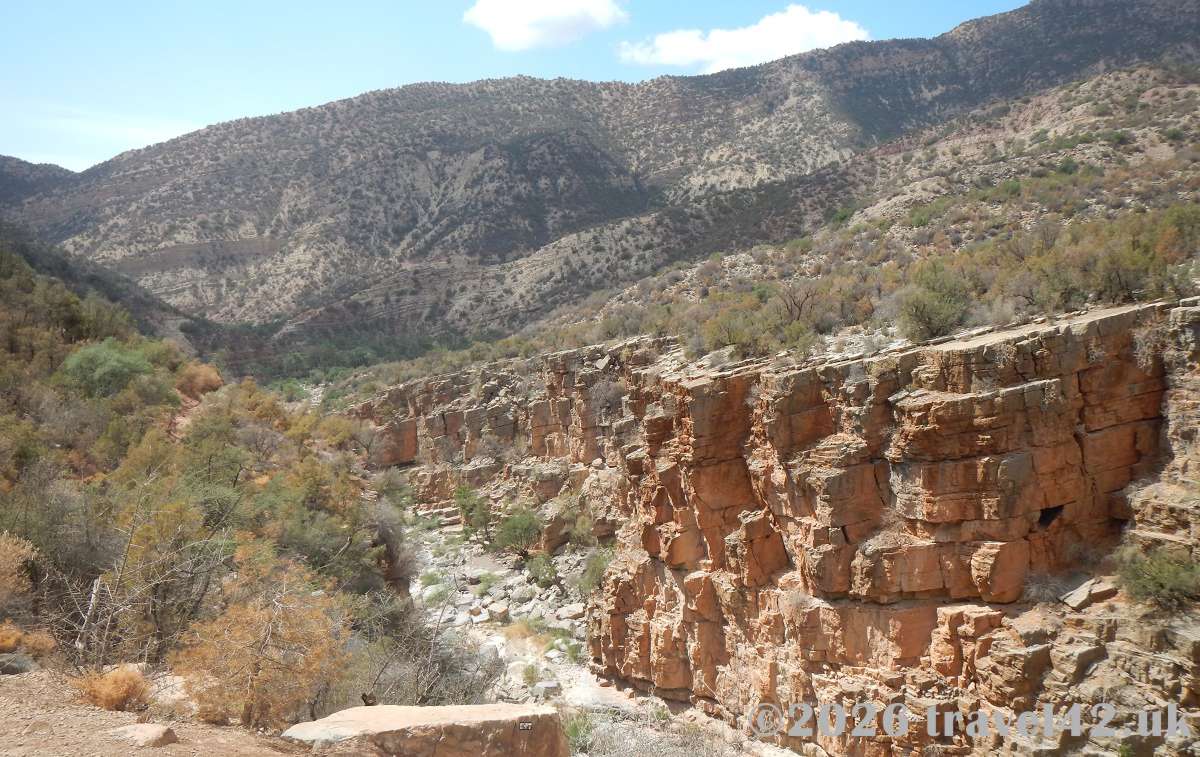
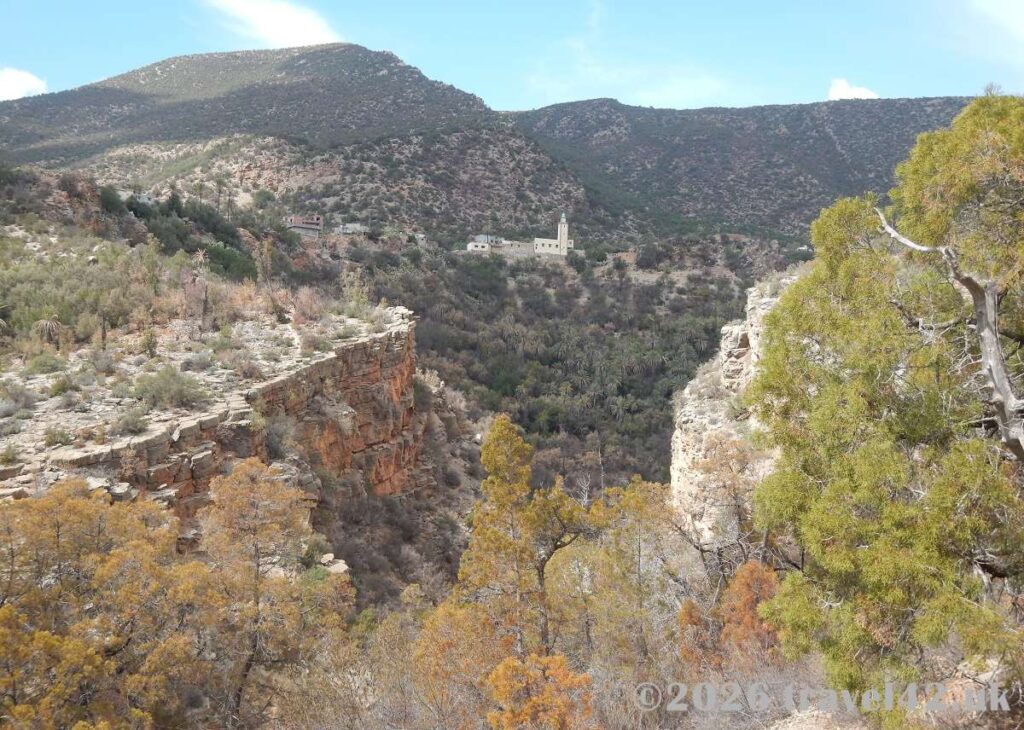
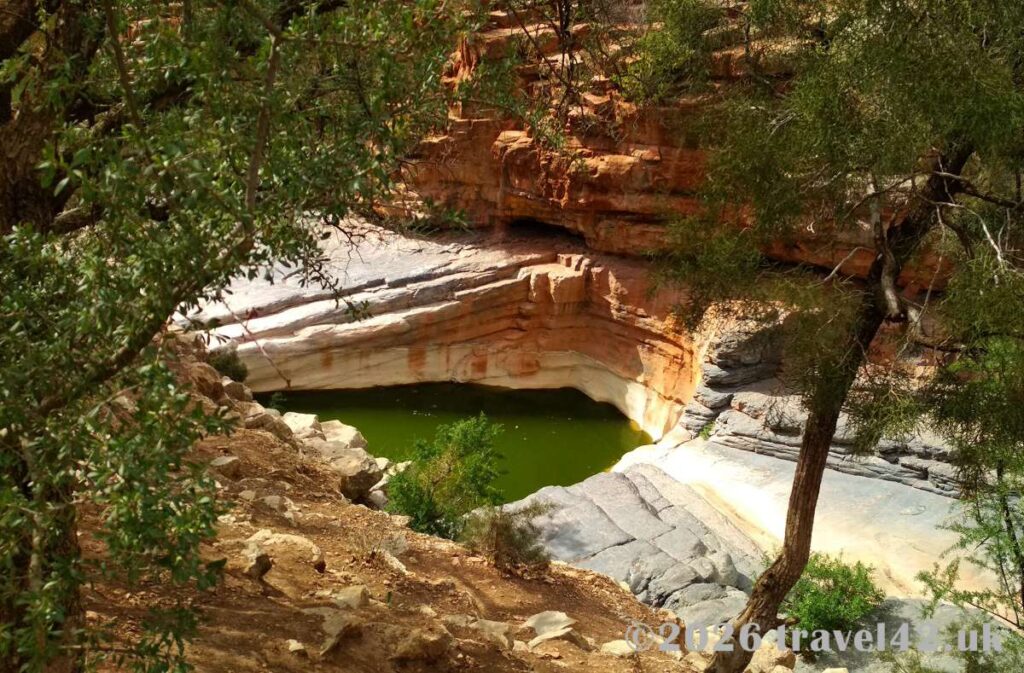
Paradise Valley is a dramatic canyon carved by the Tamraght River through the foothills north-east of Agadir. It is renowned for its natural pools, towering date palms, red-rock formations and – when the season cooperates – small waterfalls. Sitting at around 500 metres above sea level, the valley feels entirely removed from the modern city you’ve left behind: quieter, wilder, and genuinely beautiful.
It’s one of the most popular day trips from Agadir, and deservedly so. However, most visitors arrive with organised tour groups and only see the most accessible section of the valley. Arriving the night before and hiking independently, as we did, means you can start early, avoid the crowds, and venture further than many day-trippers ever manage.
Getting to the Trailhead
The following morning we drove roughly 5 kilometres (3 miles) from our hotel to the car park at the start of the trail (coordinates: 30.596774, -9.522854). It’s a sizeable, clearly marked parking area and easy to locate.
At the car park there is a noticeboard with general information about the route – useful for orientation, though bear in mind that the distances and walking times shown are not entirely accurate. Treat them as a rough guide rather than gospel.
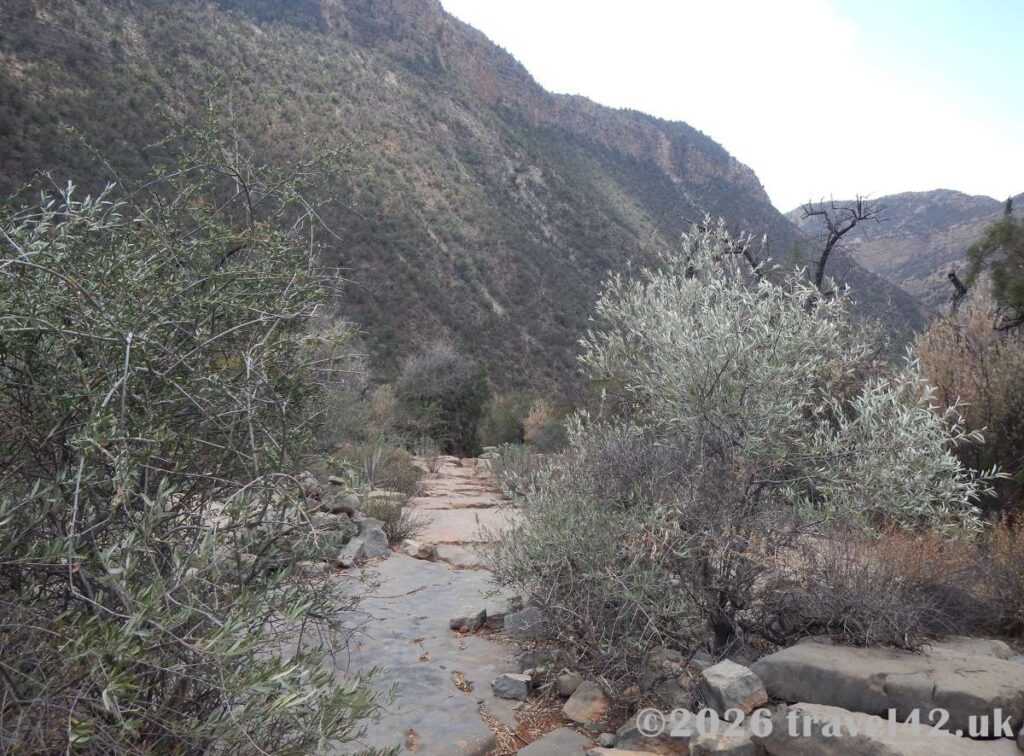
From the car park, the path initially crosses a small hill before descending towards a rural track – and this is where we very nearly went wrong. When you reach the small tarmac road at the bottom of the hill (approximate coordinates: 30.594959, -9.523113), turn left and follow it until you reach a signpost pointing towards Paradise Valley (approximate coordinates: 30.593968, -9.520802). Turn right here. The signage is reasonably clear, but the junction after crossing the hill is surprisingly easy to miss. Walk straight past without paying attention and you’ll end up heading in entirely the wrong direction.
The Hike Itself
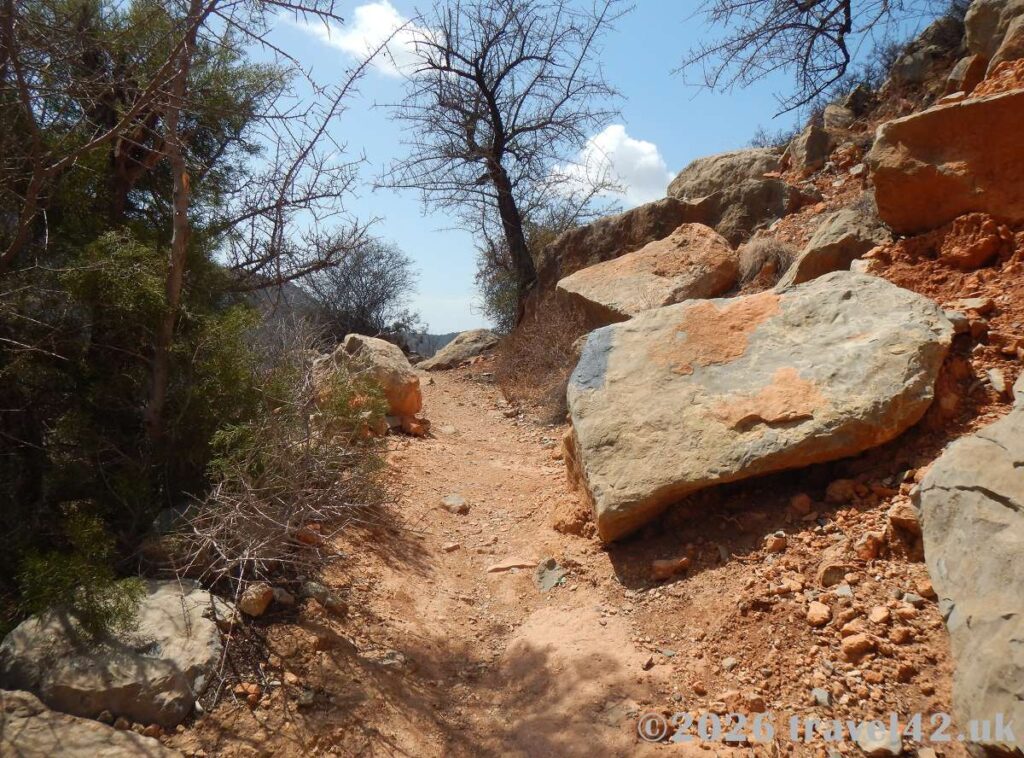
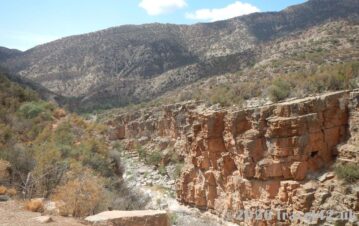
From the signposted turning, the path descends gently towards the valley floor, where you join the Tamraght River (coordinates: 30.588606, -9.526019). From there, continue along the riverbank heading east for approximately 1.4 kilometres to reach the heart of the canyon – a beautiful, sheltered gorge where the rock walls close in overhead, palms cast their shade, and flat boulders invite you to stop, breathe, and simply enjoy being somewhere extraordinary.
This is the highlight of the walk and, if you’ve packed sandwiches, absolutely the place to eat them.
We continued beyond the canyon, following the path uphill for roughly another half-mile to a viewpoint on the ridge above. The views were pleasant enough, but honestly, the valley floor is where the magic lies. The uphill section is more of a workout than a reward, and with hindsight we wouldn’t necessarily recommend it unless you’re keen to see the broader landscape spread out below you.
In total, we walked approximately 7 kilometres (4.5 miles), though the route is winding enough that the actual distance may have been slightly greater.
What struck us most was how refreshingly unmanicured the whole experience felt. The paths are largely formed by use rather than construction, and the route remains genuinely wild in places. If you prefer purpose-built hiking infrastructure – think the engineered boardwalks of Zhangjiajie in China – this may not be your terrain. But if you enjoy the feeling of walking through a landscape that hasn’t been tamed for tourism, you’ll find it immensely satisfying.
A Word on Water — Both Kinds
Water to Drink
Carry more than you think you’ll need. We each brought 1.5 litres, which proved just about sufficient, but there were moments on the return walk when we were rationing carefully. On a warm day, or if you intend to explore beyond the main canyon, 2 litres per person is a safer minimum.
Water in the River
If you’ve seen photographs of Paradise Valley showing emerald pools sparkling beneath palm trees, be aware that reality depends heavily on rainfall and the time of year.
The best period to visit is generally between February and April, when winter rains have replenished the valley and water levels tend to be at their highest. Spring and, to a lesser extent, autumn are usually considered the most rewarding seasons for both hiking and photography.
When we visited in March, following a particularly dry winter, the riverbed was largely empty. A few pools remained – enough for somebody determined to cool off – but certainly not the swimming paradise often depicted in travel brochures.
The canyon itself was still spectacular and the hike thoroughly worthwhile, but those turquoise pools that dominate social media and travel photography had been reduced to rather modest puddles. If swimming is your primary reason for visiting, check recent weather conditions or ask locally before making the journey.
Practical Tips for Hiking Paradise Valley
- Start early. Organised tours from Agadir usually arrive from mid-morning onwards, and the most popular sections can become surprisingly busy. Early starts also provide the best photography light.
- Wear proper footwear. The paths are rocky and uneven, with occasional slippery sections near the riverbed. Trail shoes or sturdy walking shoes are strongly recommended.
- Bring food. There are no reliable cafés or food vendors along the trail itself. A few stalls occasionally appear near the river, but don’t depend on them — they were closed during our visit.
- Carry cash. There is no official entrance fee, but an informal parking charge may be requested at the main car park.
- Don’t leave valuables in your vehicle. A sensible precaution at any trailhead.
Where to Stay Near Paradise Valley
We stayed at Hotel Restaurant Tifrit (coordinates: 30.599090, -9.497355), and we’d happily book again.
It’s a simple but comfortable mountain guesthouse in Tizgui, and the price – around £35 per room per night when we checked in 2026 – felt like excellent value considering the quality of the accommodation, the mountain setting, and the home-cooked dinner.
The location works particularly well if you’re planning to hike Paradise Valley and then continue east towards Taroudant, as we did.
Given the limited accommodation options in the area, booking ahead is advisable, especially during spring and autumn when visitor numbers are at their highest.
Continuing the Journey
Paradise Valley was our first proper hike in Morocco on this trip – a gentle warm-up, as it turned out, for considerably more demanding terrain to come. Our legs had no idea what was waiting for them further south.
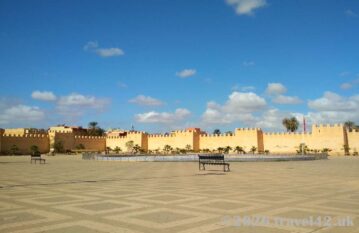
The following morning we checked out after breakfast and drove east towards Taroudant – a walled Berber market town that deserves far more attention than it typically receives from international visitors.
But that’s a story for the next post.
Part of our 12-Day Morocco Road Trip: Agadir to Tafraout & the Anti-Atlas series on travel42.uk.
Frequently Asked Questions
Absolutely. Even during a dry period when the famous pools are reduced in size, the scenery alone makes the trip worthwhile. The canyon, palm groves and mountain setting create one of the most beautiful landscapes near Agadir.
Paradise Valley is approximately 58 km (36 miles) north-east of Agadir. The drive typically takes between 1 and 1.5 hours, depending on traffic and road conditions.
Sometimes. Water levels vary significantly throughout the year. Following good winter rains, several natural pools become deep enough for swimming. During dry years, some pools may disappear almost entirely.
February to April is generally considered the best period, when winter rainfall has replenished the pools and temperatures remain comfortable for hiking. Autumn can also be an excellent time to visit.
No. The main hiking route can be completed independently with reasonable navigation skills. However, a guide may be useful if you wish to explore lesser-known sections of the valley or combine the hike with nearby attractions
Travel for Two is a couples travel journal dedicated to immersive road trips, slow travel, and destination storytelling.
Explore More of Morocco:
–






The long way round, as a couple
About the Author
The author, ainarsbl, is a Level 7 Google Local Guide, Master Reviewer and expert travel reviewer focused on scenic landscapes, UNESCO sites and meaningful couples travel experiences.